
De-dollarisation

Search documents
Dollar has lost some of its safe-haven status, ING report says
Reuters· 2026-02-23 12:57
Core Viewpoint - The U.S. dollar has lost some of its safe-haven status since 2024, but there is no significant decline in global demand for the currency according to ING's report [1] Group 1: Dollar Performance - The dollar index experienced a nearly 10% decline in value last year, marking its worst annual performance since 2017 [1] - Erratic U.S. trade policy and tariff threats from former President Donald Trump have negatively impacted the currency [1] Group 2: Safe-Haven Status - The dollar's safe-haven value has diminished when compared to 2024, as indicated by the three-month correlation between the dollar index and U.S. stocks and 10-year Treasuries [1] - Despite the decline, private investors, who hold over 80% of foreign holdings of U.S. assets, continue to remain invested [1] Group 3: Future Outlook - The current weakness of the dollar appears to be more cyclical than structural [1] - There are no indications of an acceleration in de-dollarisation when analyzing the dollar's use in global assets, liabilities, market turnover, and transactions [1] - ING predicts that the fall in the dollar this year is unlikely to match last year's decline, forecasting the euro to end the year at $1.22 compared to the current level of around $1.18 [1]


核心关注点与主题-短期美元或更趋稳定的风险;我们的相对价值与做空美元观点-Key focus and themes - Risk of a more stable near-term USD; our RV and short USD views
2026-02-03 02:06
Summary of Key Points from Conference Call Industry Overview - **Focus**: Global Foreign Exchange (FX) and Rates Strategy, particularly in Asia ex-Japan, Euro Area, and Europe Core Insights and Arguments - **USD Outlook**: There is a risk of a more stable near-term USD, with current expectations for 2026 Fed rate cuts at approximately 50.7 basis points [1] - **Top FX Trades**: - Long SGD/IDR with a target of 13,530 by end-March, conviction level raised to 4/5 [19] - Short USD/NOK with a target of 9.20 by end-April, conviction level raised to 4/5 [15] - Short USD/CNH with a target of 6.70 by mid-April, conviction level at 4/5 [18] - Long NZD/USD with a target of 0.6275 by end-March, conviction level at 4/5 [13] - Long USD/INR with a target of 96.0 by end-May, conviction level at 4/5 [25] Important Developments - **USD Weakness**: Recent declines in USD attributed to capital flow slowdowns into the US, with average daily inflows into US-focused ETFs dropping from USD850 million to USD90 million [4] - **US Treasury Comments**: Treasury Secretary Bessent reiterated a strong USD policy, which temporarily supported USD but raised questions about the sustainability of portfolio inflows [5] - **Market Sentiment**: Concerns over political uncertainty and potential trade issues affecting capital flows into the US, particularly from Europe [6] Additional Insights - **Asia FX Strategy**: - Strong corporate FX settlement demand in China, with expectations for CNH appreciation due to favorable trade conditions [18] - Concerns over Indonesia's central bank independence and MSCI's reassessment of Indonesia's market accessibility could lead to significant foreign equity outflows [22] - **Australia's RBA**: Anticipation of a rate hike due to stronger CPI data, but expectations of a cautious approach from the RBA [35] - **Korean Market**: Continued outflows from Korean retail investors into US equities, with significant implications for KRW depreciation [24] Risks and Considerations - **Geopolitical Risks**: Potential geopolitical tensions and their impact on currency valuations, particularly in relation to USD and regional currencies [21] - **Economic Indicators**: Upcoming economic data releases, including inflation and GDP figures, will be critical in shaping market expectations and currency movements [32][33] This summary encapsulates the key themes and insights from the conference call, highlighting the strategic positions and market outlooks relevant to the foreign exchange and rates landscape in Asia and beyond.
Adani looks to home to raise 1,000 crore over next 3 years
BusinessLine· 2026-01-30 03:42
Core Viewpoint - Adani Group is significantly increasing its reliance on domestic financing amid global market volatility and ongoing legal challenges, aiming to support its ambitious infrastructure investment plans [1][3]. Financing Strategy - The conglomerate has ramped up funding from local debt capital markets to approximately $2 billion in 2025, a ten-fold increase from the previous year, with plans to raise this to $10 billion over the next three years [2]. - Local banks' share of Adani Group's total debt has risen from about 30% two years ago to roughly 50% as of September [11]. Investment Plans - Adani Group is pursuing a five-year investment plan that could involve capital expenditures of up to $100 billion, which may strain balance sheets if reliance on Indian lenders increases [3]. Market Conditions - The US Securities and Exchange Commission's actions regarding a fraud case against Adani have highlighted the uncertainties surrounding the conglomerate, making local funding more appealing [4]. - Despite scrutiny, local creditors are showing a strong willingness to extend more debt to Adani Group, indicating confidence in its projects [5]. Recent Fundraising Activities - Adani Group's flagship firm successfully issued a $110 million public rupee bond that was fully subscribed within an hour, and Adani Power Ltd raised ₹7,500 crore ($818 million) in local-currency bonds, marking its largest issuance [6]. - The group has also engaged multiple state-run entities and top private sector lenders for funding, including Life Insurance Corporation of India and HDFC Bank Ltd [7]. Diversification and Global Trends - The shift towards local lenders is seen as a sensible strategy in the current global environment, with local market liquidity being favorable for infrastructure investments [8]. - The group's diversification in funding reflects a broader trend of de-dollarisation and India's recalibration on the global stage, as evidenced by recent trade agreements [10]. Future Outlook - Adani Group plans to buy back at least $100 million in dollar bonds this year, increasing its share of local borrowing due to lower costs associated with issuing rupee debt [13]. - Despite challenges, the group has maintained access to liquidity and has successfully closed transactions amid legal uncertainties [15].
Explained! Gold smashes Rs 1.5 lakh mark for first time, ever: 6 reasons why it appears unstoppable
The Economic Times· 2026-01-20 11:05
Geopolitics - US-Iran tensions and local demonstrations in Iran are enhancing gold's appeal as a safe-haven asset [2] - President Trump's threats to acquire Greenland and impose tariffs are contributing to market instability and increasing gold prices [4][6] Tariffs - Trump has threatened a 25% additional tariff on countries trading with Iran and a 10% tariff on European nations opposing his Greenland acquisition [6] - Europe is considering retaliation on over $100 billion worth of US goods, raising fears of a trade war and boosting safe-haven demand [7] Demand and Supply - Total gold demand grew 3% year-on-year to 1,313 tonnes in Q3, the highest quarterly total recorded, with a 44% increase in value to $146 billion [9] - Year-to-date demand is up 1% at 3,717 tonnes, equating to $384 billion, a 41% year-on-year increase [9] - Heavy ETF buying of 222 tonnes and bar and coin demand of 316 tonnes contributed to the overall demand rise [10] - Jewellery consumption declined for the sixth consecutive quarter to 371 tonnes, while value increased by 13% year-on-year to $41 billion [10] Central Bank Buying - Central bank purchases remained high at 220 tonnes, a 28% increase from the previous quarter, although year-to-date buying is slower compared to last year [11] De-dollarisation - The US dollar's share in global exports and output is declining, with its dominance in transactional areas still evident [12] Rupee - Domestic gold prices are supported by the weakening Indian rupee, which has depreciated significantly since the start of 2026 [13] - USDINR January futures are trading above 91, indicating a depreciation of over one rupee this year, benefiting local participants from rising global gold prices and rupee depreciation [13]

Gold is world's most valuable assets, Silver chases Nvidia's market cap. What to expect in 2026?
The Economic Times· 2025-12-28 13:57
Gold Price Prediction - Analysts predict gold prices may rise to USD 5,000-5,200 and Rs 1,50,000-1,55,000 on the MCX in 2026, driven by factors such as monetary policy easing, de-dollarisation, and global trade tensions [1][7] - Gold prices recently climbed by USD 165.4, or 3.77 percent, reaching a lifetime high of USD 4,584 per ounce on the Comex [2][6][8] Silver Price Prediction - Silver prices gained USD 9.71, or 14.4 percent, in the past week, reaching a lifetime high of USD 79.70 per ounce [4][8] - Analysts expect silver prices to rise to USD 80-85 per ounce globally due to supply constraints [4][5][8] - Silver's market capitalisation has increased to USD 4.220 trillion, making it one of the most valuable assets, closely following NVIDIA Corporation [7]

China steps up campaign to de-dollarise | FT #shorts
Financial Times· 2025-11-10 04:00
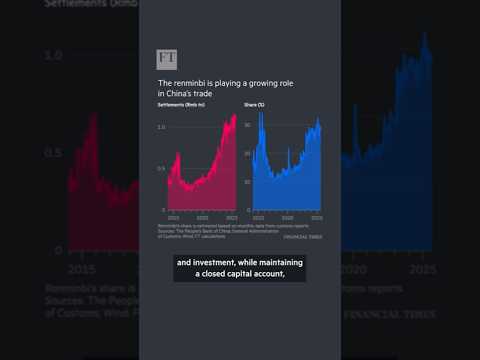
Currency Internationalization - China is intensifying efforts to internationalize the Renminbi (RMB) and decrease reliance on the US dollar [1] - RMB overseas lending is increasing significantly [1] - Beijing is creating more channels for foreign investment in Chinese bonds [1] - China has established an alternative payment system to circumvent US sanctions [2] - Several countries, including Angola, Ethiopia, and Kenya, have converted old dollar debts into RMB this year [2] Trade and Investment - A significant portion of the increase in RMB lending is in trade financing [1] - Beijing aims to reduce exposure to policies that weaponize the dollar [1] - More sovereign borrowers are issuing RMB debt due to relatively low interest rates in China [2] - China seeks to increase the RMB's role in global trade and investment while maintaining a closed capital account [3] Strategic Objectives - China does not intend to replace the US dollar as the dominant global currency [3]
At least 2 Indian banks should be in global top 20: PSB chiefs
Rediff· 2025-10-30 07:33
Core Viewpoint - The executives of top public sector banks (PSBs) advocate for further consolidation in the banking sector, emphasizing the need for at least two Indian banks to be among the top 20 globally to meet the growing demands of the economy aiming for developed nation status by 2047 [1][3][14]. Group 1: Need for Large Banks - The increasing scale of operations and GDP growth necessitates the presence of large banks in India [14]. - Bankers argue that large banks are essential for underwriting significant projects, with current project sizes ranging from ₹8,000 crore to ₹15,000 crore, compared to previous sizes of ₹800 crore to ₹1,500 crore [6][5]. - The consolidation of PSBs during the pandemic has boosted confidence in managing mergers and amalgamations [4][9]. Group 2: Global Positioning - There is a consensus that India should have at least three to four large banks in the top 100 globally based on total business, market capitalization, and asset size [7]. - The need for large banks is further driven by the de-dollarization trend, which will increase the demand for substantial banking entities [6]. Group 3: Operational Efficiency - Larger banks can optimize costs, with the cost-to-income and cost-to-asset ratios improving as banks grow; in India, these ratios are between 1.5-2%, while globally they are around 1% or lower [17]. - Integration of diverse systems and human resources is critical during consolidation, and large banks can better attract and retain specialized talent in areas like risk management and technology [19][20]. Group 4: Cultural and HR Considerations - Cultural integration is vital for successful mergers, with emphasis on harmonizing the workforce and processes [21]. - Transparency and fairness in handling HR issues during consolidation are essential to ensure that all employees feel included in the process [22].

X @Nick Szabo
Nick Szabo· 2025-10-12 04:52
RT Senator Matt Canavan (@mattjcan)China's bullying to get Australia to join its BRICS de-dollarisation agenda, and to get us more exposed to the yuan, deserves way more attention than it is getting. https://t.co/lXvyMaYxGD ...
Dollar anxiety drives precious metals rally as gold trade gets crowded
Yahoo Finance· 2025-10-09 09:07
Core Insights - The surge in gold prices above $4,000 per ounce is causing a ripple effect in other precious metals due to concerns over the Trump administration's economic policies, which may lead to a devaluation of the U.S. dollar [1][4] - Precious metals like silver, platinum, and palladium are experiencing significant gains amid geopolitical and economic uncertainties, particularly related to U.S. trade policies [2][4] - Despite a remarkable 53.8% year-to-date increase, gold is the worst-performing precious metal this year, while platinum leads with an 83.6% rise, silver has surged 70.4%, and palladium is up 60.5% [3] Precious Metals Performance - Gold's rally has made it the second-largest reserve asset after the U.S. dollar, surpassing the euro in 2024 [5] - Central banks' gold holdings have increased, now accounting for a record high of 24% of total assets, up from 23.3% in the previous quarter [6] - Analysts suggest that while gold may continue to rise, the pace could slow as high prices incentivize new mining operations, potentially increasing future supply [5] Investment Strategies - Analysts recommend investing in hard assets rather than shorting U.S. bonds or equities, with palladium currently favored [7] - The rally in silver is closely tied to record-high gold prices, prompting HSBC to raise its average price forecast for silver to $38.56 per ounce for this year and $44.50 per ounce by 2026 [7]