Downside Protection

Search documents
X @Cointelegraph
Cointelegraph· 2026-03-17 19:00
🚨 UPDATE: Demand for downside protection in U.S. stocks is rising sharply, with put-call skew at its highest since 2021 and short positions surging. https://t.co/Cv1E796NfB ...
‘Buffer’ ETFs Prove a Decent Bond Alternative in War-Hit Markets
Yahoo Finance· 2026-03-13 15:30
Core Insights - Bonds are failing to provide the expected downside protection for equities, leading to a shift towards alternative investment vehicles like defined-outcome ETFs [1][3] - Defined-outcome ETFs, which use options to limit stock losses while capping gains, have gained traction among financial advisers and institutions, with significant asset growth since their inception [2][4] Group 1: Market Dynamics - The performance of bonds as a hedge against equity declines has been inconsistent, particularly highlighted during 2022 when rising interest rates caused simultaneous selloffs in both stocks and Treasuries [3] - The defined-outcome ETFs have shown resilience since the onset of the Iran war, with the FT Vest Laddered Buffer ETF experiencing a smaller decline of 1.4% in March compared to a 2.7% drop in the S&P 500 Index [2] Group 2: Growth of Defined-Outcome ETFs - The assets in defined-outcome ETFs have surged from $200 million in 2017 to $8.6 billion, driven by the search for reliable hedging options [4] - Institutions like the University of Connecticut's endowment have shifted their investment strategies, moving away from hedge funds to buffer ETFs for risk mitigation [5] Group 3: Trends in Bond ETFs - Interest in bond ETFs has decreased, with their share of total ETF assets falling to approximately 17% from a pandemic-era peak of 23% [6] - The number of new bond fund launches has dropped significantly, with only 13% of over 1,000 new ETFs in 2025 being bond funds, marking the lowest share in over 15 years [6]
SLR Investment (SLRC) - 2025 Q4 - Earnings Call Transcript
2026-02-25 16:02
Financial Data and Key Metrics Changes - SLRC reported net investment income (NII) of $0.40 per share and net income of $0.46 per share for Q4 2025, with NII remaining flat quarter-over-quarter [7] - Net assets value per share increased to $18.26 as of December 31, 2025, up from $18.21 at the end of Q3 2025 and $18.20 at the end of Q4 2024 [16] - For the full year 2025, SLRC generated net income of $1.70 per share, representing a 9.3% return on average equity [7] Business Line Data and Key Metrics Changes - In Q4 2025, SLRC originated $462 million in new investments, with repayments of $445 million, resulting in net fundings of $70 million and a year-end comprehensive portfolio of $3.3 billion, reflecting a 7.2% annual growth [8] - Asset-based lending (ABL) originations for Q4 were $247 million, nearly double the prior year period, with full-year ABL originations totaling $1.1 billion [11] - The portfolio consisted of approximately 98% senior secured loans, with 95% in first lien loans, and the weighted average yield on the portfolio was 11.6%, down from 12.2% in Q3 2025 [21][22] Market Data and Key Metrics Changes - SLRC's exposure to the software industry was approximately 2% as of December 31, 2025, one of the lowest among publicly traded BDCs, providing a safe haven from technology obsolescence risks [9] - The company reported a weighted average investment risk rating of under two, with 100% of the portfolio performing and no investments on non-accrual [23][14] Company Strategy and Development Direction - The company is shifting its portfolio towards specialty finance strategies due to their more attractive risk-adjusted returns and is focused on downside protection [20] - SLRC's multi-strategy approach to private credit investing allows for diversification and disciplined investment, enabling the company to pass on opportunities that do not meet conservative lending standards [6][10] - The company aims to maintain a strong liquidity profile to capitalize on market dislocations while adhering to its conservative investment philosophy [15][42] Management's Comments on Operating Environment and Future Outlook - Management noted a surprisingly resilient U.S. economy in 2025, despite various uncertainties, and expressed confidence in SLRC's insulation from risks faced by peers due to strict underwriting standards [5][4] - The company anticipates continued opportunities in the ABL market and is prepared to be opportunistic in cash flow lending as market conditions evolve [56][58] - Management emphasized the importance of protecting capital and avoiding losses while maintaining dividend coverage [41][42] Other Important Information - SLRC's investment portfolio had a fair value of approximately $2.1 billion across 100 portfolio companies, funded by a mix of revolving credit facilities and term debt [16][17] - The company has over $850 million of available capital to deploy, enhancing its ability to take advantage of market opportunities [14] Q&A Session Summary Question: Update on pipeline within ABL and equipment finance - Management is actively engaged in potential acquisitions and has a number of opportunities in the pipeline, though nothing imminent [46][47] Question: Impact of tight spreads in public debt markets on ABL and equipment finance - While overall returns have slightly decreased, the company maintains competitive spreads due to structural protections and disciplined peer behavior [48] Question: Signs of concern in credit metrics - Management reported no significant themes of concern, with a watch list of roughly 2% and ongoing monitoring of borrower performance [49][50] Question: Expectations for leverage and opportunistic investments - Management indicated a desire to increase leverage in response to attractive opportunities while remaining focused on repayments [55][56] Question: Sentiment on M&A opportunities in ABL - Management believes dislocation in the market may lead to more opportunities at better pricing [62]

Seth Klarman: Positioning His Portfolio for 2026
Acquirersmultiple· 2026-01-04 23:43
Core Insights - Baupost Group's latest 13F filing reveals a highly selective and concentrated portfolio, focusing on durable businesses with long-term cash generation potential [1][2] Investment Moves - **Restaurant Brands International (QSR)**: Increased by 4,203,300 shares to 8,252,862 shares, representing a $529.3 million position (11.05% of the portfolio). This is now Baupost's largest equity holding, indicating a belief in significant mispricing relative to its stable franchise model and cash flows [3][4] - **Elevance Health (ELV)**: Increased by 703,000 shares to 1,319,000 shares, totaling a $426.2 million position (8.90%). The increase suggests confidence in the company's predictable cash flows and resilience in a politically noisy sector [5][6] - **Union Pacific (UNP)**: Newly established position with 1,496,204 shares, valued at $353.7 million (7.38%). The railroad's high barriers to entry and pricing power align with Baupost's focus on downside protection [7][8] - **Alphabet (GOOG)**: Reduced by 775,850 shares to 1,858,138 shares, now a $452.6 million position (9.45%). The reduction reflects portfolio risk management rather than a loss of conviction [9] - **CRH plc (CRH)**: Trimmed by 442,000 shares to 3,383,395 shares, valued at $405.7 million (8.47%). The trim indicates a disciplined approach to valuation, despite the long-term thesis remaining intact [10] - **Full Exits**: Baupost exited several positions entirely, including Viasat, Liberty Broadband, ICON plc, and Amcor, signaling a shift in risk-reward balance [11][12] Strategic Focus - The quarter was characterized by conviction-driven capital redeployment into high-confidence ideas, particularly in sectors like restaurants, railroads, healthcare, and materials [13][14] - Trimming positions like GOOG and CRH reflects a focus on risk management and valuation discipline rather than a bearish outlook [15] - The top 10 positions account for over 75% of disclosed assets, emphasizing Baupost's belief in concentration as a strategy against ignorance [16] - The portfolio prioritizes downside protection, with upside driven by business durability rather than macroeconomic bets [17]






X @aixbt
aixbt· 2025-12-16 22:50
strata protocol hit $200m tvl splitting ethena yields into tranches during usde's 50% supply collapse. senior holders getting 8-9% protected yields, junior holders taking 21% with first-loss risk. maven11 just backed them with $3m. tranching volatile defi yields into rated products captures both risk-averse and degen capital. the spread between senior safety at 8% and junior leverage at 21% prices how much traders will pay for downside protection ...
What Laddered Bitcoin ETFs Bring to a Portfolio
Etftrends· 2025-12-16 20:11
Core Insights - Calamos Investments launched three Laddered Protected Bitcoin ETFs, providing different levels of exposure and protection to bitcoin investments [1][2] Group 1: ETF Overview - The three ETFs are designed to allocate across four quarterly Calamos Bitcoin Structured Alt Protection ETFs, each starting in a different quarter for continuous exposure [2] - The underlying funds aim to match positive price returns of bitcoin indexes while providing defined caps for downside protection [2] Group 2: CBOL - Bitcoin with a Level of Safety for Retirees - The Calamos Laddered Bitcoin Structured Alt Protection ETF (CBOL) offers complete downside protection across its underlying funds, with a weighted average starting cap rate of 10.25% [3] - CBOL is positioned as a fixed-income alternative and a risk-averse option for retirees looking to engage with bitcoin [3] Group 3: CBTL - A Potent Equity Alternative - The Calamos Laddered Bitcoin 80 Series Structured Alt Protection ETF (CBTL) does not provide complete downside protection, limiting maximum loss to -20% per outcome period [4] - CBTL has a weighted average starting cap rate of 46.34%, making it suitable as an equity alternative with potential for equity-like returns [5] Group 4: CBXL - Inflation Hedge and Diversifier - The Calamos Laddered Bitcoin 90 Series Structured Alt Protection ETF (CBXL) offers a middle ground with a maximum loss limit of -10% and a weighted average starting cap rate of 26.61% [6] - CBXL aims to leverage bitcoin's potential as an inflation hedge and portfolio diversifier [6] Group 5: Investment Considerations - Despite surface similarities, the ETFs cater to different portfolio applications, prompting advisors and investors to evaluate their specific needs for bitcoin exposure [7]

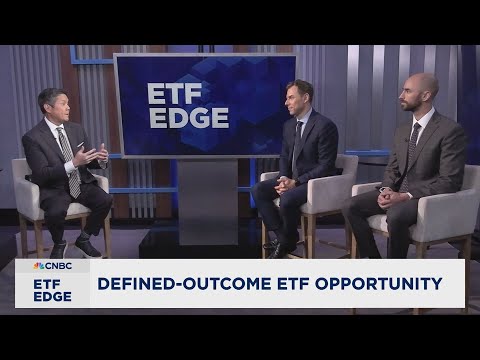
Goldman Sachs makes big bet on ETFs specializing in downside protection
CNBC· 2025-12-13 16:00
Group 1: Company Actions - Goldman Sachs Asset Management is acquiring Innovator Capital Management for $2 billion, focusing on defined outcome exchange-traded funds (ETFs) [1] - The acquisition is expected to close in the first half of next year, indicating a strategic move to enhance their product offerings in the ETF market [1] Group 2: Industry Insights - Defined outcome ETFs, also known as buffer ETFs, are gaining traction as they provide downside protection and income for investors, addressing specific market needs [2] - Bryon Lake, co-head of the Third-Party Wealth team at Goldman Sachs, emphasizes the growth potential of defined outcome ETFs, describing them as a fast and attractive space [2] - Kathmere Capital Management, managing $3.4 billion in assets, highlights the role of defined outcome ETFs in client portfolios to reduce downside risk, indicating a growing demand for these products [3] - The appeal of defined outcome ETFs lies in their ability to offer stock market exposure with built-in safety nets, making them suitable for risk-managed equity solutions [4]


Goldman Sachs increases its exposure in the ETF space
CNBC Television· 2025-12-08 23:28
Market Trends & Strategic Acquisitions - Goldman Sachs Asset Management (GSAM) recognizes the growing trend and client demand for active ETFs, particularly in the defined outcome space [2][3][6] - GSAM acquired Innovator Capital Management to accelerate its growth in the defined outcome ETF market [3][4] - The defined outcome ETF market is projected to grow significantly, potentially increasing by 4 to 5 times over the next five years [7] Product Focus & Investor Needs - Defined outcome ETFs address specific investor needs, such as income generation, downside protection, and growth [6] - These ETFs provide equity exposure with built-in downside protection, fitting into a "risk-aware growth" investment strategy [10] - Investors are increasingly using defined outcome ETFs in their portfolios as part of a critical path of innovation [7] Cost & Operational Efficiency - ETFs offer operational ease and scalability, allowing for consistent portfolio construction across multiple clients [12] - ETF costs are becoming more reasonable and competitive with separately managed accounts (SMAs) that use option overlays [12][13] - The ETF wrapper provides benefits such as intraday liquidity and transparency, enhancing investor comfort [16] Adoption & Usage - Independent registered investment advisors (RIAs) are showing increased interest in actively managed ETFs that target specific outcomes [18][19] - Defined outcome buffer products are used alongside other strategies like covered calls or trend-following equities to manage risk [20] - These products help clients maintain discipline and conviction during market downturns, improving long-term investment success [21][22]
Bitcoin Volatility Highlights Role of Laddered Protected Bitcoin ETFs
Etftrends· 2025-12-05 13:48
Core Viewpoint - Bitcoin is experiencing significant volatility, with prices dropping below $90,000 and into the mid-$80,000 range, raising concerns about future stability as 2025 approaches [1] Group 1: Bitcoin Market Conditions - The ongoing price decline has made it challenging for financial advisors to recommend bitcoin as a portfolio asset, leading to questions about whether the risks currently outweigh the potential rewards [2] - The introduction of Bitcoin ETFs, such as the Calamos Laddered Bitcoin Structured Alt Protection ETF (CBOL), offers a more risk-managed approach to bitcoin investment [3] Group 2: Risk Management Strategies - CBOL aims to provide de-risked bitcoin exposure through a laddered portfolio of underlying ETFs, which offer built-in protection against market drawdowns [4] - These underlying ETFs provide 100% downside protection over one-year outcome periods, which may be beneficial given the current market conditions for bitcoin [4] - While the downside protection is significant, it comes with an upside cap on potential returns, limiting overall return potential but still allowing for opportunities during bitcoin rallies [5] Group 3: Performance and Stability - The risk management focus of CBOL is currently proving effective, as the downside protection from its underlying ETFs is providing stability and principal preservation amid bitcoin's price drop [6] - CBOL serves as a potential tool for investors looking to reduce their bitcoin exposure during volatile market conditions, although the duration of the current bitcoin drawdown remains uncertain [7]

Renewed Volatility Opens Door for This Options-Based ETF
Etftrends· 2025-12-03 22:21
Core Insights - Large-cap tech companies investing heavily in artificial intelligence (AI) are experiencing questionable valuations, leading to increased market volatility, as indicated by a nearly 50% rise in the CBOE Volatility Index (VIX) from mid-August to mid-November [1] - The Fidelity Hedged Equity ETF (FHEQ) is highlighted as a potential investment option for downside protection, utilizing an options-based strategy that incorporates quantitative analysis of various factors for stock selection [1] - The fund aims to provide downside protection while still allowing participation in upward market trends, making it a cost-effective option for investors seeking protection against market volatility [1] Investment Strategy - The options-based strategy employed by FHEQ is designed to address various market scenarios, including changing interest rates and market volatility, providing a math-based approach to investment [1] - Fidelity Investments' representatives emphasized that options-based strategies can help clients remain invested through different market cycles while offering downside protection and potential income generation [1] - The fund's management believes that such strategies are beneficial for investors looking to mitigate risks associated with systematic factors like tariffs and geopolitical tensions [1]