Energy Policy

Search documents
X @Bloomberg
Bloomberg· 2026-03-12 06:08
Japan’s dependence on overseas energy supplies — laid bare by an oil shock in 1973 — has shaped its policy for more than half a century. Now, Tokyo plans to tap its strategic oil reserves, testing decades of planning https://t.co/kf0Df7etlH ...
X @The Economist
The Economist· 2026-03-04 04:00
Japan’s energy policy has come to an impasse: a stalled renewable buildout, an ageing nuclear fleet and enduring dependence on imported fossil fuels. Its strategy is riddled with contradictions https://t.co/5CIu2JZh0a ...
Petro's Policies Are Decimating Colombia's Natural Gas Industry
Yahoo Finance· 2026-02-21 22:00
Core Insights - Colombia is facing a significant energy crisis due to a sharp decline in natural gas production and reserves, exacerbated by policy changes and increased reliance on imports [5][8][11] Group 1: Natural Gas Supply and Demand - Domestic natural gas production has decreased from a high of 1.1 billion cubic feet per day in February 2020 to only 693 million cubic feet in December 2025, marking a 9% drop from November 2025 and a 23% decline year-over-year [1] - Colombia's natural gas reserves have fallen from 5.7 trillion cubic feet in 2012 to just over 2 trillion cubic feet by 2024, indicating a production life of only 5.9 years [4] - The country is increasingly reliant on natural gas for electricity generation, with thermal facilities generating over 20% of Colombia's electricity [2][3] Group 2: Policy and Economic Impact - President Petro's policies aimed at reducing fossil fuel dependency have led to the replacement of coal-fired plants with natural gas facilities, contributing to the energy crisis [2][5] - The cessation of new exploration contracts and increased taxes on the extractive industries have resulted in reduced drilling activities and foreign investment [8] - The reliance on costly liquefied petroleum gas (LPG) imports has surged, with imports reaching 94.33 billion cubic feet in 2024, nearly triple the previous year's volume [9] Group 3: Future Projections and Challenges - Without new domestic sources of natural gas, the supply deficit is projected to reach 56% of demand by 2029 [11] - The Sirius natural gas project, expected to come online by 2030, aims to develop 6 billion cubic feet of natural gas but will require a $5 billion investment [13] - Rising natural gas prices, driven by increased imports, are contributing to inflation and impacting the cost of living for households [12]


X @Bloomberg
Bloomberg· 2026-02-13 19:16
Also, where the US and China are headed on climate and energy policy. https://t.co/cibEpmyQeO ...
Conservative states see lower inflation than liberal ones nationwide, White House data shows
Fox Business· 2025-12-23 23:10
Core Insights - Inflation has been lower in conservative-led states compared to liberal-led states, averaging 2.5% versus 3% respectively [1] - The analysis indicates significant differences in energy and transportation costs contributing to the inflation gap [1][4] Inflation Analysis - The White House Council of Economic Advisers (CEA) utilized regional inflation data adjusted for state populations due to the absence of official state-level Consumer Price Index (CPI) [2] - Metro areas in conservative states experienced a year-over-year inflation rate of 1.9%, while those in liberal states saw a rate of 3% [3] Energy and Transportation Costs - Energy inflation is a major factor driving higher overall inflation in liberal-run cities, with cities like Baltimore, Chicago, Los Angeles, and New York experiencing rapid increases in energy prices compared to conservative states [3] - Energy and transportation costs are significant contributors to the inflation gap, affecting household expenses quickly even with slight price increases [4] Housing Affordability - Housing inflation remains high nationwide, with prices rising faster in liberal-led states than in conservative-led states [5] - The Trump administration is actively working on proposals to address housing affordability, with a comprehensive plan expected to be announced early in the new year [8][6] Voter Concerns - The findings from the CEA come at a time when inflation is a primary concern for voters, influencing discussions on energy, housing, and transportation policies that impact the cost of living [9]


Trump's 'Drill, Baby Drill' Is Bringing Relief For Americans In New Year, Says Doug Burgum: 'We're Going To Unleash American Energy' - United States Oil Fund (ARCA:USO)
Benzinga· 2025-12-22 07:12
Core Viewpoint - President Trump's energy policies are credited with providing relief to Americans through record natural gas exports and deregulation efforts that have expedited project approvals nationwide [1][2]. Group 1: Energy Policy Impact - Trump's "drill, baby drill" slogan signifies a commitment to maximizing American energy production, which has led to the U.S. becoming the largest LNG exporter, displacing Russia in the European market [2]. - The administration has significantly reduced the time required for environmental assessments and impact statements, with assessments now completed in less than 14 days and impact statements in less than 28 days, compared to previous timelines that took years [4]. Group 2: Market Conditions - Despite the positive impacts of energy policies, the drop in crude oil prices to around $57.21 per barrel, a 20% decrease year-to-date, poses challenges for U.S. producers to maintain profitable output [6]. - The United States Oil Fund LP, which tracks West Texas Intermediate Light Sweet Crude Oil, has seen a decline of 3.39% over the past month and 11.57% year-to-date, indicating unfavorable market conditions for energy stocks [7]. Group 3: Geopolitical Context - The energy agenda is framed as a strategic response to geopolitical threats, with the assertion that countries like Russia and Iran benefit from reduced U.S. energy production, which could fund conflicts and terrorism [5].

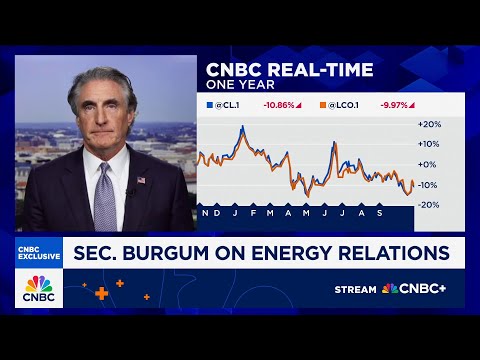
Interior Sec. Doug Burgum: Doing everything we can do to supply AI and bring prices down
CNBC Television· 2025-10-28 19:09
Energy Policy & AI - The US aims to secure its position in the AI race by ensuring domestic energy production [1][2] - The Trump administration established the National Energy Dominance Council (NEDC) to boost power supply for AI development [2][3] - A key strategy involves lowering domestic energy prices and increasing energy supply for AI, alongside energy diplomacy efforts [4] - The current administration's energy policies are viewed as hindering AI development due to reliance on intermittent energy sources [6] - AI development requires consistent power supply (24/7/365) [6] US LNG Exports & European Energy Security - US LNG exports have increased by 25% in the first 10 months [8] - Increased US LNG exports to the EU are helping to displace Russian gas purchases, impacting Russia's war funding [8] - The EU is committed to stopping Russian oil and gas purchases and is accelerating its timeline [10] - Infrastructure development, particularly pipelines in Eastern Europe (North-South corridor), is crucial for increasing LNG exports [11][12] - Europe has allocated $750 billion for energy-related infrastructure, with 15% of NATO's 5% goal dedicated to infrastructure [13] Future Opportunities - Deals are being signed for the purchase of Alaska LNG upon completion of the Alaska LNG pipeline [14]
Ex-Trump adviser: Current economy makes you 'feel proud to be an American'
Youtube· 2025-10-28 05:45
Economic Policies and Trade - Discussion on Trump's tariff policies and their negative impact on the market, referencing a historical market crash in 1929 due to tariffs [2] - Debate on whether Trump is a free trader, with arguments suggesting he uses tariffs strategically for better trade deals [3][7] - Ronald Reagan's approach to trade is highlighted, noting that he was fundamentally a free trader but also utilized tariffs strategically [5][9] Market Performance and Economic Outlook - Current U.S. economy and stock market performance is described as booming compared to stagnant economies in Europe, Japan, and a recession in China, attributed to deregulation, lower taxes, and energy policies [10][11] - The potential for Argentina's new leadership under Malay to stabilize the economy through currency reforms and spending cuts is discussed [12][14] Taxation and Wealth Distribution - Criticism of New York City's political climate, particularly targeting billionaires as the source of economic problems, with a counterargument emphasizing the importance of wealthy individuals in job creation [20][21] - Florida's tax policies are highlighted, noting that the absence of an income tax has led to significant income inflow from other states, totaling $1 trillion [22][23]

Alliance Resource Partners (NasdaqGS:ARLP) Conference Transcript
2025-10-08 17:02
Summary of Alliance Resource Partners Conference Call (October 08, 2025) Company Overview - **Company**: Alliance Resource Partners (NasdaqGS:ARLP) - **Market Capitalization**: Approximately $3.5 billion - **Structure**: Master Limited Partnership (MLP) which is tax-advantaged and yield-oriented, primarily focused on energy infrastructure and natural resource activities [2][3][5] Business Segments 1. **Coal Operations**: - Generates 80% to 85% of cash flow - Second largest coal producer in the Eastern United States - Operates seven underground mining complexes across several states - 92% of sales in 2024 directed to domestic electric power generation markets [5][6][10] 2. **Oil and Gas Mineral Interests**: - Represents 15% to 20% of cash flows - Generated approximately $115 million in segment-adjusted EBITDA in 2024, up from $40 million in 2020 - Focused on passive investments in royalty interests, primarily in the Permian Basin [6][19][20] 3. **Other Growth Investments**: - Includes investments in energy technology (Matrix) and digital asset technology (BitTiki for Bitcoin mining) - Recent investment in Gavin Coal-Fired Power Plant, representing a 5.5% equity stake [7][22][24] Industry Outlook - **Coal Industry**: - Positive outlook supported by current administration policies emphasizing coal's role in grid reliability - Anticipated increase in U.S. electricity demand driven by data centers, onshoring, and AI [8][10][13] - Shift towards domestic markets with 92% of sales expected to be domestic in 2025, compared to an average of 86% from 2021 to 2024 [10][11] - **Government Support**: - Recent actions from the administration include extending compliance timelines for environmental regulations and funding for modernizing coal plants [15][16][17] Capital Allocation Priorities 1. **Strengthening Balance Sheet**: - Low leverage with gross debt to trailing 12 months adjusted EBITDA at 0.8 times [26][27] 2. **Investments in Coal Operations**: - Planned capital investment of $285 million to $320 million in mining operations for 2025 [27][28] 3. **Oil and Gas Royalties**: - Approximately $100 million allocated for reinvestment in oil and gas minerals [28] 4. **Distributions to Unitholders**: - Focus on providing attractive yields through cash distributions rather than stock buybacks [29][30] Additional Insights - **Growth Potential**: - The oil and gas minerals segment is expected to potentially double in size over the next eight years [21] - Investments in technology and diversification into non-fossil fuel sectors are seen as growth opportunities [23][24] - **Market Dynamics**: - Domestic pricing for coal is currently more attractive than export pricing, leading to a strategic focus on domestic markets [11][12] This summary encapsulates the key points discussed during the conference call, highlighting the company's structure, business segments, industry outlook, capital allocation strategies, and additional insights into growth potential and market dynamics.

Pennsylvania threatens to go “own way” if grid doesn’t change #shorts #energy #pjm #pensylvania
Bloomberg Television· 2025-09-22 17:51
PJM Reform & Potential Exit - Pennsylvania is willing to leave PJM if it doesn't enact reforms giving governors more say in policies to control costs and increase power generation [1] - PJM's actions have slowed down Pennsylvania's energy production efforts and increased costs [2] - Pennsylvania is capable of producing enough energy for itself at a faster rate than PJM [3] Energy Production & Economic Impact - Pennsylvania is the second largest energy producer in the US and aims to produce more energy for economic opportunity and freedom [2] - Pennsylvania's potential exit from PJM would significantly impact the other 12 states in PJM and the entire nation [4]