GPU生态体系

Search documents
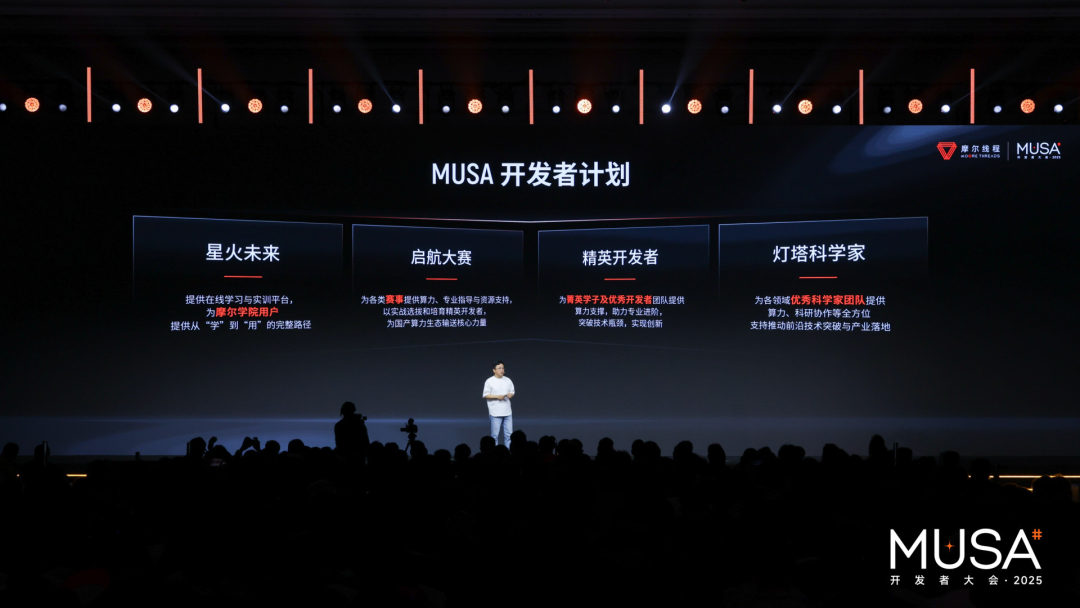
上市后的摩尔线程,重心从造芯变成建生态
Xin Lang Cai Jing· 2025-12-22 11:02
Core Viewpoint - The Moer Thread's first MUSA Developer Conference (MDC 2025) showcased significant advancements in GPU technology and emphasized the importance of ecosystem development in the GPU industry, positioning itself as a key player in the market with a valuation of 300 billion [1][26]. Group 1: Ecosystem and Developer Focus - The ecosystem is identified as the core moat and value in the GPU industry, with a strong emphasis on developer engagement as a critical component of ecosystem construction [2][27]. - The MUSA architecture has undergone comprehensive upgrades centered around developers, aiming to reduce development and migration costs while enhancing usability [2][27]. - Moer Thread's strategy appears to challenge NVIDIA's CUDA ecosystem, highlighting the necessity for domestic GPU manufacturers to build robust ecosystems beyond mere technological competition [2][28]. Group 2: MUSA Architecture and Full-Stack Technology - MUSA (Meta-computing Unified System Architecture) is the first domestic architecture to support AI computing, graphics acceleration, scientific computing, and more on a single chip, representing a full-stack technology system [8][32]. - The full-function GPU is designed to handle various tasks, supporting multiple precision levels, which enhances efficiency and compatibility for emerging applications [9][33]. - MUSA has evolved to its fifth generation since its launch in 2022, with significant performance improvements across various GPU engines [11][35]. Group 3: Upcoming Products and Innovations - The new full-function GPU architecture "Huagang" was introduced, featuring substantial upgrades in computing density, energy efficiency, and precision support [16][40]. - Two upcoming chips, "Huashan" and "Lushan," are set to focus on AI training and high-performance graphics rendering, respectively, indicating a strategic dual focus on AI and graphics [20][44][48]. - "Huashan" will support a wide range of precision calculations and enhance AI training capabilities, while "Lushan" aims to significantly improve graphics performance metrics [23][48].