Global de - dollarization

Search documents
Using Free Cash Flow Across International Value and Growth Equity Investing
Etftrends· 2026-03-20 18:21
Core Insights - The article discusses the significance of free cash flow (FCF) as a flexible metric for international equity investing, especially in the context of global de-dollarization and a weakening dollar [2][4]. Group 1: International Investing Trends - There is a growing interest in international investing as U.S. equities, particularly those focused on artificial intelligence, may have reached peak valuations [2]. - Investors are increasingly looking for value-oriented opportunities outside U.S. borders, making FCF a critical metric for assessing companies' cash deployment capabilities [2]. Group 2: FCF-Driven Investment Strategies - Investors can utilize cash flow statements of international equities to identify opportunities, or they can invest through ETFs like VictoryShares International Free Cash Flow ETF (IFLO) and VictoryShares International Free Cash Flow Growth ETF (GRIN) for diversified exposure [3][4]. - IFLO targets the largest profitable companies with the highest FCF, combining trailing and forward-looking metrics to provide a clearer picture of future cash generation [4]. - GRIN focuses on companies with strong future growth prospects, analyzing their ability to sustain FCF gains over time [5]. Group 3: Portfolio Diversification - Both IFLO and GRIN can be used independently or together to provide comprehensive exposure to international equities, regardless of whether value or growth is currently favored in the market [6]. - A combined portfolio of IFLO and GRIN offers diversification across value and growth factors while leveraging the all-weather FCF metric, beneficial in various market conditions [7].


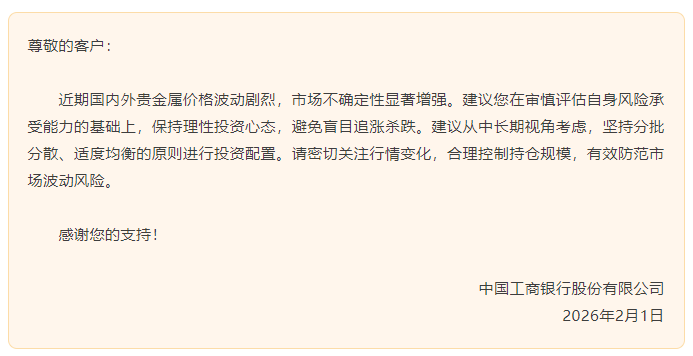
工行紧急提示风险,有品牌金饰克价大跌160元
2 1 Shi Ji Jing Ji Bao Dao· 2026-02-01 07:02
Core Viewpoint - The recent volatility in precious metal prices has prompted major banks in China to issue risk assessments and warnings to investors, emphasizing the need for cautious investment strategies and risk management [1][2][3]. Group 1: Bank Responses - Industrial and Commercial Bank of China (ICBC) has advised clients to complete risk assessments before engaging in gold-related transactions, requiring a minimum risk tolerance rating of C3 [2]. - Agricultural Bank of China has implemented similar measures, mandating that clients achieve at least a cautious risk assessment rating for gold accumulation transactions starting January 30 [2]. - Bank of Communications has also introduced risk assessment requirements for clients engaging in related business as of January 31 [3]. Group 2: Market Conditions - As of January 31, spot gold prices fell below $4,900, dropping nearly $500, while spot silver plummeted over 26% due to panic selling influenced by geopolitical factors and changes in U.S. monetary policy [6]. - The current prices for precious metals reflect significant declines, with London gold at $4,880.034, down 9.25% year-to-date, and London silver at $85.259, down 26.42% [7]. Group 3: Price Adjustments - Major banks have adjusted investment thresholds and trading limits to mitigate risks, with China Construction Bank raising the minimum investment for gold accumulation to 1,500 yuan starting February 2 [4]. - Other banks, including China Merchants Bank and Ping An Bank, have also increased their investment minimums for gold products, indicating a tightening of market access [4]. Group 4: Market Outlook - Analysts suggest that the recent sharp declines in gold and silver prices were expected following rapid price increases, indicating a strong profit-taking demand [8]. - Long-term perspectives remain optimistic for gold prices due to ongoing issues with the U.S. dollar and increasing global central bank gold reserves, which may support future price increases [8].






金价暴跌,消费者观望“双11”
3 6 Ke· 2025-10-24 10:37
Core Viewpoint - The international gold market has experienced significant volatility, with a notable drop in prices following a series of record highs, leading to varied responses in investment and consumer behavior [1] Group 1: Market Trends - As of October 21, the international spot gold price fell sharply by 6.3%, marking the largest single-day decline since April 2013 [1] - On October 22, gold prices further declined, approaching the $4000 per ounce mark [1] - The fluctuation in gold prices has triggered a chain reaction in both investment and consumer markets, with online gold stores preparing for the upcoming "Double Eleven" shopping festival [1] Group 2: Consumer Behavior - Major brands continue to price gold jewelry at high levels, with prices for mainstream brands like Chow Tai Fook at 1223 CNY per gram and other brands similarly priced [2] - Brand representatives indicate that significant price adjustments are unlikely until there is a sustained downward trend in gold prices [2] - Consumers are finding opportunities for better deals online during the "Double Eleven" event, with platforms offering exclusive coupons for gold purchases [2] Group 3: Regulatory and Quality Standards - The purity labeling of gold has been standardized, with the national standard stating that gold content must be no less than 990‰ to be labeled as "foot gold" [4] - The previous terms like "thousand-foot gold" and "ten-thousand-foot gold" have been eliminated to prevent price inflation based on purity claims [4] Group 4: Secondary Market Activity - The second-hand market for gold is becoming increasingly active, with users listing gold jewelry for resale on platforms like Xianyu [4] - Some sellers are pricing second-hand items above official retail prices, which may be due to supply shortages in brand stores [4][15] - The wholesale market in Shenzhen shows a significant price difference, with gold priced at 936 CNY per gram, reflecting a 40% increase since January [15] Group 5: Investment Market Dynamics - There is a noticeable divergence in the investment market, with long-term investors seeing substantial gains while short-term traders face losses [16] - Long-term investors, such as those in hedge funds, maintain a positive outlook on gold despite recent price corrections, citing ongoing factors like de-dollarization and inflation expectations [16] - Short-term investors are experiencing pressure from recent declines, with many choosing to hold their positions rather than sell at a loss [18]

Should EM Investors Trim or Retain Their China Exposure?
Etftrends· 2025-10-03 18:49
Core Viewpoint - Gaining exposure to emerging markets is considered a viable strategy in the current market environment due to global de-dollarization and the potential for further interest rate cuts by the Federal Reserve [1] Group 1 - The current market environment is characterized by global de-dollarization, which is influencing investment strategies [1] - The prospect of further rate cuts by the Federal Reserve is creating favorable conditions for investing in emerging markets [1]