Growth scare

Search documents
S&P 500 Correction Amid Iran War Isn't Typical Bear Market, It Lacks 'Quick Drop' Signature, Says Strategist
Benzinga· 2026-03-31 12:12
Market Overview - The S&P 500 has experienced a 9.4% decline, which is atypical for historical bear market patterns, indicating that the current volatility may represent a "growth scare" rather than a prolonged downturn [1] - The current market environment lacks the rapid decline typically associated with the onset of a true bear market, as evidenced by the S&P 500's slower pace in reaching a 5% decline [2] Market Dynamics - The current pullback that began on January 27 took 35 trading days to reach a 5% decline, which is significantly longer than the historical average of 14.5 trading days since 1950, suggesting a potentially bullish signal for long-term investors [3] - Morgan Stanley analysts believe that the market correction is nearing its end stages, despite ongoing geopolitical risks, such as the Iran war and the closure of the Strait of Hormuz, which are already reflected in current prices [4] Economic Indicators - Brent crude oil prices have risen to $107.35 per barrel amid escalating conflicts in the Middle East, while the 10-year Treasury yield is approaching 4.5%, currently at 4.33% [5] - Morgan Stanley has cautioned that interest rate hikes pose a significant threat, noting that equities are currently highly sensitive to interest rate changes [5] Earnings and Recovery Outlook - Positive earnings growth is seen as a buffer against potential downturns, leading to a higher "cumulative probability" of resuming trade flows compared to the likelihood of entering a full-blown recession [6] Index Performance - As of Monday's close, the S&P 500 is down 9.41% from its record high of 7,002.38 points, with a year-to-date decline of 7.51% but an annual increase of 13.04% [7] - The Nasdaq Composite index has declined 13.43% from its record of 24,019.99 points, with a year-to-date drop of 10.51% and an annual increase of 20.21% [7]

Why the Consumer is a Critical Indicator to Watch for Any Economic Downturn
Youtube· 2026-02-12 14:00
Market Volatility and Positioning - Market volatility is expected to be a feature this year, driven by high valuations and earnings expectations, indicating limited cushion for absorbing bad news [2][3] - Recent corrections are viewed more as positioning and sentiment resets rather than true growth scares, suggesting they are likely to be shorter and shallower [3][4] Key Metrics to Monitor - Two critical metrics to watch are market leadership and intermarket analysis, particularly high yield spreads, which remain contained despite concerning headlines [6][7] - The ratio of equal weight consumer discretionary to consumer staples has softened, which could indicate pressure on consumer spending, a significant driver of GDP [8][9] Consumer Spending Insights - Recent jobs data showed stronger-than-expected results, but retail sales numbers were weaker, presenting conflicting signals about consumer behavior [10][11] - The K-shaped economy is highlighted, where consumption is primarily driven by wealthy households, necessitating a strong stock market to sustain their spending [12][13] Software Sector Analysis - The software sector is experiencing significant selling pressure, referred to as "software as a soreness," indicating that trades in this area are likely to be short-term [16] - The software index has shown oversold conditions, but any bounce has been short-lived, suggesting ongoing challenges within the sector [16][17]

'Fast Money' traders talk AI valuation fears rattling the markets
Youtube· 2025-11-06 22:43
Economic Concerns - The Federal Reserve expressed concerns about the labor market during the Jackson Hole meeting, indicating that recent labor market data supports these worries [1] - There are conflicting signals from the Fed, with some officials more worried about inflation than job losses, creating tension in the market [7] Market Performance - Bitcoin has underperformed for at least three weeks, reflecting a risk-on, risk-off sentiment in the market [2] - The S&P 500 was noted to be 13% above its 200-day moving average, suggesting that the market was overextended [8] - Companies exposed to consumer lending and mortgage servicing are under pressure, indicating potential consumer concerns [6] Stock Analysis - Amazon and Apple have shown negative price action despite positive earnings reports, suggesting a potential reversal in market sentiment [3] - Oracle's stock retracing entirely is seen as significant, indicating broader market implications [3] Investor Behavior - There is a historical tendency for investors to buy the dip, but there are concerns that this trend may not hold in the current market environment [10][13] - The VIX is expected to rise, indicating potential further market volatility and a possible wave of downside [12][14]

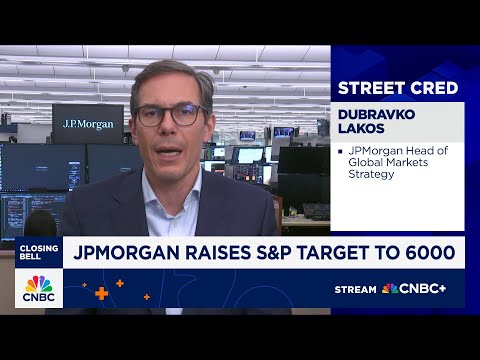
JPMorgan's Dubravko Lakos on raising its S&P target to 6,000
CNBC Television· 2025-06-12 20:34
a couple of months ago. It shows how much sentiment has shifted with stocks edging towards new highs. Dubravko Lakos JP morgan's head of global market strategy joins us now.It's good to see you. Welcome back. >> Thank you Scott.>> You did raise your target. But it's to 6000 where we're already there. So you think the next six months are going to bring us what.>> Well, look, if you look at the details of our last 2 or 3 reports, we've actually been pushing the bullish tactical trade since the end of April. A ...