HBM增长

Search documents
行业聚焦:全球球形二氧化硅行业头部生产商市场份额及排名调查(附核心企业名单)
QYResearch· 2026-02-09 06:59
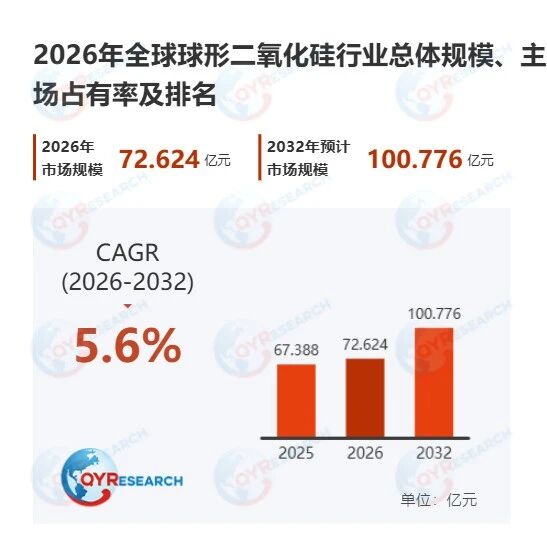
Core Insights - The global spherical silica market is projected to reach $1.48 billion by 2032, with a compound annual growth rate (CAGR) of 5.6% over the coming years [3] - The production of spherical silica is aimed at achieving higher packing density and more stable rheological properties compared to irregularly shaped silica [2] Market Overview - The estimated global production of silica is approximately 239,000 tons, with an average market price of $4,154 per ton [2] - The leading manufacturers in the spherical silica market include Denka, Admatechs, NIPPON STEEL Chemical & Material, and others, with the top ten companies holding about 61.0% market share by 2025 [5] - The primary product type in the market is 10 μm-20 μm, accounting for approximately 53.6% of the market share [7] Application Segmentation - The main demand source for spherical silica is epoxy molding compounds, which represent about 55.1% of the market [10] - Spherical silica is predominantly used in applications related to electronic materials, particularly in epoxy encapsulation [16] Industry Drivers - Significant investments in the semiconductor ecosystem in Asia, such as China's $150 billion chip initiative, are driving local material supply and increasing demand for electromagnetic compatibility (EMC) materials [17] - The rise of advanced packaging technologies is increasing the demand for fillers, with a projected CAGR of 8-10% [18] - The explosive demand for high-performance computing and 5G devices is a major driver for the need for high-quality packaging materials [19] Challenges - Rising compliance and operational costs due to stringent regulations on crystalline silica are impacting production costs [20] - The high concentration of raw material supply, particularly high-purity quartz, poses a risk of supply disruptions [20] - Long certification cycles in the semiconductor industry slow down the adoption of new filler technologies [21] Opportunities - The adoption of silane coupling agents for surface treatment of silica particles is enhancing resin adhesion and moisture resistance, which is becoming a standard process in advanced EMC fillers [22] - There is a growing demand for low-alpha fillers, particularly in memory and aerospace applications, which is opening new market opportunities [22] - The increasing need for thermal management and dimensional stability in automotive and industrial electronics is accelerating the application of silica fillers in composite laminates [24]