Healthcare reform

Search documents
Why AbbVie Stock Looks Like a Dirt Cheap Buy Right Now
The Motley Fool· 2026-03-23 18:30
Core Viewpoint - AbbVie is currently underperforming in the market, down 11% this year compared to the S&P 500's 4% decline, amid broader bearish sentiment in the healthcare sector due to concerns over healthcare reform and government cuts [1][2] Company Performance - AbbVie's revenue reached $61.2 billion in 2025, reflecting a 9% increase from the previous year, with a strong upward growth trend observed in recent quarters [4] - The company has adapted to challenges, including the loss of patent protection for its top drug, Humira, by successfully launching new immunology drugs, Skyrizi and Rinvoq, which generated $25.9 billion in revenue last year [3] Market Position - AbbVie is trading at a forward price-to-earnings multiple of 14, significantly lower than the S&P 500 average of 21, indicating it may be undervalued [7] - The price-to-earnings-growth (PEG) multiple stands at 0.49, suggesting the stock is cheap relative to expected growth, as a PEG below 1.0 is considered favorable [8] Future Potential - Despite current market conditions, AbbVie presents potential upside for investors, supported by an above-average dividend yield of 3.4%, making it an attractive long-term hold [9] - The company's diverse operations provide multiple avenues for growth, although aesthetics sales have declined by 6%, indicating potential for recovery as consumer spending increases [6]



Billionaire Mark Cuban Says 'Remove Insurance Companies From the Equation' —Make 'All' Payments Cash And It'll Be Cheaper
Yahoo Finance· 2026-02-26 14:00
Core Perspective - Mark Cuban critiques the complexity of the U.S. healthcare system, advocating for transparency and simplicity in pricing, emphasizing that the focus should be on how to pay for care for those who cannot afford it [2][3][5]. Group 1: Healthcare System Critique - Cuban describes the healthcare industry as unnecessarily complicated, driven by financial engineering rather than patient care [3][4]. - He distinguishes between innovation in patient care and the financial complexities that obscure costs, asserting that the latter is the main issue [4]. Group 2: Proposed Simplicity - Cuban envisions a return to a simpler healthcare model reminiscent of 1955, where patients directly pay for care they receive [5]. - He posits that the central question in healthcare reform should be how to fund care for those unable to pay, suggesting that all reforms should revolve around this issue [5]. Group 3: Financial Transparency - Cuban highlights the need for transparency in healthcare costs, criticizing the current practices of bundling and upcoding that obscure true expenses [6]. - He emphasizes that simply posting procedure prices is insufficient, as it does not address the underlying issues of revenue extraction in the healthcare system [6].
Mark Cuban Asked Which Hurts More: Premiums or Deductibles? Results Were Neck-and-Neck, But One Barely Edged Out —'You Choose Your Own Pain'
Yahoo Finance· 2026-01-30 19:21
Core Insights - Mark Cuban is advocating for healthcare reform through social media, highlighting issues within the U.S. insurance system without running for office [1] - A recent poll on X revealed that 51.8% of respondents find deductibles to be a more painful financial expense compared to monthly premiums, indicating widespread frustration with the current healthcare payment structure [2] Group 1: Public Sentiment on Healthcare Costs - The poll results show a nearly even split between preferences for premiums and deductibles, reflecting a deep frustration among users regarding both costs [2] - Users expressed that deductible costs are more visible and immediate, while premiums are often perceived as an invisible tax deducted from paychecks [4] - Many respondents described the healthcare payment system as a "pick-your-poison" scenario, where lower premiums lead to higher out-of-pocket costs, forcing individuals to gamble on their healthcare needs [4] Group 2: Financial Burden of Healthcare - One user detailed a scenario involving a $1,160 monthly premium and a $1,500 deductible, illustrating how insurance companies limit their payouts while consumers bear the financial burden [5] - Comments highlighted the issue of deductible resets each January, leading to significant debt accumulation before any coverage kicks in, with one user mentioning a potential $12,000 debt before receiving any benefits [5] - While some users noted the advantages of health savings accounts, they remained cautious, emphasizing that even with pre-tax contributions, upfront cash payments are still required for services [5]
As Trump Unveils His ‘Great Healthcare Plan,’ How Should You Play UnitedHealth Stock?
Yahoo Finance· 2026-01-15 21:16
Group 1 - UnitedHealth (UNH) shares are in focus following President Trump's announcement of the "Great Healthcare Plan," which aims to lower costs, expand access, and boost competition in the healthcare sector [1][3] - The stock has increased approximately 42% compared to its 52-week low, indicating a significant recovery [2] - The new healthcare initiative presents both challenges and opportunities for insurance companies like UnitedHealth, with potential near-term profitability pressures due to lower costs, but long-term growth prospects from expanded coverage pools [3] Group 2 - UnitedHealth's net margin has declined to 2.1% in the latest reported quarter, reflecting ongoing margin pressures [4] - The company faces regulatory and reputational risks due to new Medicare accusations and a DOJ investigation into its billing practices, which could hinder growth through 2026 [5] - The stock is currently trading at about 19 times forward earnings, significantly higher than Cigna's 9 times, indicating it may not be an inexpensive investment following a recent rally [6] Group 3 - Despite the challenges, Wall Street remains optimistic about UnitedHealth, with a consensus rating of "Moderate Buy" and a mean target price of approximately $397, suggesting an upside potential of around 18% [8]

Mark Cuban Asks Why Insurance Pays $2,500 for an MRI When a Center Down the Street Charges $350
Yahoo Finance· 2026-01-13 14:50
Core Insights - Mark Cuban highlights the disparity in healthcare pricing, questioning why insurance companies pay significantly higher prices for services compared to cash prices at local centers [1][3] - Cuban criticizes the influence of pharmacy benefit managers (PBMs) and large insurance companies, arguing that they contribute to inflated healthcare costs without providing value [2][5] - He advocates for healthcare reform, emphasizing the need for transparency and consumer leverage in the healthcare system [6] Group 1: Pricing Disparities - Cuban points out that an MRI can cost $2,500 through insurance, while a local center charges only $350, illustrating the inefficiency in the current system [1][3] - Real-world examples from users show that MRIs quoted at over $1,500 with insurance can be as low as $275 when paid in cash, further emphasizing the pricing discrepancies [4] Group 2: Critique of Healthcare System - Cuban's frustration is directed at the healthcare system's middlemen, including insurers, who he believes exploit patients by maintaining high prices [5] - He argues that insurance companies lack incentives to control costs, as they benefit from a system that rewards inflated charges [4][5] Group 3: Advocacy for Reform - Cuban has called on Congress to enforce divestment of overlapping interests between PBMs and insurers, aiming for greater transparency in the healthcare market [6] - His efforts include promoting a low-cost pharmacy platform, Cost Plus Drugs, to combat the inefficiencies and high costs associated with traditional healthcare providers [5]
Thinking of ditching Medicare Advantage? Here’s why John Oliver and Suze Orman say you should. But are they right?
Yahoo Finance· 2025-12-29 13:00
Core Argument - Influential figures like John Oliver and Suze Orman are urging older adults to reconsider their Medicare Advantage (MA) plans, highlighting significant flaws in the system [3][5]. Group 1: Criticism of Medicare Advantage - John Oliver criticized MA in a 31-minute segment, describing it as "woefully insufficient," with issues such as denials, delays, and high costs to taxpayers [3]. - Oliver accused major insurers of inflating patient risk scores to increase federal payments and using restrictive networks to limit care [3][4]. - Suze Orman warned that major insurers are terminating or consolidating plans for 2026, which could leave older adults vulnerable to unexpected changes in premiums, networks, and benefits [5]. Group 2: User Experience and Affordability - Despite criticisms, some MA users report satisfaction with their plans, citing low annual copay costs, with one user stating they have never spent more than $200 or $300 in a year [6].
X @The Wall Street Journal
The Wall Street Journal· 2025-11-20 23:02
Healthcare Reform - GOP electoral success depends on fashioning a healthcare reform agenda [1] Political Analysis - Healthcare reform is vital for the Republican party's electoral success [1]
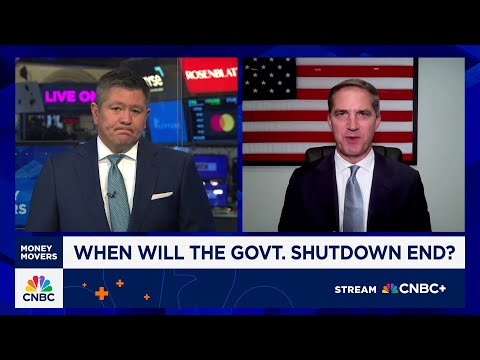
Government shutdown could extend to week of Oct. 13, says Strategas' Dan Clifton
CNBC Television· 2025-10-01 16:48
Government Shutdown Duration & Resolution - Strigus Strategus Securities predicts the government shutdown could extend into the third week of October [1] - The shutdown's resolution is anticipated when missed paychecks create real pressure [5] - Historically, government shutdowns resolve after paychecks are missed [7] Political Dynamics & Incentives - Democrats see the budget fight as an opportunity to challenge policies, specifically ACA subsidies, potentially leading to premium increases [2] - Republicans are unwilling to negotiate on healthcare reform until the government reopens [3] - A potential catalyst for resolution could be some senators advocating to reopen the government [3] - Watching today's vote is crucial; four or five Democrats voting to keep the government open could signal a shorter shutdown [4] Economic & External Factors - The economy is softening, and crucial data like jobs and inflation numbers are unavailable during the shutdown [7] - Potential catalysts like hurricanes or geopolitical pressures (e.g., Russia challenging NATO) could influence the situation [6] - Missing military payments on October 15th will increase pressure [5]
One Big Beautiful Bill Act: A Boon or Bane for Centene?
ZACKS· 2025-08-07 18:06
Core Insights - Centene Corporation (CNC) faces both opportunities and challenges under the One Big Beautiful Bill Act (OBBBA), which aims to simplify and digitize the U.S. healthcare payment system [1][3] - The bill includes approximately $1 trillion in federal Medicaid cuts over the next decade and mandates eligibility verification every six months, potentially increasing administrative costs and affecting ACA plan enrollment [2][8] Group 1: Opportunities and Challenges - The emphasis on billing standardization and digital infrastructure in the OBBBA may benefit Centene, allowing for enhanced claims accuracy and improved cash flow [3][4] - Centene's nationwide presence and experience in navigating complex regulations provide a competitive edge, enabling the company to develop tailored products and expand into private markets [4] Group 2: Financial Performance and Estimates - Centene's shares have lost 57.6% year to date, underperforming the industry [7] - The Zacks Consensus Estimate for CNC's EPS has been revised downward for the second and third quarters of 2025, with a similar trend for full-year estimates [10][11] - Current estimates indicate a year-over-year revenue increase for 2025, but a decline in EPS, while the opposite is expected for 2026 [11] Group 3: Valuation and Market Position - Centene trades at a forward 12-month price-to-earnings ratio of 8.98, below the industry average of 11.96 [9] - The company may face pressure from the $1 trillion in Medicaid cuts and potential increases in costs due to eligibility checks [8]