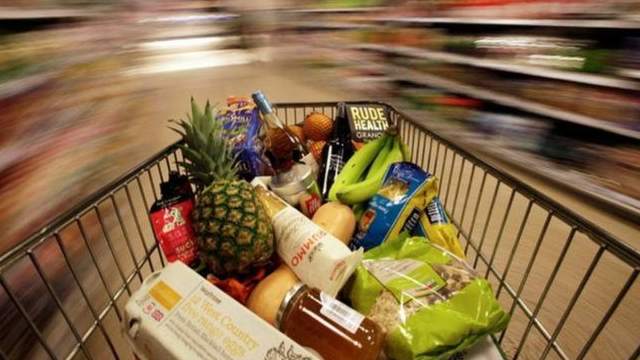
Healthier food options

Search documents
Target Aims At Healthier Breakfasts — Synthetic Colors Out By May - Target (NYSE:TGT)
Benzinga· 2026-02-27 12:03
Core Insights - Target Corporation is shifting its cereal offerings to ensure that 100% of its cereal assortment will be made without certified synthetic colors by the end of May, reflecting a trend towards healthier food options for families [1][3][4] Product Strategy - The initiative to reformulate cereal products aligns with consumer preferences for healthier options, particularly for busy families, and involves collaboration with national and owned brand partners [3] - Target's broader strategy includes ongoing investments in wellness and food innovation, highlighted by the launch of its Good & Gather brand in 2019, which features over 2,500 products free from artificial flavors, synthetic colors, and high-fructose corn syrup [4] Market Context - The broader market experienced declines, with the Nasdaq down 0.31% and the S&P 500 falling 0.37%, which has contributed to Target's stock decline, indicating that the stock is affected by a broader market sell-off [5] - Target is currently trading 5.3% below its 20-day simple moving average (SMA) and 9.8% below its 100-day SMA, indicating short-term weakness [6] Technical Analysis - The Relative Strength Index (RSI) is at 50.00, indicating neutral momentum, while the Moving Average Convergence Divergence (MACD) is at 0.10, below its signal line at 0.15, suggesting bearish pressure on the stock [7] Earnings Outlook - Target is set to report earnings on March 3, 2026 [8] Analyst Consensus - The stock carries a Hold Rating with an average price target of $101.70, with recent analyst moves indicating mixed sentiments: JP Morgan raised its target to $115.00, while Bernstein lowered it to $91.00 [9][10]



Cheerios maker says cost of living, housing expenses changing way consumers spend
Fox Business· 2026-02-17 18:10
Core Viewpoint - General Mills has reduced its annual sales and profit forecasts due to weak consumer sentiment and a shift towards healthier, lower-cost food options impacting demand for packaged products [1][9]. Group 1: Sales and Profit Forecasts - The company now expects annual sales to decline by 1.5% to 2%, a revision from its previous forecast of a decline of 1% to an increase of 1% [11]. - General Mills anticipates that annual adjusted operating profit and adjusted earnings per share will fall by 16% to 20% in constant currency, compared to the earlier outlook of a 10% to 15% decline [13]. Group 2: Consumer Behavior and Market Trends - Weak consumer sentiment, heightened uncertainty, and significant volatility have negatively impacted category growth and altered consumer purchasing patterns, leading to a slower recovery in volume and higher costs than expected [2]. - The shift in consumer preferences towards healthier options and the increased use of GLP-1 weight-loss drugs are further pressuring demand for packaged foods [3][6]. - Economic pressures are causing lower- and middle-income consumers to focus more on value, reshaping their spending patterns [6][7]. Group 3: Competitive Landscape - General Mills faces growing competition in the protein options market, which is affecting its product lines, including its own protein cereals [5]. - Other companies in the industry, such as PepsiCo, have responded to consumer backlash by cutting prices on core brands, indicating a trend towards value offerings [9].

Is Sprouts Farmers Stock a Buy, Hold or Sell After a 26% YTD Jump?
ZACKS· 2025-07-10 14:16
Core Insights - Sprouts Farmers Market Inc. (SFM) has achieved a year-to-date gain of 25.7%, significantly outperforming the Zacks Food-Natural Foods Products industry, which rose by 14% [1] - The company is benefiting from a shift in consumer preferences towards healthier food options, supported by strong fundamentals and strategic initiatives [1][7] - Investors are questioning whether SFM still has upside potential or if it is time to lock in gains, given the stock's strong performance [1] Performance Overview - SFM has outperformed major indexes, including the broader Retail and Wholesale sector and the S&P 500, which saw declines of 4.1% and 5.2%, respectively [1] - The stock closed at $159.75, below its 52-week high of $182 reached on June 3, 2025 [5] Competitive Positioning - SFM has outperformed peers such as Farmer Bros. Co. (decline of 20%), Grocery Outlet Holding Corp. (decline of 16.2%), and Performance Food Group Company (increase of 6.6%) [5][6] - The company’s private-label products account for 24% of total sales, with 300 new items launched last year, enhancing customer loyalty [8] Strategic Initiatives - SFM is rolling out a new loyalty program, which has shown positive results in pilot stores, achieving sign-ups and scan rates above internal targets [9] - The company plans to open at least 35 new stores in 2025, targeting approximately 10% unit growth, supported by a robust pipeline of 120 approved sites [10] - SFM has initiated self-distribution of fresh meat and seafood, improving control and freshness while optimizing supply-chain capacity [9] Financial Projections - For fiscal 2025, SFM anticipates net sales growth of 12% to 14% and comparable store sales growth of 5.5% to 7.5% [12] - The company projects adjusted earnings before interest and taxes between $640 million and $660 million for 2025, with earnings per share expected to be between $4.94 and $5.10, up from $3.75 in 2024 [12] Market Sentiment - Analysts have revised earnings per share estimates upward, with current estimates for fiscal 2025 at $5.08, reflecting a year-over-year growth rate of 35.5% [13] - SFM is currently trading at a forward 12-month price-to-sales ratio of 1.69, indicating strong investor interest despite its premium valuation compared to industry peers [15][16]