
Interest Rate Differential

Search documents
Dollar Supported by Ongoing US-Iran War
Yahoo Finance· 2026-03-25 19:37
Economic Indicators - The dollar index rose by +0.22% on Wednesday, recovering from early losses after Iran rejected the latest US peace proposal, with US economic news indicating a significant increase in the February import price index ex-petroleum, which rose by +1.2% month-over-month, the largest increase in 4 years [1][3] - US MBA mortgage applications fell by -10.5% in the week ended March 20, with the mortgage purchase sub-index down -5.4% and the refinancing mortgage sub-index down -14.6%, while the average 30-year fixed-rate mortgage increased by +13 basis points to 6.43% from 6.30% the prior week [3] Interest Rate Outlook - Swaps markets are pricing in a 4% chance of a +25 basis point rate hike at the upcoming FOMC meeting on April 28-29, with expectations that the FOMC will cut interest rates by at least -25 basis points in 2026, contrasting with the BOJ and ECB, which are expected to raise rates by at least +25 basis points in the same year [4] - A 62% chance of a +25 basis point rate hike by the ECB is being discounted for the policy meeting on April 30 [6] Currency Movements - The EUR/USD fell by -0.38% on Wednesday, pressured by a decline in business confidence in Germany, as the German March IFO business climate index fell by -2.0 to a 13-month low of 86.4 [5]
ATFX:日本央行持续加息 为何日元贬值逼近160
Xin Lang Cai Jing· 2026-01-16 11:59
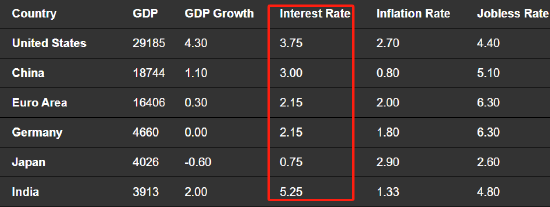
Core Viewpoint - The traditional logic that central bank interest rate hikes lead to currency appreciation does not apply to Japan, where the Bank of Japan raised rates twice in 2025 by a total of 50 basis points, yet the yen depreciated significantly against the USD [1][3]. Economic Indicators - Japan's current GDP is 4026 billion, with a GDP growth rate of -0.60% and an interest rate of 0.75%, which is significantly lower than the US (3.75%), China (3%), and Germany (2.15%) [2][7]. - The inflation rate in Japan stands at 2.90%, with a jobless rate of 2.60% [2][7]. Currency Dynamics - Despite the interest rate hikes, the yen remains a "funding currency," as financial institutions borrow yen at low rates and convert it to higher-yielding currencies and assets, leading to capital outflows from Japan [2][8]. - The depreciation of the yen during the Bank of Japan's rate hikes indicates that other impactful factors are influencing its value [1][3]. Future Projections - It is anticipated that the Bank of Japan will raise rates twice more in 2026, each by 25 basis points, potentially bringing the benchmark rate to 1.25% by year-end [3][9]. - With the Federal Reserve expected to cut rates by a total of 75 basis points in 2026, the interest rate differential between Japan and the US may narrow significantly, which could lead to a potential appreciation of the yen [9]. Market Sentiment - There is a prevailing view that the Bank of Japan's rate hikes may be a short-term measure due to unstable inflation, which could lead to a larger recession in Japan, contributing to the ongoing depreciation of the yen [3][9]. Market Analysis - In the short term, the USDJPY is experiencing a corrective phase, with a recent low of 157.95, showing signs of support but still facing potential downward movement [6][12].

Dollar Falls on Interest Rate Differential Outlook
Yahoo Finance· 2025-12-22 16:39
Group 1: Dollar Index and Economic Outlook - The dollar index (DXY00) is down -0.30%, retreating from a one-week high, indicating underlying weakness in the dollar as the FOMC is expected to cut interest rates by about -50 bp in 2026 [1] - The Fed is increasing liquidity in the financial system by purchasing $40 billion a month in T-bills, contributing to the dollar's pressure [2] - Markets are pricing in a 20% chance of a -25 bp cut in the fed funds target range at the upcoming FOMC meeting on January 27-28 [3] Group 2: Euro and ECB Position - EUR/USD is up +0.48% due to dollar weakness, supported by ECB officials' comments expressing satisfaction with the current outlook for interest rates [4] - ECB Governing Council member Gediminas Simkus stated satisfaction with current interest rates, citing inflation levels close to the 2% target and improved, albeit sluggish, economic growth [5] - The ECB is not expected to cut rates at the next policy meeting on February 5, with swaps pricing in a 0% chance of a -25 bp cut [6] Group 3: Yen and Bank of Japan - USD/JPY is down -0.47%, with the yen supported by a recent +25 bp rate hike by the Bank of Japan and rising interest rate differentials [6]
Is Consolidation in the Dollar Index Bullish or Bearish?
Yahoo Finance· 2025-09-23 19:00
Core Viewpoint - The dollar index is experiencing downward pressure due to falling U.S. interest rates and rising debt levels, indicating that it has not yet found a bottom [1][2]. Group 1: Dollar Index Performance - The dollar index was trading at 97.77 on July 21, 2025, and has shown little movement over the past two months, with potential for lower lows as U.S. rates decline [2]. - The dollar index has declined 12.5% from a high of 110.17 on January 13, 2025, to a low of 96.37 on July 1, 2025 [3]. - Since July 24, the index has consolidated within a range of 96.22 to 100.26, currently around 97.50, close to critical technical support at 96.22 [4]. Group 2: Interest Rate Dynamics - The interest rate differential between the U.S. dollar and the euro significantly influences the dollar index, with the euro making up 57.6% of the index [5]. - The Federal Reserve cut the short-term Fed Funds Rate by 25 basis points to a midpoint of 4.125% during the September 18 FOMC meeting, with expectations for further reductions due to rising unemployment and low inflation [5][6]. - The Fed is likely to continue reducing rates, influenced by the upcoming appointment of a new Chairman in early 2026, which may align with the administration's preference for lower short-term rates [7][8].