KRAS赛道竞争

Search documents
阿斯利康入局,Pan-KRAS抑制剂技术路线之争开始逆转
Zhi Tong Cai Jing· 2025-12-22 00:53
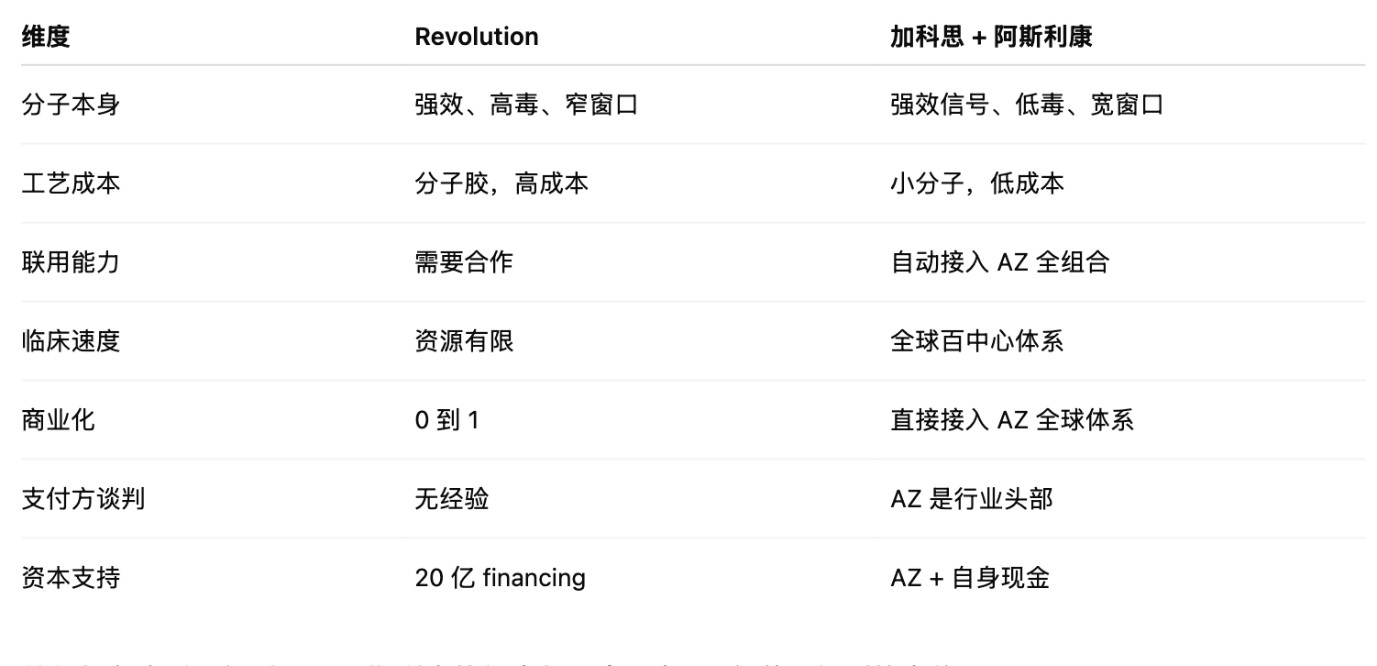
Core Viewpoint - The competition in the KRAS inhibitor space has shifted from a molecular comparison between Revolution Medicines' RMC-6236 and Adagene's JAB-23E73 to a broader corporate competition between AstraZeneca and Revolution Medicines [2][3]. Group 1: Molecular Comparison - RMC-6236 targets KRAS, HRAS, and NRAS but has significant toxicity issues, with a nearly 90% incidence of rash and 34% of patients experiencing grade 3 or higher treatment-related adverse events (TRAE) in a second-line setting [3][4]. - In contrast, JAB-23E73, still in early development, has shown a cleaner safety profile with no observed dose-limiting toxicities and only grade 1 skin toxicity reported [3][4]. - AstraZeneca's acquisition of JAB-23E73 enhances its potential in combination therapies, as a safer molecule is more likely to succeed in the competitive KRAS landscape [3][6]. Group 2: AstraZeneca's Strategic Position - AstraZeneca has been searching for a KRAS inhibitor for over a decade, previously attempting to develop other KRAS inhibitors that did not progress [5]. - The acquisition of JAB-23E73 fills a critical gap in AstraZeneca's oncology pipeline, positioning it to leverage its extensive resources for clinical development and commercialization [5][6]. - AstraZeneca's goal is to establish JAB-23E73 as a foundational treatment in combination therapies, requiring a broad safety window to withstand the toxicity of various treatment combinations [5][6]. Group 3: Resource Competition - The competition is not just about molecular efficacy but also about the resources available for clinical development, with AstraZeneca having significant financial and operational advantages over Revolution Medicines [7][8]. - AstraZeneca's established global clinical network allows it to conduct multiple phase III trials simultaneously, a capability that Revolution Medicines lacks due to its smaller scale [8][9]. - The financial disparity is stark, with AstraZeneca's revenue exceeding $50 billion and a strong growth trajectory in oncology, while Revolution Medicines has limited cash reserves [7][9]. Group 4: Manufacturing and Cost Considerations - RMC-6236's complex synthesis and high production costs pose challenges for commercialization, potentially leading to pricing pressures and supply chain risks [10]. - JAB-23E73, being a traditional small molecule, offers lower production costs and greater scalability, making it more suitable for widespread use [10]. Group 5: Market Valuation Discrepancies - The market currently values Revolution Medicines at approximately $15 billion, while Adagene's valuation is around HKD 7 billion, reflecting a significant disparity in perceived value [12]. - This valuation gap may stem from outdated perceptions, as the integration of JAB-23E73 into AstraZeneca's portfolio transforms its value proposition from a standalone molecule to a critical component of a larger therapeutic strategy [12]. Group 6: Future Implications - The true value of a drug target like KRAS lies not in the first successful inhibitor but in the ability to establish it as a standard treatment [13][14]. - The collaboration between Adagene and AstraZeneca could lead to significant advancements in cancer treatment, potentially impacting a large patient population and marking a milestone in cancer therapy [15].