
Leveraged Finance

Search documents
History Has Already Shown Us How Private Credit Challenges Played Out the Last Time.
Investment Moats· 2026-03-26 00:16
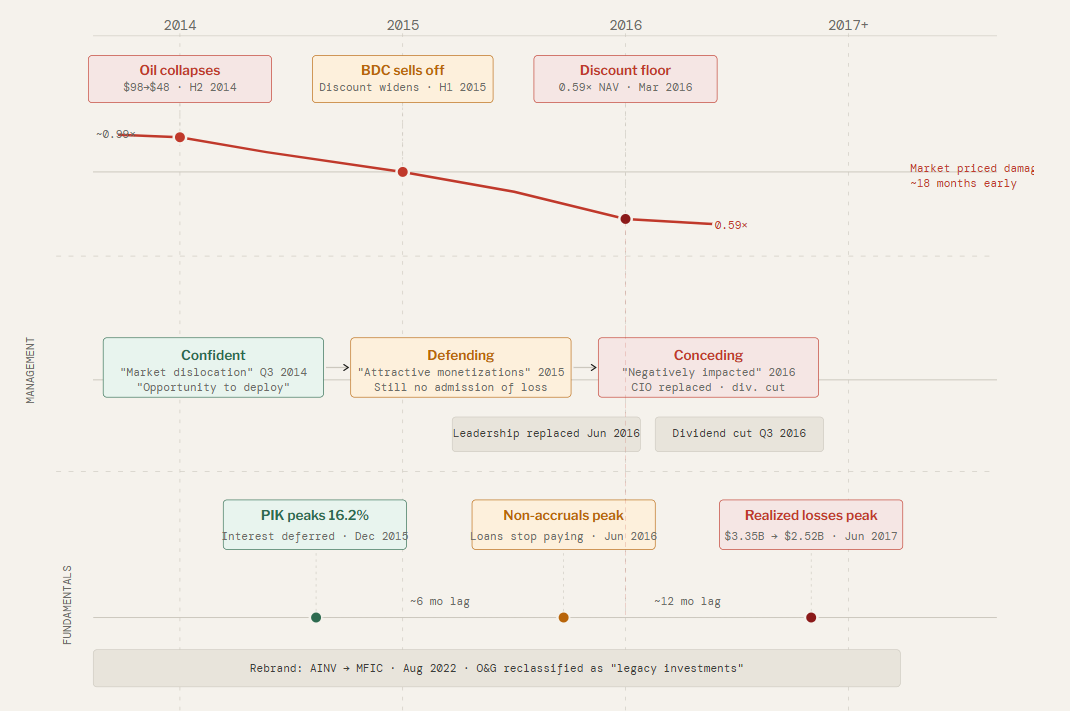
Core Insights - The article discusses the historical relationship between private credit and the energy sector, particularly shale oil and gas, before the current focus on software companies [1][2] - It highlights the significant borrowing by U.S. energy companies during the shale boom, with high yield energy issuance reaching approximately $290 billion from 2008 to 2014 [2] - The article draws parallels between the challenges faced by energy companies during the oil price collapse and the current situation of software companies in private credit [3] Group 1: Historical Context - During the shale boom, energy companies were major users of leveraged finance, with their weight in the high-yield index increasing from 10% to nearly 15% by 2014 [2] - The collapse of oil prices from $98 per barrel to $48 per barrel severely impacted shale producers, leading to increased risk for lenders [3] Group 2: Apollo's Role - Apollo, a significant alternative asset manager, had substantial exposure during the energy price trauma through its private credit lending corporation, Apollo Investment Corporation (AINV), which was later renamed MidCap Financial Investment Corporation (MFIC) [4][5] - The price of AINV declined by 48% from 2014 to 2016, reflecting the volatility and challenges faced by investors in the sector [6] Group 3: Investment Dynamics - MFIC had 17% of its portfolio exposed to the oil and gas sector at its peak, providing insights into potential future scenarios for private credit investors [7] - The article discusses the progression of interest payments and the eventual realization of losses when borrowers cannot meet their obligations [8] Group 4: Investor Experience - Investors who remained invested in AINV since 2013 experienced a 9% distribution yield initially, but faced capital losses, resulting in an overall return of approximately 2% per annum after 12 years [11][12] - The article emphasizes the psychological aspects of investing, noting that discomfort is a common experience and that investors often misinterpret their returns [10][15] Group 5: Broader Implications - The article suggests that discomfort in investing is inevitable, and investors should be aware of the historical patterns and management responses during challenging times [14] - It highlights the importance of understanding the range of potential returns and the psychological factors influencing investor behavior [15]


JPM's O'Donnell Expects a Pickup in M&A Activity
Bloomberg Television· 2026-03-02 16:24
I am here at the JPMorgan Leveraged Finance Conference with someone who is a star here, Katherine O'Donnell, who is the head of North America leveraged finance and has a ton of meetings. Katherine, thank you so much for being with us. I want to start with the news of the day, which is clearly the question around the war in Iran and what that sort of percolating into the Middle East is going to do for fund raising for for companies being able to issue currently.Do you see a sort of hesitance to really start ...

CoreWeave (NasdaqGS:CRWV) 2025 Conference Transcript
2025-12-02 22:52
CoreWeave 2025 Conference Summary Company Overview - **Company**: CoreWeave (NasdaqGS:CRWV) - **Industry**: AI Infrastructure and Cloud Computing - **Role**: CoreWeave is positioned as an AI hyperscaler, providing high-performance compute and cloud-ready infrastructure specifically for AI workloads, serving major companies and AI labs [7][12][68]. Key Points and Arguments Infrastructure and Technology - CoreWeave focuses on delivering high-performance compute capabilities, utilizing advanced infrastructure that is specifically designed for AI workloads, including liquid cooling systems for high-density servers [8][9]. - The proprietary software, CoreWeave Mission Control, is a critical differentiator, enabling active health management of clusters and maximizing performance [9][10]. Investment Thesis - **Bull Case**: The infrastructure provided by CoreWeave is deemed mission-critical for the future of AI, with a strong belief from customers in the necessity of their services [12]. - **Customer-Led CapEx**: Capital expenditures are closely tied to customer contracts, ensuring that investments are not speculative but rather based on confirmed demand [13][14]. Customer Contracts and Renewals - CoreWeave has seen successful renewals of contracts, including a significant renewal of a 10,000 GPU cluster at a price close to the original, indicating strong demand for their services [14][16]. - Inference workloads, which require more GPUs than training, are expected to drive continued demand, countering concerns about potential oversupply as clients transition from training to inference [20]. Financial Performance and Guidance - The company lowered its revenue guidance for 2025 by $100 million to $200 million due to construction delays of a data center, impacting operating income guidance as well [35][39]. - Despite these adjustments, CoreWeave is still expected to bring on significant power capacity, indicating ongoing growth potential [40]. Debt Structure and Financing - CoreWeave employs a contract-first financing approach, raising capital based on signed customer contracts, which mitigates risks associated with capital expenditures [52][53]. - The company has a diverse set of balance sheets through various Special Purpose Vehicles (SPVs) that support different contracts, ensuring that debt is self-amortizing at the SPV level [55]. Market Position and Future Outlook - CoreWeave is optimistic about the demand for its services, citing strong performance from major customers and a favorable supply-demand dynamic in the market [67][68]. - The company aims to achieve investment-grade status, which will enhance its ability to raise capital and support its growth trajectory [32][66]. Additional Insights - CoreWeave's strategy includes a focus on both strategic and opportunistic acquisitions, with a notable interest in building and owning data centers as its credit profile improves [28]. - The company is actively diversifying its customer base, reducing reliance on a few large clients, which enhances its stability and growth prospects [30]. This summary encapsulates the key points discussed during the CoreWeave conference, highlighting the company's strategic positioning, financial outlook, and market dynamics.


Option Care Health, Inc. (OPCH) Presents at Bank of America Leveraged Finance Conference Transcript
Seeking Alpha· 2025-12-02 18:13
Core Insights - Option Care Health is the leading home and alternate site infusion provider in the United States, operating over 90 full-service pharmacies and covering 96% of the population [3]. Group 1: Business Overview - The company infuses patients both in their homes and in over 700 alternate site suites, providing a full network of therapies for both acute and chronic conditions [3]. - Despite disruptions in 2024 due to events like hurricanes and supply chain shortages, the company has made significant progress and is optimistic about its performance [2]. Group 2: Market Position - Option Care Health's mission is to serve healthcare needs effectively, positioning itself as a critical player in the infusion services market [3].


X @Bloomberg
Bloomberg· 2025-11-18 21:50
Financial Activities - Genmab 完成了自四月以来美国杠杆融资市场最大规模的收购融资,总额达 45 亿美元 [1] - 融资方式包括垃圾债券和杠杆贷款 [1]
X @Bloomberg
Bloomberg· 2025-10-22 13:54
Market Monitoring - The Bank of England is "closely monitoring" standards in leveraged finance markets [1] - The Bank of England is watching out for signs of forced selling by investors [1] Risk Assessment - Monitoring is occurring after the high-profile collapse of two US companies [1]
摩根士丹利:全球信用投资手册_顺势而为
摩根· 2025-06-30 01:02
Investment Rating - The report does not explicitly provide an investment rating for the industry but discusses various credit spreads and return forecasts for different segments, indicating a cautious outlook on high-yield (HY) and leveraged loans while favoring investment-grade (IG) credit [5][61][72]. Core Insights - The report emphasizes a yield-driven market for global investment-grade credit, with expectations for spreads to remain stable or widen modestly in high-yield and leveraged loan segments due to slower global growth and sticky inflation [5][61][72]. - It highlights the divergence in economic forecasts, with the US and Euro Area experiencing low growth and inflation pressures, while Asia is expected to face wider spreads due to trade risks and high valuations [9][10][81]. - The report suggests a preference for quality over cyclicality in credit investments, indicating that investors may be better compensated for taking duration risk rather than cyclical risk in the current environment [30][32][39]. Summary by Sections Global Credit Outlook - Global investment-grade credit remains attractive due to good yields, with a preference for 5-10 year maturities in the US and 15 years or more in Europe [5][61]. - High-yield spreads are expected to widen modestly, reflecting slower growth and increasing default rates, with a forecast of 3.5% for high-yield defaults [61][72]. Macro Economic Forecasts - The report forecasts US GDP growth at 1.0% for 2025, with core inflation at 3.3%, and no Federal Reserve rate cuts expected this year [10][11]. - Euro Area growth is projected at 0.8% with core inflation at 2.2%, while China is expected to grow at 4.0% with minimal inflation [10]. Sector-Specific Insights - In the US, investment-grade credit is expected to see excess returns of 2.1%, while high-yield is forecasted at 3.6% [61]. - European investment-grade credit is projected to have a total return of 2.0% in the base case, with high-yield expected to yield 4.9% [72]. Asia Credit Outlook - Asia's investment-grade spreads are anticipated to widen to 100 basis points, reflecting concerns over weaker growth and tariff uncertainties [81][83]. - The report indicates a preference for non-China investment-grade credit due to expected tariff impacts on China [84][85].