Long context

Search documents
姚顺雨对着唐杰杨植麟林俊旸贴大脸开讲!基模四杰中关村论英雄
量子位· 2026-01-10 13:17
Core Viewpoint - The AGI-Next summit organized by Tsinghua University highlights the rapid advancements in AI, emphasizing the transition from conversational AI to task-oriented AI, indicating a significant shift in the AI landscape [4][34]. Group 1: Key Insights from Speakers - Tang Jie stated that with the emergence of DeepSeek, the era of chatbots is largely over, and the focus should now be on actionable AI [7]. - Yang Zhilin emphasized that creating models is fundamentally about establishing a worldview [7]. - Lin Junyang expressed skepticism about China's ability to overtake in the AI race, suggesting that a 20% improvement in capabilities would be optimistic [7]. - Yao Shunyu noted that most consumers do not require highly intelligent AI for everyday tasks [7]. Group 2: Development Trajectory of Large Models - The development of large models has progressed from solving simple tasks to handling complex reasoning and real-world programming challenges, with expectations for continued improvement by 2025 [18][21]. - The evolution of models reflects human cognitive development, moving from basic reading and arithmetic to complex reasoning and real-world applications [19]. - The introduction of HLE (Human-Level Evaluation) tests models on their generalization capabilities, with many questions being beyond the reach of traditional search engines [20]. Group 3: Challenges and Innovations in AI - Current challenges include enhancing models' generalization abilities and transitioning from scaling to true generalization [22][25]. - The path to improving generalization involves scaling, aligning models with human intentions, and enhancing reasoning capabilities through reinforcement learning [28][29]. - The introduction of RLVR (Reinforcement Learning with Verified Rewards) aims to allow models to explore autonomously and improve through verified feedback, addressing the limitations of human feedback [29]. Group 4: Future Directions and Expectations - The future of AI development will focus on multi-modal capabilities, memory structures, and self-reflective abilities, which are essential for achieving AGI [59][61][64]. - The integration of self-learning mechanisms is seen as crucial for models to adapt and improve continuously [69][73]. - The exploration of new paradigms beyond scaling is necessary to achieve breakthroughs in AI capabilities [89]. Group 5: Open Source and Global Positioning - The open-source movement in China has gained significant traction, with many models emerging as influential in the global landscape [53]. - The ongoing development of models like KimiK2 aims to establish new standards in AI, particularly in agent-based tasks [110]. - The emphasis on creating a diverse range of models reflects a commitment to advancing AI technology while addressing various application needs [125][134].



杨植麟揭秘Kimi预训练策略:提升Token efficiency,实现长文本
Xin Lang Cai Jing· 2026-01-10 12:09
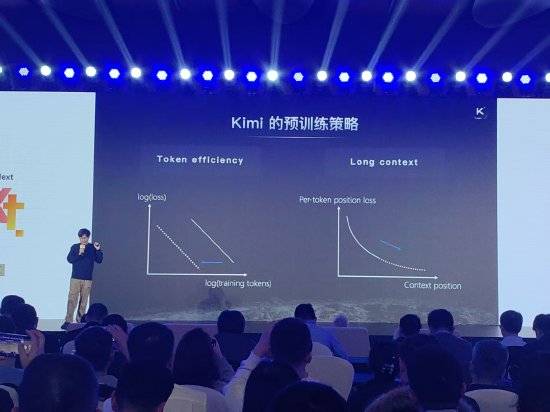
Core Insights - The core focus of the article is on the strategies for pre-training AI models, specifically emphasizing Token Efficiency and Long Context as critical components for enhancing performance in complex tasks [2][6]. Group 1: Token Efficiency - Token Efficiency is crucial because the reasoning or training of agents is fundamentally a search process, where better pre-training reduces the search space and enhances prior knowledge [3][7]. - The importance of Token Efficiency is highlighted by the need for AI to develop complex systems, such as an operating system, without enumerating every possible token combination, which may be meaningless or incorrect [7]. Group 2: Long Context - The architecture of Transformers shows significant advantages in long context scenarios, with experiments indicating that performance drops below LSTM when context length exceeds 1000 tokens, underscoring the importance of context length in model design [2][6]. - In the current Agentic era, many tasks require long contexts to execute complex instructions, making architectures with lower positional loss more technically capable [2][6]. Group 3: Aesthetic Considerations in AI - The development of AI models is not just a technical challenge but also involves aesthetic considerations, where the creation of a model reflects a worldview and values, akin to the concept of "Taste" as articulated by influential figures like Steve Jobs [3][7]. - Each model generates unique tokens that are not interchangeable, indicating that intelligence produced by different roles (e.g., a CEO vs. a designer) varies significantly, leading to an exponential increase in the space of possible "Tastes" [4][8].