Machine Legibility

Search documents
a16z“2026年AI Agent三大猜测”:输入框的消失,代理使用优先,语音代理的崛起
硬AI· 2025-12-23 09:24
Core Insights - AI is evolving from a passive tool to an active agent capable of executing tasks autonomously, marking a significant shift in the software and labor market [2][3][4] Group 1: Predictions on AI Evolution - The input box as the primary user interface for AI applications is predicted to disappear by 2026, with AI proactively intervening based on user behavior [4][13] - The market opportunity for AI is expanding from $400 billion in software spending to $13 trillion in labor spending, increasing the potential market size by approximately 30 times [4][15] - Future AI applications are envisioned to function like top-performing employees, identifying problems, diagnosing issues, and proposing solutions for human approval [4][16] Group 2: Design and Interaction Changes - Software design will shift from being human-centric to agent-centric, prioritizing machine legibility over visual optimization [8][20] - The focus will move from attracting human attention to generating content that is optimized for AI agents, potentially leading to an increase in low-quality, high-frequency content [8][21] Group 3: Rise of Voice AI - Voice AI is transitioning from a conceptual technology to a widely adopted solution in various sectors, including healthcare and finance, due to its reliability and compliance capabilities [11][22] - In the banking and financial services sector, voice AI is outperforming humans in compliance adherence, making it a valuable tool for these industries [11][22] - The voice AI market is expected to grow significantly, with applications in government services and consumer health, indicating a shift towards a more integrated voice AI industry rather than isolated markets [24][26]


a16z“2026年AI Agent三大猜测”:输入框的消失,代理使用优先,语音代理的崛起
Hua Er Jie Jian Wen· 2025-12-23 03:09
Core Insights - The evolution of AI technology is transitioning from a passive chat tool to an active agent capable of executing tasks autonomously [1] - Three major predictions were made regarding the transformation of industries: the disappearance of input boxes, a shift towards agent-first product design, and the rise of voice agents [1][8] Group 1: Disappearance of Input Boxes - By 2026, input boxes as the primary user interface for AI applications are expected to vanish, with future applications observing user behavior and proactively offering actionable solutions [2] - The market opportunity for AI is projected to expand approximately 30 times, shifting focus from $400 billion in global software spending to $13 trillion in labor spending in the U.S. [2][12] - Future AI applications are envisioned to function like top-tier employees, identifying problems, diagnosing root causes, and implementing solutions before seeking human approval [2][11] Group 2: Agent-First Design - Software design will transition from being human-centric to agent-centric, emphasizing machine legibility over visual hierarchy [5][17] - The optimization of content creation will shift towards generating high-frequency, hyper-personalized content tailored for AI agents rather than human attention [5][18] - This change will significantly impact various aspects of product development and content creation, moving away from traditional user interface designs [5][16] Group 3: Rise of Voice Agents - Voice agents are beginning to play a significant role in various industries, particularly in healthcare, banking, and recruitment, due to their reliability and compliance capabilities [8][19] - In the banking and financial services sector, voice AI is noted to outperform humans in compliance adherence, making it a valuable asset [8][19] - The voice AI sector is evolving into a comprehensive industry, with opportunities across the entire value chain, from foundational models to platform-level applications [8][20]

AI Agents in 2026 | 3 Predictions For What’s To Come (a16z Big Ideas)
a16z· 2025-12-22 14:01
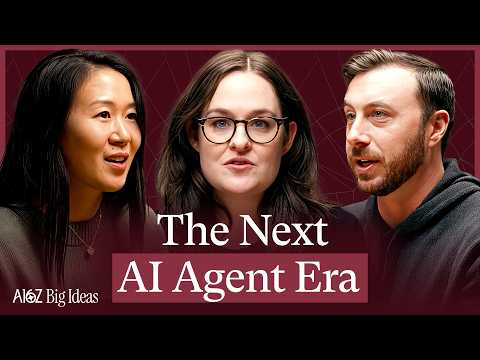
Welcome to Big Ideas for 2026. We'll hear from Mark Andrew on the evolution of AI user interfaces and how the way we interact with intelligent systems is fundamentally changing. Stephanie Zayn discusses what it means to design for agents rather than humans, a shift that's reshaping product development.And Olivia Moore will share her thoughts on the rise of AI voice agents and their growing role in our daily lives. These aren't just predictions. They're insights from the people working directly with the foun ...