Model Fusion

Search documents
走向融合统一的VLA和世界模型......
自动驾驶之心· 2025-12-23 09:29
Core Viewpoint - The article discusses the integration of two advanced directions in autonomous driving: Vision-Language-Action (VLA) and World Model, highlighting their complementary nature and the trend towards their fusion for enhanced decision-making capabilities in autonomous systems [2][51]. Summary by Sections Introduction to VLA and World Model - VLA, or Vision-Language-Action, is a multimodal model that interprets visual inputs and human language to make driving decisions, aiming for natural human-vehicle interaction [8][10]. - World Model is a generative spatiotemporal neural network that simulates future scenarios based on high-dimensional sensor data, enabling vehicles to predict outcomes and make safer decisions [12][14]. Comparison of VLA and World Model - VLA focuses on human interaction and interpretable end-to-end autonomous driving, while World Model emphasizes future state prediction and simulation for planning [15]. - The input for VLA includes sensor data and explicit language commands, whereas World Model relies on sequential sensor data and vehicle state [13][15]. - VLA outputs direct action control signals, while World Model provides future scene states without direct driving actions [15]. Integration and Future Directions - Both technologies share a common background in addressing the limitations of traditional modular systems and aim to enhance autonomous systems' cognitive and decision-making abilities [16][17]. - The ultimate goal for both is to enable machines to understand environments and make robust plans, with a focus on addressing corner cases in driving scenarios [18][19]. - The article suggests that the future of autonomous driving may lie in the deep integration of VLA and World Model, creating a comprehensive system that combines perception, reasoning, simulation, decision-making, and explanation [51]. Examples of Integration - The article mentions several research papers that explore the fusion of VLA and World Model, such as 3D-VLA, which aims to enhance 3D perception and planning capabilities [24][26]. - Another example is WorldVLA, which combines action generation with environmental understanding, addressing the semantic and functional gaps between the two models [28][31]. - The IRL-VLA framework proposes a closed-loop reinforcement learning approach for training VLA models without heavy reliance on simulation, enhancing their practical application [34][35]. Conclusion - The article concludes that the integration of VLA and World Model is a promising direction for the next generation of autonomous driving technologies, with ongoing developments from various industry players [51].

教AI「择偶生娃」,复刻自然演化,上交校友提名最佳论文
3 6 Ke· 2025-08-27 02:46
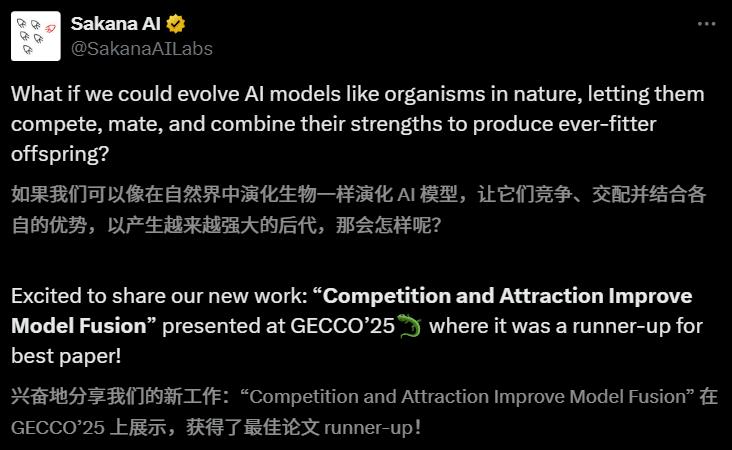
Core Insights - Sakana AI introduces a novel model merging approach inspired by natural evolution, termed M2N2, which incorporates a "mate selection mechanism" to enhance AI model fusion [1][5][6] - The company draws parallels between AI model development and natural evolution, advocating for a diverse ecosystem of specialized AI models that compete, cooperate, and merge [3][5] - M2N2 has been recognized for its innovative approach, receiving a best paper nomination at the GECCO 2025 conference [3] Group 1: M2N2 Methodology - M2N2 allows for more flexible model combinations by breaking predefined static boundaries, expanding the exploration space for model fusion [5][7] - The method mimics natural competition, encouraging models to specialize and find their "niche" within a diverse population, ultimately leading to a higher quality of model offspring [5][6] - A heuristic "attraction" mechanism is introduced, pairing models based on complementary strengths, significantly improving the efficiency of evolutionary searches and reducing computational costs [6][7] Group 2: Experimental Results - M2N2 has shown superior performance in various experiments, including the evolution of an MNIST classifier, outperforming other evolutionary algorithms in terms of accuracy and computational efficiency [11][19] - In experiments involving large language models (LLMs) and image generation models, M2N2 demonstrated significant advantages, particularly in maintaining high training coverage and avoiding catastrophic forgetting [25][26] - The results indicate that M2N2 not only enhances model performance but also retains the ability to understand multiple languages effectively, showcasing its potential for cross-domain applications [31][33] Group 3: Future Implications - The research suggests that models evolving together will face strong evolutionary pressure to maintain compatibility for successful fusion, which could lead to insights into the dynamics of model co-evolution [34] - Defining compatibility metrics could enhance the success rate of model fusion, allowing for better control during preprocessing and fine-tuning stages [34]