Multi - Agent Systems

Search documents
AI Agent如何实现商业化?
Xin Lang Cai Jing· 2026-02-14 08:31
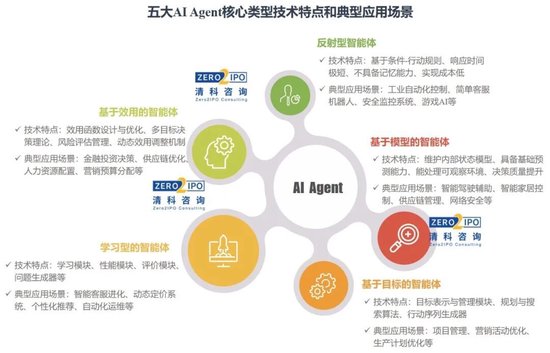
Core Insights - AI Agents are evolving from technical tools to new production factors, marking a critical phase for industry development and increasing investment interest [1][8] - The Chinese government aims for over 90% penetration of new generation AI applications by 2030, indicating a broad market potential for AI Agents [8][34] - The global AI Agent market is projected to grow from $5.1 billion in 2024 to $47.1 billion by 2030, with a CAGR of 44.8% [8][34] Group 1: AI Agent Definition and Characteristics - AI Agents are defined as autonomous or semi-autonomous software entities that perceive, decide, and act to achieve business goals, emphasizing autonomy, interactivity, and adaptability [2][3] - The "perception-decision-action" loop in AI Agents is powered by large models, which provide essential capabilities like dialogue and logical reasoning, although they lack autonomous action [3][29] - AI Agents can be categorized into five core types: reflex agents, model-based agents, goal-based agents, utility-based agents, and learning agents, each serving different applications [5][31] Group 2: Market Growth and Policy Support - The AI Agent industry is structured into three layers: foundational technologies, platform development, and application layers, with significant growth expected in enterprise and consumer applications [7][33] - The Chinese government's policies are driving rapid growth in the AI Agent market, with a focus on integrating AI into various sectors, including manufacturing [8][34] - Market forecasts indicate that by 2026, the proportion of enterprise applications integrating task-specific AI agents will rise from under 5% to 40% [8][34] Group 3: Competitive Landscape and Business Models - The AI Agent market features diverse players, including AI-native platform providers, tech giants, large model vendors, vertical solution providers, and traditional enterprises undergoing digital transformation [9][35] - Main business models in the AI Agent field include SaaS subscription, platform ecosystem, and customized enterprise services, each with distinct advantages [16][41] - The competition is intensifying, with companies focusing on integrating AI capabilities into existing products and developing specialized agents for various industries [15][40] Group 4: Application Areas and Demand Differentiation - AI Agents are being deployed across various sectors, including media, customer support, finance, and software development, with significant value realized in customer service and data analysis [19][44] - Different industries exhibit distinct needs for AI Agents, with manufacturing focusing on efficiency, finance on risk control, and healthcare on diagnostic accuracy [22][47] - The trend is shifting towards specialized AI Agents that cater to specific industry requirements, enhancing their effectiveness and value [22][47] Group 5: Investment Trends and Challenges - Investment in the AI Agent sector has surged since 2025, with notable funding rounds and acquisitions highlighting the growing interest in this space [48][49] - The investment focus is shifting from general platforms to specialized agents in vertical industries, with a preference for companies with established customer bases and positive cash flow [49] - Challenges remain in the commercialization of AI Agents, including technical limitations, integration difficulties, and emerging security risks [26][52]

硅谷顶尖风投 a16z 2026 大构想:从 AI 到现实世界的全面重塑
3 6 Ke· 2025-12-19 07:43
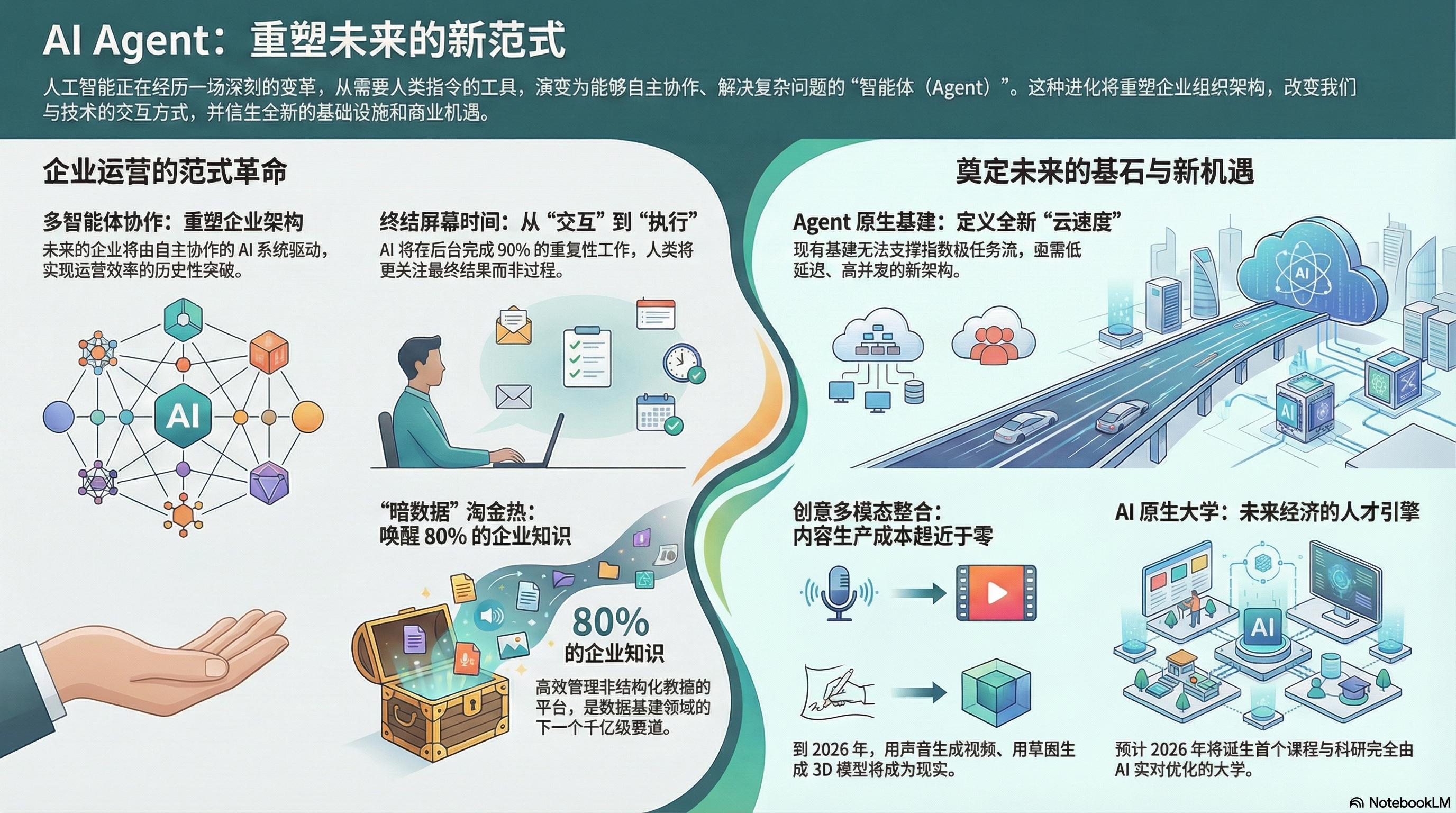
Group 1 - AI is evolving from "digital assistants" to "autonomous execution clusters," with a significant transition expected by 2026 towards multi-agent systems that will redefine operational leverage for enterprises [1][2][7] - The integration of electrification, materials science, and AI is creating an "electro-industrial stack" that will serve as the foundational logic for the physical world, leading to a renaissance in American manufacturing [1][2][21][22] - SaaS is shifting from passive data recording to proactive reasoning, enabling personalized services that cater to individual needs rather than a one-size-fits-all approach [1][2][13][14] Group 2 - The future of enterprise software will be driven by multi-agent systems that can understand instructions and manage complex workflows collaboratively, resulting in significant increases in per-employee revenue [7] - AI is expected to automate 90% of repetitive tasks, shifting investment focus from user engagement metrics to the quality of automated task completion [8] - The emergence of platforms that can efficiently manage unstructured data will be crucial for enterprise knowledge management, representing a potential multi-billion dollar market [8] Group 3 - The rise of AI-driven cybersecurity will automate repetitive tasks, allowing security teams to focus on deeper vulnerabilities and crime tracking [10] - Creative tools will integrate across modalities, drastically reducing content production costs and enabling users to generate complex outputs from simple inputs [10] - The concept of an AI-native university is anticipated, which will optimize its curriculum and research collaboration in real-time, indicating a transformation in education and workforce development [10] Group 4 - The "electrification revival" of American factories is being driven by software and AI, enabling efficient production processes akin to assembly lines [21] - The integration of software with physical automation will redefine industrial capabilities, allowing for rapid production of complex products [21][22] - Countries and companies that master the electrification supply chain will hold strategic advantages in future industrial and military technologies [24] Group 5 - The future of healthcare will focus on preventive services, leveraging AI to manage health proactively, which presents a lucrative subscription-based business model [25] - Cryptocurrencies are expected to evolve, with privacy becoming a key competitive factor and stablecoins emerging as the foundational layer for global payments [27][29] - Decentralized networks will transform communication methods, enhancing user privacy and control over information [30]
Why Every AI Agent Will Likely Run On Microsoft
Seeking Alpha· 2025-07-13 10:51
Group 1 - The AI landscape is evolving from basic single-model applications to complex multi-agent systems that resemble human organizational structures [1] - Companies are increasingly utilizing multiple AI systems rather than relying on a single AI to perform all tasks [1] Group 2 - The focus is on long/short equity strategies, emphasizing deep fundamental analysis to identify undervalued stocks for long positions and overvalued stocks for short positions in global equity markets [1] - Detailed financial models are constructed using discounted cash flow (DCF), relative valuation, and scenario analysis to assess company fundamentals, growth potential, and risks [1] - High-conviction investment recommendations are delivered through comprehensive research, contributing to alpha generation for the fund [1] - Market trends, sector dynamics, and macroeconomic factors are monitored to adjust strategies and optimize portfolio performance in real time [1] - Collaboration with the Portfolio Manager is essential for sizing positions, managing risk exposure, and addressing challenges such as short squeezes or market volatility [1]