Next - State Prediction(NSP)

Search documents
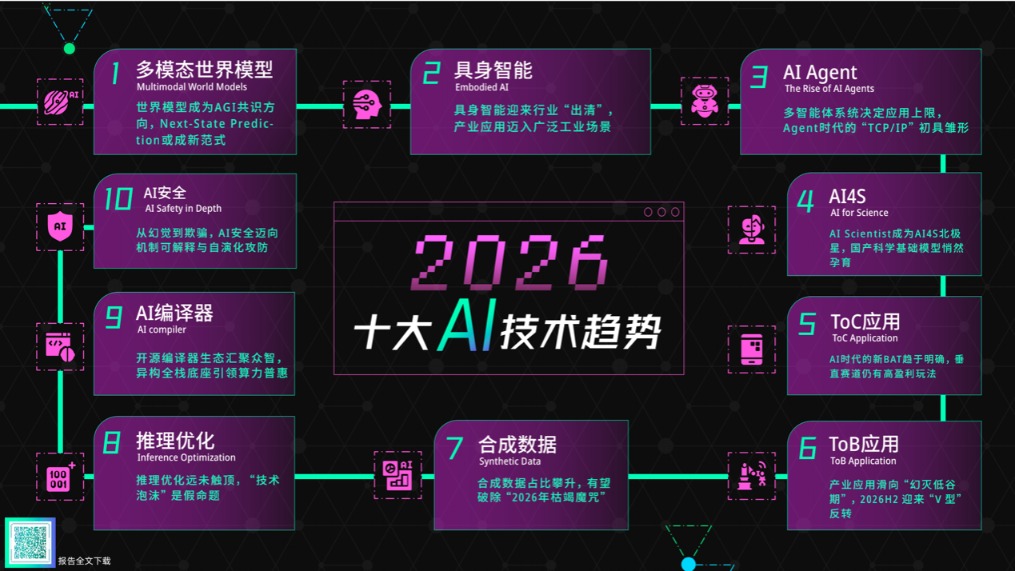
报告:2026年将是AI从技术演示走向规模价值的关键分水岭
Zhong Zheng Wang· 2026-01-09 07:30
Core Insights - The evolution of artificial intelligence (AI) is shifting from a focus on parameter scale in language learning to a profound understanding and modeling of the underlying order of the physical world, indicating a paradigm shift in industry technology [1][2] Group 1: AI Development Trends - AI is transitioning from functional imitation to understanding the laws of the physical world, marking a clear development path that integrates into the real world to address systemic challenges [1] - The competition in foundational models has shifted from "how large the parameters are" to "whether it can understand how the world operates," indicating a new paradigm represented by "Next-State Prediction" (NSP) [1] Group 2: Key Drivers of AI Transition - The year 2026 is identified as a critical watershed for AI, moving from the digital world to the physical world and from technical demonstrations to scalable value, driven by three clear mainlines [2] - The first mainline is the "upgrading" of cognitive paradigms, where AI begins to learn physical laws, providing a new cognitive foundation for complex tasks like autonomous driving simulation and robot training [2] - The second mainline involves the embodiment and socialization of intelligence, with AI moving from software to physical entities and from individual units to collaborative systems [2] - The third mainline focuses on the "dual-track application" of value realization, where super application portals are forming in the consumer sector, and AI is generating measurable commercial value in vertical industries through better data governance and industry standard interfaces [2]
智源研究院发布2026十大AI技术趋势报告
Zheng Quan Ri Bao· 2026-01-09 06:40
Core Insights - The report from Beijing Zhiyuan Artificial Intelligence Research Institute highlights a significant shift in AI evolution from parameter scale in language learning to a profound understanding and modeling of the physical world [1][2] - The transition marks a move from functional imitation to understanding the laws of the physical world, indicating a clearer development path for AI that integrates into the real world to address systemic challenges [1] Group 1: Key Trends in AI - The competition in foundational models has shifted focus from "how large the parameters are" to "whether it can understand how the world operates" [1] - The new paradigm represented by "Next-State Prediction" (NSP) is pushing AI from "perception" in the digital space to "cognition" and "planning" in the physical world [1] Group 2: Driving Forces Behind the Transition - The transition to 2026 is driven by three clear main lines: the "upgrading" of cognitive paradigms, where AI begins to learn physical laws, providing a new cognitive foundation for complex tasks like autonomous driving simulation and robot training [2] - The "embodiment" and "socialization" of intelligent forms, where intelligence is moving from software to physical entities, with humanoid robots entering real production scenarios [2] - The "dual-track application" for value realization, where a super application portal is forming on the consumer side, and on the enterprise side, AI is yielding measurable commercial value products in vertical fields after the initial concept validation phase [2]