
Partial electrification

Search documents
Ford CEO Jim Farley knew the EV pain would be bad but the 'punch line' is a $4.8 billion loss
Fortune· 2026-02-12 16:40
Core Viewpoint - Ford Motor Company is experiencing significant challenges in its electric vehicle (EV) segment, with CEO Jim Farley predicting a substantial decline in EV market share due to the expiration of federal tax credits, which could reduce EV sales to 5% of the industry from the current 10% to 12% [1][2] Financial Performance - Ford reported a $4.8 billion operating loss for its Model E electric vehicle unit, with expectations of an additional loss of $4 billion to $4.5 billion in 2026, pushing the break-even target to 2029 [1] - The company anticipates approximately $7 billion in special charges over 2026 and 2027 related to the transition away from its previous EV strategy [5] Market Strategy - Ford is shifting its focus to the "high volume, affordable end of the market," specifically targeting the $30,000 to $35,000 price range for EVs, contrasting with the previous focus on higher-priced electric trucks and SUVs [4] - The company is moving away from building EVs solely to meet regulatory targets, emphasizing a more consumer-driven approach [3] Consumer Trends - There is a growing consumer preference for "partial electrification," with hybrids gaining popularity over pure EVs, now accounting for over 20% of Ford's U.S. sales mix [7] - JD Power reported that affordability remains a significant pressure in the car sales market, with average monthly finance payments reaching $760, contributing to depressed EV retail sales [6] Operational Strengths - Ford's commercial division, Ford Pro, generated $6.8 billion in EBIT for the year, helping to subsidize losses from the electric vehicle segment [6] Political and Economic Environment - The current political landscape is volatile, with Ford acknowledging a partnership with the administration and a reset in emission standards as key factors for 2026 [8] - The company faced an unexpected $1 billion hit in the fourth quarter due to late-year changes in tariff credits for auto parts, complicating its financial outlook [9]


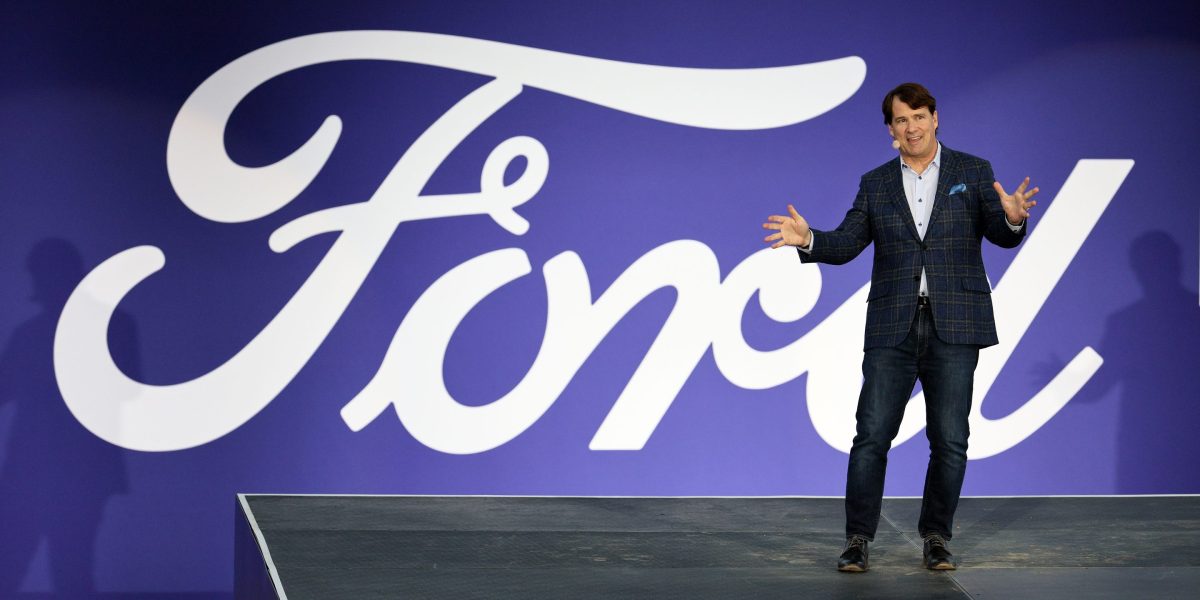
Ford CEO says Trump killing off the EV tax credit could cut the industry in half: ‘way smaller than we thought’
Yahoo Finance· 2025-09-30 19:57
Core Insights - The expiration of the federal electric vehicle (EV) tax credit marks the end of a 17-year policy that significantly aided EV adoption and reduced the price gap with gasoline vehicles [1] - The immediate consequences include reduced demand for EVs, streamlined production, and a shift in strategy by traditional automakers towards hybrids and profitable internal combustion engine (ICE) models [1] - Ford's CEO predicts a substantial decline in EV market share, potentially dropping to 5% from the current 10-12% due to the removal of the $7,500 consumer incentive [3] Industry Impact - The end of the subsidy is causing structural changes, leading to a surplus in battery production and halted factory plans, which could jeopardize future supply if production capacity is reduced too much [2] - The recent surge in demand before the subsidy expiration is expected to be followed by a significant drop in sales in Q4 as consumers reassess the value of EVs without the tax credit [5] Consumer Behavior - Consumers show a preference for more affordable vehicles, with a noted disinterest in high-priced EVs, indicating a shift towards hybrid and partial electrification solutions [4] - The removal of the tax credit has led to a pause in consumer purchasing decisions as they evaluate financing options and the overall value of EVs [5]
Ford CEO expects EV sales to be cut in half after end of tax credits
CNBC· 2025-09-30 15:37
Core Insights - Demand for all-electric vehicles is expected to drop significantly after the end of federal tax incentives, with projections indicating a decrease in market share from approximately 10%-12% to around 5% [1][2] Industry Outlook - The electric vehicle industry is anticipated to be vibrant but smaller than previously expected due to policy changes regarding tailpipe emissions and the removal of the $7,500 consumer incentive [2] - The industry has learned that "partial electrification," such as hybrids, is currently more acceptable to consumers [2] Company Strategy - The company is actively analyzing daily demand for non-gas-powered vehicles, indicating a focus on understanding market trends [3] - The company offers several all-electric vehicles, including the F-150 Lightning pickup, which has a price point exceeding $90,000, and the Mustang Mach-E crossover [3]