PeV粒子加速器

Search documents
高海拔宇宙线观测站破解宇宙线“膝”形成之谜
Huan Qiu Wang Zi Xun· 2025-11-19 03:54
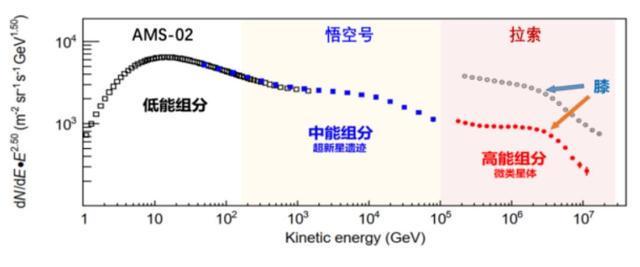
Core Insights - The recent findings from the LHAASO (Large High Altitude Air Shower Observatory) reveal that microquasars driven by black hole accretion are powerful particle accelerators in the Milky Way, capable of accelerating protons to the PeV energy range, indicating black holes as likely sources of cosmic rays [1][2][3] Group 1: Scientific Discoveries - LHAASO has systematically detected ultra-high-energy gamma rays from five microquasars, with SS 433 showing a strong correlation between its ultra-high-energy radiation and surrounding giant atomic clouds, suggesting high-energy protons accelerated by black holes [2][3] - The proton energy from the system exceeds 1 PeV, with a total power output of approximately 10^32 joules per second, while gamma rays from V4641 Sgr reach 0.8 PeV, marking it as another "super PeV particle accelerator" [2][3] Group 2: Cosmic Ray Research - The cosmic ray energy spectrum exhibits a critical knee feature around 3 PeV, where the number of higher-energy cosmic rays sharply decreases, a measurement previously deemed nearly impossible [3] - LHAASO's advanced ground observation technology has successfully measured a high-purity proton sample, revealing an unexpected energy spectrum structure and a new high-energy component [3] Group 3: Implications for Astrophysics - This research establishes a connection between the knee structure and specific celestial bodies, particularly black hole jet systems, indicating that microquasars are new sources of cosmic rays with acceleration limits exceeding those of supernova remnants [3][4] - The findings provide significant observational evidence for understanding the role of black holes in the origin of cosmic rays, addressing a long-standing challenge in the field of astrophysics [3]