黑洞系统极端物理过程

Search documents
用好“拉索”,揭示宇宙线起源之谜(奋进“十五五”·一线见闻)
Ren Min Ri Bao· 2026-01-04 22:35
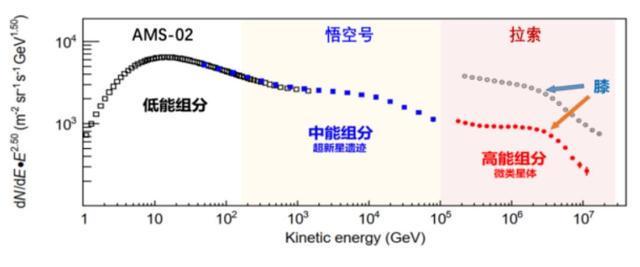
Core Insights - The "LHAASO" observatory has made significant discoveries regarding cosmic rays, particularly in the "knee" region of the energy spectrum, revealing new sources of high-energy cosmic rays [1][2] - The findings indicate that black hole accretion-driven microquasars are likely candidates for the origin of these high-energy cosmic rays, providing new insights into extreme astrophysical processes [1][2] Group 1: Research and Discoveries - The "LHAASO" observatory, located at an altitude of 4410 meters in Sichuan, is the world's most sensitive ultra-high-energy gamma-ray detection facility, designed to decode high-energy particle signals from deep space [2][3] - Initial research faced challenges due to the lack of a unified coordinate system among the three detector arrays, which required extensive simulation and adjustments [2] - The unexpected "bump" in the knee region of the cosmic ray proton energy spectrum suggests the existence of new sources capable of producing extremely high-energy cosmic rays [2] Group 2: Future Plans and Goals - The team plans to measure a broader range of proton energy spectra, aiming to cover four orders of magnitude in energy range [2] - Future research will focus on deepening scientific data analysis and promoting technological upgrades to address major international research questions in the field of cosmic ray studies [2]
高海拔宇宙线观测站破解宇宙线“膝”形成之谜
Huan Qiu Wang Zi Xun· 2025-11-19 03:54
Core Insights - The recent findings from the LHAASO (Large High Altitude Air Shower Observatory) reveal that microquasars driven by black hole accretion are powerful particle accelerators in the Milky Way, capable of accelerating protons to the PeV energy range, indicating black holes as likely sources of cosmic rays [1][2][3] Group 1: Scientific Discoveries - LHAASO has systematically detected ultra-high-energy gamma rays from five microquasars, with SS 433 showing a strong correlation between its ultra-high-energy radiation and surrounding giant atomic clouds, suggesting high-energy protons accelerated by black holes [2][3] - The proton energy from the system exceeds 1 PeV, with a total power output of approximately 10^32 joules per second, while gamma rays from V4641 Sgr reach 0.8 PeV, marking it as another "super PeV particle accelerator" [2][3] Group 2: Cosmic Ray Research - The cosmic ray energy spectrum exhibits a critical knee feature around 3 PeV, where the number of higher-energy cosmic rays sharply decreases, a measurement previously deemed nearly impossible [3] - LHAASO's advanced ground observation technology has successfully measured a high-purity proton sample, revealing an unexpected energy spectrum structure and a new high-energy component [3] Group 3: Implications for Astrophysics - This research establishes a connection between the knee structure and specific celestial bodies, particularly black hole jet systems, indicating that microquasars are new sources of cosmic rays with acceleration limits exceeding those of supernova remnants [3][4] - The findings provide significant observational evidence for understanding the role of black holes in the origin of cosmic rays, addressing a long-standing challenge in the field of astrophysics [3]