宇宙线起源

Search documents
四川LACT首台望远镜“首光” 捕获宇宙“标准烛光”
Xin Lang Cai Jing· 2026-01-30 06:14
Core Insights - The first telescope of the Large Air Shower Telescope (LACT) project successfully achieved its "first light" observation, capturing gamma-ray signals from the Crab Nebula, marking a significant step in understanding the origins of cosmic rays [1][2] Group 1: Project Overview - The LACT project was approved in September 2024, aiming to construct an array of 32 imaging atmospheric Cherenkov telescopes to enhance the precision and imaging capabilities of ultra-high-energy gamma-ray source detection [1] - The first telescope, with a 6-meter aperture, was deployed at an altitude of 4410 meters in Daocheng, Sichuan, and successfully detected multiple gamma-ray signals from a celestial body approximately 6500 light-years away [1] Group 2: Technical Achievements - The design, development, and high-altitude installation of the telescope were completed by a team of young scientists, overcoming challenges such as low oxygen and temperature at high altitudes [2] - The newly developed composite material mirrors achieved international advanced performance, ensuring the successful completion of the observation tasks [2] Group 3: Future Developments - The project team has optimized and finalized the design of the LACT telescope, with the second telescope currently being installed at the Tianfu Cosmic Ray Research Center, and plans for batch production are underway [2] - The first batch of four telescopes is expected to be completed and installed by 2026, with the full array anticipated to yield significant scientific results in the fields of cosmic ray origins and ultra-high-energy gamma astronomy [2]
【人民日报】用好“拉索”,揭示宇宙线起源之谜
Ren Min Ri Bao· 2026-01-06 01:58
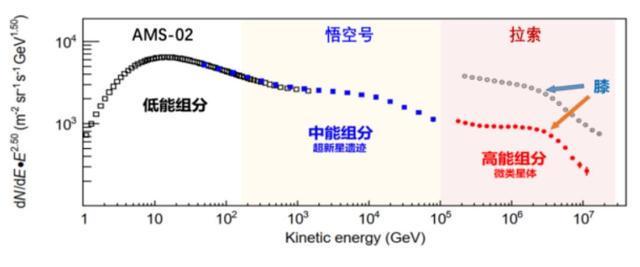
Core Insights - The "LHAASO" (Large High Altitude Air Shower Observatory) has successfully identified black hole accretion-driven microquasars as significant sources of ultra-high-energy cosmic rays, revealing new insights into the origins of cosmic rays and the extreme physical processes of black hole systems [1][2] Group 1: Research Findings - The cosmic ray proton energy spectrum shows an unexpected "bump" in the "knee" region, indicating the presence of a new type of source capable of producing extremely high-energy cosmic rays [2] - The findings suggest that there are multiple types of acceleration sources within the Milky Way, each with unique acceleration capabilities and energy ranges, with the "knee" representing the acceleration limit for high-energy components [2] Group 2: Technological Advancements - "LHAASO" is the world's most sensitive ultra-high-energy gamma-ray detection facility, located at an altitude of 4,410 meters in Sichuan, China, and is designed to decode high-energy particle signals from deep space [3] - The observatory employs a combination of ground-based particle detectors, water Cherenkov detectors, and wide-angle atmospheric Cherenkov telescopes to achieve high-precision, all-weather observations of ultra-high-energy cosmic rays and gamma rays [3] Group 3: Future Plans - The research team plans to measure a broader energy range of the proton energy spectrum, ultimately covering four orders of magnitude in energy [2] - The team aims to deepen scientific data analysis and promote technological upgrades to address major international research questions in the field of cosmic ray studies [2]
用好“拉索”,揭示宇宙线起源之谜(奋进“十五五”·一线见闻)
Ren Min Ri Bao· 2026-01-04 22:35
Core Insights - The "LHAASO" observatory has made significant discoveries regarding cosmic rays, particularly in the "knee" region of the energy spectrum, revealing new sources of high-energy cosmic rays [1][2] - The findings indicate that black hole accretion-driven microquasars are likely candidates for the origin of these high-energy cosmic rays, providing new insights into extreme astrophysical processes [1][2] Group 1: Research and Discoveries - The "LHAASO" observatory, located at an altitude of 4410 meters in Sichuan, is the world's most sensitive ultra-high-energy gamma-ray detection facility, designed to decode high-energy particle signals from deep space [2][3] - Initial research faced challenges due to the lack of a unified coordinate system among the three detector arrays, which required extensive simulation and adjustments [2] - The unexpected "bump" in the knee region of the cosmic ray proton energy spectrum suggests the existence of new sources capable of producing extremely high-energy cosmic rays [2] Group 2: Future Plans and Goals - The team plans to measure a broader range of proton energy spectra, aiming to cover four orders of magnitude in energy range [2] - Future research will focus on deepening scientific data analysis and promoting technological upgrades to address major international research questions in the field of cosmic ray studies [2]
【中国青年报】在地球上寻找宇宙线的源头
Zhong Guo Qing Nian Bao· 2025-11-24 03:07
Core Insights - The recent findings from the LHAASO (High Altitude Cosmic Ray Observatory) reveal that black holes, particularly microquasars, are significant sources of high-energy cosmic rays, challenging traditional views of black holes as mere absorbers of matter [6][9][10] - The research indicates that microquasars can accelerate protons to the PeV energy range, contributing to the understanding of cosmic ray origins and the mechanisms behind high-energy particle acceleration [10][12] Group 1: Discoveries Related to Black Holes - The LHAASO has identified microquasars as powerful particle accelerators within the Milky Way, capable of accelerating protons to energies exceeding 1 PeV [9][10] - The study highlights that the cosmic ray proton energy spectrum shows unexpected high-energy components, suggesting black holes as potential sources [10][11] - The findings provide a new perspective on black holes, revealing their role in producing high-energy particles rather than solely consuming surrounding matter [9][10] Group 2: Methodology and Observations - LHAASO utilized advanced ground-based observational techniques to measure cosmic ray spectra, achieving precision comparable to satellite experiments [12][14] - The observatory's design allows for the detection of both cosmic ray sources and the precise measurement of cosmic ray particles, linking the observed high-energy emissions to specific astrophysical phenomena [14][15] - The research successfully correlates the knee structure in cosmic ray energy distribution with specific types of celestial bodies, particularly black hole jet systems [15][16] Group 3: Implications for Future Research - The discoveries pave the way for further exploration of cosmic ray origins, with expectations of identifying additional black holes contributing to high-energy cosmic rays [15][16] - The findings may inspire new approaches in high-energy physics, potentially leading to experimental simulations of cosmic processes in laboratory settings [16][17] - The research emphasizes the importance of continued observation and theoretical development to understand the universe's high-energy phenomena [16][17]

高海拔宇宙线观测站破解宇宙线“膝”形成之谜
Huan Qiu Wang Zi Xun· 2025-11-19 03:54
Core Insights - The recent findings from the LHAASO (Large High Altitude Air Shower Observatory) reveal that microquasars driven by black hole accretion are powerful particle accelerators in the Milky Way, capable of accelerating protons to the PeV energy range, indicating black holes as likely sources of cosmic rays [1][2][3] Group 1: Scientific Discoveries - LHAASO has systematically detected ultra-high-energy gamma rays from five microquasars, with SS 433 showing a strong correlation between its ultra-high-energy radiation and surrounding giant atomic clouds, suggesting high-energy protons accelerated by black holes [2][3] - The proton energy from the system exceeds 1 PeV, with a total power output of approximately 10^32 joules per second, while gamma rays from V4641 Sgr reach 0.8 PeV, marking it as another "super PeV particle accelerator" [2][3] Group 2: Cosmic Ray Research - The cosmic ray energy spectrum exhibits a critical knee feature around 3 PeV, where the number of higher-energy cosmic rays sharply decreases, a measurement previously deemed nearly impossible [3] - LHAASO's advanced ground observation technology has successfully measured a high-purity proton sample, revealing an unexpected energy spectrum structure and a new high-energy component [3] Group 3: Implications for Astrophysics - This research establishes a connection between the knee structure and specific celestial bodies, particularly black hole jet systems, indicating that microquasars are new sources of cosmic rays with acceleration limits exceeding those of supernova remnants [3][4] - The findings provide significant observational evidence for understanding the role of black holes in the origin of cosmic rays, addressing a long-standing challenge in the field of astrophysics [3]
腾讯三季度净利润同比增长47%,冰雪季新疆、内蒙古旅游热度显著提升
HUAXI Securities· 2025-11-17 08:27
Group 1: Tencent's Q3 Financial Performance - Tencent reported a net profit of 53.23 billion yuan for Q3, a year-on-year increase of 47% [1] - The company's revenue for Q3 was 167.19 billion yuan, representing an 8% year-on-year growth, slightly below market expectations [1][8] - The revenue from value-added services in Q3 grew by 9% to 82.695 billion yuan, with domestic game revenue increasing by 14% to 37.3 billion yuan [1][9] Group 2: Dama Entertainment's Mid-Year Performance - Dama Entertainment announced a net profit of approximately 519.5 million yuan for the six months ending September 30, 2025, a 54% year-on-year increase [2] - The company's revenue reached about 4.047 billion yuan, marking a 33% year-on-year growth [2] - The Dama APP underwent a comprehensive upgrade, leveraging AI technology to enhance its entertainment service offerings [2] Group 3: Trends in Domestic Ice and Snow Tourism - According to a report by Tongcheng Travel, there has been a significant increase in flight bookings to popular ice and snow destinations since November, with Harbin leading the trend [3][15] - The report predicts that the average ticket prices for popular ice and snow routes will rise by over 50% from November to early January 2026 [17] - The top ten ice and snow travel destinations for the 2025-2026 season include Harbin, Urumqi, and Almaty, with a notable increase in interest in destinations like Xinjiang and Inner Mongolia [19][21] Group 4: Investment Recommendations - The report suggests that the "AI+" logic will catalyze the optimization of Hong Kong stock valuations, with new industry leaders stabilizing under changing consumer patterns [5] - Beneficiaries in the internet and technology sector include Alibaba, Tencent, Kuaishou, and Meituan, while new consumption leaders include Pop Mart, Laoputang, and various travel companies [5] Group 5: Market Overview - The Hong Kong stock market saw the Hang Seng Index rise by 1.26% this week, while the Hang Seng Technology Index fell by 0.42% [24][25] - The major US stock indices showed mixed results, with the Dow Jones Industrial Average increasing by 0.34% and the Nasdaq Composite Index decreasing by 0.45% [32][37] Group 6: AI Travel Assistant Developments - The AI Travel Assistant Evaluation System was launched to establish a scientific assessment standard for the rapidly growing AI travel planning sector [50][51] - The market has seen the emergence of four main types of AI travel assistants, each competing in the evolving landscape of online travel services [51]

解谜、突破、首次,振奋人心!中国“硬核”科技成果不断“上新”
Yang Shi Wang· 2025-11-17 02:45
Group 1: Scientific Discoveries - China's research team discovered five micro-quasars in the Milky Way that emit ultra-high-energy particle streams, providing significant insights into black holes and cosmic rays [1][5][6] - The phenomenon known as the "knee" structure in the cosmic ray energy spectrum, which has puzzled scientists for nearly 70 years, has been linked to these micro-quasars [4][5] Group 2: Lunar Research - The Chinese National Space Administration announced a breakthrough in lunar research, identifying micro-sized hematite and magnetite crystals from samples collected by the Chang'e 6 mission, revealing new mechanisms of lunar oxidation [6][9] Group 3: Military Developments - The first sea trial of China's 076 amphibious assault ship, the Sichuan, was successfully completed, demonstrating its capabilities and innovative technologies such as electromagnetic catapults [9][11][13] Group 4: Space Missions - The Shenzhou 21 manned spacecraft successfully landed, with the crew having spent 204 days in orbit, setting a new record for the longest single crew duration in space for China [15][16][18] Group 5: Renewable Energy Innovations - China's first high-altitude wind energy project, featuring the world's largest 5000 square meter wind energy capturing parachute, successfully completed its test, marking significant progress in harnessing high-altitude wind energy [21][23][25] Group 6: 6G Technology Development - China has completed the first phase of 6G technology trials, developing over 300 key technology reserves and entering the international standard research phase, with commercial deployment expected around 2030 [25]
拉索发布新成果,发现黑洞在宇宙线起源中的作用
Xin Jing Bao· 2025-11-16 22:49
Core Insights - The latest findings from the High Altitude Cosmic Ray Observatory (LHAASO) indicate that cosmic ray protons in the PeV energy range primarily originate from microquasars, providing significant observational evidence for understanding the role of black holes in the origin of cosmic rays [1][2] Group 1: Cosmic Rays and Their Sources - Cosmic rays are high-energy particle streams from space that carry information about their astrophysical environments [1] - A critical turning point in the energy distribution of cosmic rays occurs around 3 PeV, where the number of cosmic rays sharply decreases, referred to as the "knee" [1] - Previous beliefs attributed cosmic rays to supernova remnants, but it has been found that they struggle to accelerate particles to energies above the "knee" [1] Group 2: Role of Microquasars - Microquasars, formed when black holes in binary systems accrete material from companion stars, are identified as significant PeV particle accelerators [2] - LHAASO has systematically detected ultra-high-energy gamma rays from five microquasars, highlighting their importance in the Milky Way [2] Group 3: LHAASO's Contributions - The High Altitude Cosmic Ray Observatory is designed, constructed, and operated by Chinese scientists, achieving globally impactful breakthroughs in gamma-ray astronomy and cosmic ray measurements [2] - The recent discoveries enhance the understanding of black holes' contributions to the origin of cosmic rays [2]
权威快报丨“拉索”首次揭示黑洞在宇宙线起源中的作用
Xin Hua She· 2025-11-16 06:20
Core Viewpoint - The LHAASO (Large High Altitude Air Shower Observatory) in Daocheng, Sichuan Province, has systematically detected five ultra-high-energy gamma-ray signals from microquasars formed by the interaction of black holes and companion stars, providing crucial evidence for understanding the origin of cosmic rays [1] Group 1 - The detection of gamma-ray signals indicates that microquasars act as powerful "particle accelerators," capable of accelerating cosmic rays to energies at and above the "knee" region of the cosmic ray energy spectrum [1] - The "knee" refers to a specific structure in the cosmic ray energy spectrum, occurring around 30 trillion electron volts, where the number of cosmic rays sharply decreases [1] - This discovery offers key observational evidence to address the long-standing mystery of the formation of the cosmic ray "knee" and points to new directions for solving this scientific challenge [1]
“拉索”首次揭示黑洞在宇宙线起源中的作用
Xin Hua She· 2025-11-16 06:11
Core Insights - The LHAASO (Large High Altitude Air Shower Observatory) in Sichuan, China, has made a significant discovery by systematically detecting five ultra-high-energy gamma-ray signals from microquasars formed by the interaction of black holes and companion stars [3] Group 1: Discovery Details - The detected gamma-ray signals are believed to provide clues about the origin of cosmic rays, particularly in the "knee" region of the cosmic ray energy spectrum, which is around 30 trillion electron volts [3] - The "knee" represents a structural inflection in the cosmic ray energy spectrum, where the number of cosmic rays sharply decreases above this energy level [3] - This discovery indicates that microquasars act as powerful "particle accelerators," capable of accelerating cosmic rays to energies at or above the "knee," offering critical observational evidence to solve the long-standing mystery of the formation of the cosmic ray "knee" [3]