Price Controls

Search documents
Why Is Donald Trump The Only Villain In Jerome Powell's Investigation?
Forbes· 2026-01-18 15:21
Group 1 - The article discusses the implications of Donald Trump's desire to influence Federal Reserve interest rate decisions upon his potential re-election, highlighting the absurdity of central planning in economic policy [2][4][5] - It critiques the academic economists who mock Trump's ambitions while simultaneously claiming expertise in economic management, suggesting that both sides exhibit a misunderstanding of market dynamics [3][4][6] - The commentary emphasizes that Trump's political pressure on the Federal Reserve could lead to detrimental economic policies, such as pushing for easy money to stimulate growth, which is a common criticism of his approach [5][6] Group 2 - The article notes that despite the criticism of Trump's proposed price controls on credit cards, similar principles apply to the Federal Reserve's interest rate policies, indicating that market forces will ultimately prevail regardless of government intervention [7] - It points out the hypocrisy in the reactions of economists and commentators who supported Jerome Powell's nomination by Trump, questioning their current outrage over Trump's influence on the Fed [6][7] - The piece concludes that the ongoing debate about Trump's influence on the Federal Reserve may not significantly impact the market, as economic realities will dictate outcomes regardless of political pressures [7]

Trump's 'Performative' Tweets Don't Change Law, Says Economist Paul Krugman, Calling Credit Card Rate Cap As 'Charade'
Yahoo Finance· 2026-01-17 04:31
Core Viewpoint - Nobel laureate Paul Krugman criticizes President Trump's announcement of a 10% cap on credit card interest rates as a politically motivated "charade" lacking legal authority [1][2]. Group 1: Performance and Legality - Krugman describes Trump's declaration as "performative," emphasizing that a post on Truth Social does not have the legal power to change financial regulations [2]. - He characterizes Trump as a "would-be price controller" who prefers to govern through edicts rather than legislative processes [2]. Group 2: Historical Context and Ideology - Krugman contrasts Trump with Richard Nixon, noting that Nixon implemented price controls through legitimate legislation, while Trump shows no interest in substantive actions [3]. - The economist points out that Trump's approach reveals a lack of consistent ideology, describing him as "utterly transactional" and willing to abandon free-market principles for political gain [4]. Group 3: Administration's Track Record - Krugman highlights the contradiction in Trump's concern for borrowers, citing his administration's efforts against the Consumer Financial Protection Bureau (CFPB) [5][6]. - He notes that Trump's Budget Director previously attempted to dismantle the CFPB, indicating that Trump's motives are cynical [6]. Group 4: Economic Solutions - While acknowledging that credit card rates are unfair and disconnected from supply and demand, Krugman argues that the solution lies in enforcing existing laws rather than impulsive executive actions [7]. - He advises Democrats to avoid legitimizing Trump's "charade" and instead focus on restoring the CFPB's funding and independence to provide real relief for American families [7].
JPMorgan CEO and CFO: Staying competitive requires investment
Yahoo Finance· 2026-01-14 13:13
Core Insights - JPMorgan Chase reported fourth-quarter 2025 earnings, showing a net income of $13 billion, a 7% decline year-over-year, primarily due to a $2.2 billion pre-tax credit reserve related to the acquisition of the Apple Card portfolio [2][3] - Revenue increased by 7% to $46.8 billion, with net interest income also rising by 7% to $25.1 billion, driven by higher revolving credit card balances and improved deposit margins [2] Financial Performance - The bank's net income decreased to $13 billion, down from the previous year, attributed to the reserve build for the Apple Card acquisition [2] - Revenue growth of 7% to $46.8 billion indicates strong performance, with net interest income reflecting similar growth [2] Market Position and Outlook - JPMorgan's earnings are viewed as a barometer for the health of the consumer, corporate, and financial systems, with broad-based revenue growth suggesting stability [3] - Management's cautious outlook beyond 2026 is indicated by the increase in excess reserves [3] Expense Projections - Projected expenses for 2026 are around $105 billion, with the increase attributed to structural optimism and necessary investments to maintain competitive positioning [4] - The competitive environment is intensifying, necessitating ongoing investments to secure market position against both traditional and non-traditional competitors [4] Competitive Strategy - Higher spending on technology and AI is deemed essential to compete with fintech companies and established financial firms [5] - CEO Jamie Dimon emphasized the importance of staying ahead in the competitive landscape, indicating a commitment to proactive investment rather than merely meeting expense targets [6] Regulatory Concerns - Concerns were raised regarding President Trump's proposal to cap credit card interest rates at 10%, which could reduce access to credit and lead to lending cutbacks, particularly for higher-risk borrowers [6]

X @The Wall Street Journal
The Wall Street Journal· 2025-10-20 12:31
Industry Overview - The home and auto insurance industry in America is facing a cost crisis [1] - Some states are considering price controls as a controversial solution [1]
X @Bloomberg
Bloomberg· 2025-08-26 09:35
Market Dynamics - Argentina's yerba mate industry saw the removal of state price controls under Milei's shock plan [1] - Investors are reportedly pleased with the policy change [1] Industry Concerns - Yerba mate producers in Misiones express concerns about being left "to the luck of God" following the deregulation [1]
X @The Wall Street Journal
The Wall Street Journal· 2025-08-06 22:14
Policy & Regulation - Trump's "most-favored nation" price controls will harm US companies [1] Industry Impact - Americans will get fewer cures as a result of the price controls [1]
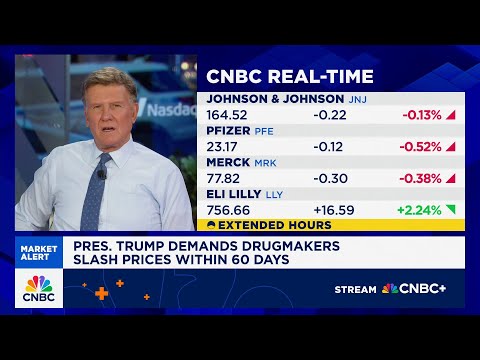
President Trump demands drugmakers slash prices within 60 days
CNBC Television· 2025-08-01 10:54
Government Policy & Regulation - President Trump demanded major drug makers lower prices for Americans within 60 days [1] - President Trump requested drug companies offer their full drug portfolio to Medicaid patients at prices equivalent to those paid abroad, known as the most favored nation rule [1] - Trump urged drug makers to guarantee Medicare, Medicaid, and private insurance patients receive the same lower overseas prices for all newly approved medicines and demanded a direct-to-consumer option for certain drugs [2] - The efforts are expected to face strong opposition from the pharmaceutical industry, and the president's authority to enforce price reductions without Congressional support is uncertain [2] Industry Concerns & Potential Consequences - The implementation of price controls, similar to those in Europe, could stifle pharmaceutical innovation in the US [5] - Concerns exist that price controls may lead to a decline in drug innovation within the country [5] - The fairness argument suggests developed nations should be able to afford drug prices, but the industry should have addressed price control issues earlier [7] Economic Implications - The discussion revolves around importing price controls, raising concerns about the long-term impact on drug development and research [3][5] - The potential unintended consequence of price controls is the reduction of innovation in the pharmaceutical industry [5]