Price to Earnings Multiple

Search documents
The Fed will most likely 'asterisk' inflation from tariffs and the war as one-offs, says Jim Cramer
CNBC Television· 2026-04-13 23:45
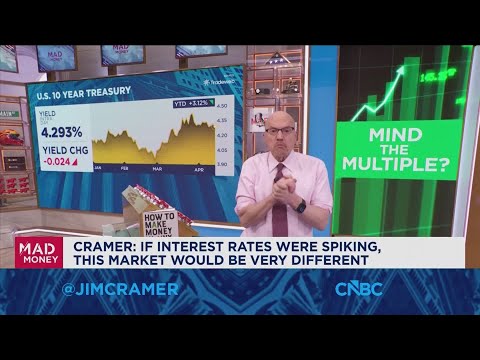
It's natural gas not oil that will break bunch of the world's back particularly in Asia but not ours. There's a huge reason why our markets can shrug off the straight of removes even as most snack gas hungry countries can because they get a lot of their gas from cutter formerly the world's biggest export before being taken offline by a devastating Iranian drone and missile attack. Second, number two, let's talk about inflation more broadly.The consumer price index we got Friday was already elevated by tarif ...

ServiceNow's multiple is being compressed, says Jim Cramer
Youtube· 2026-01-30 00:56
Core Viewpoint - The price-to-earnings multiple (referred to as "M") is crucial in determining stock prices and investor sentiment, particularly in the enterprise software sector, which is currently facing significant challenges due to concerns over AI replacing human employees [1][2][3]. Company Analysis - Service Now is highlighted as a strong company with a respected CEO, known for its ability to automate and digitize business processes, thereby improving efficiency [4][5]. - Despite Service Now's strong earnings and growth, its stock has declined over 50% in the past year, with a notable drop in its price-to-earnings multiple from 65 times forward earnings at the end of 2024 to just under 28 times earnings currently [6][8]. - The market is skeptical about Service Now's future profitability, believing that AI advancements will lead to reduced demand for user-based pricing, which poses an existential threat to the company [7][10]. Industry Context - The enterprise software industry, particularly companies like Service Now and Salesforce, is experiencing multiple compression, indicating that even with strong earnings, investor confidence is waning [10][12]. - The market's perception of growth potential is critical, as it currently views these companies as no longer being growth names despite their ongoing strong performance [11][12]. - There is an expectation that the price-to-earnings multiple may continue to shrink before it stabilizes, suggesting a potential buying opportunity in the future once the bottom is reached [13].


Jim Cramer Says High Price to Earnings Multiples Are Hurting Spotify Stock
Yahoo Finance· 2026-01-22 14:10
Group 1 - Spotify Technology S.A. is a leading audio streaming service with approximately 700 million monthly active users and over 275 million paying subscribers, controlling about one-third of the global music streaming market [2] - The company operates in two segments: premium (approximately 90% of revenues) and ad-supported (approximately 10% of revenues) [2] - Recently, Spotify has begun to raise prices after not doing so for over a decade, with limited impact on customer churn [2] Group 2 - The company has several growth levers, including adding new users, converting ad-supported users to premium subscribers, and implementing price increases [2] - Despite the potential of Spotify as an investment, some analysts believe that certain AI stocks may offer greater upside potential and carry less downside risk [3]

Jim Cramer talks how to value the financial sector
Youtube· 2025-09-16 23:59
Core Viewpoint - The next non-tech stock likely to cross the trillion-dollar market cap threshold may be JP Morgan instead of Eli Lilly, which has been previously anticipated to achieve this milestone due to its promising drug developments [2][20]. Company Analysis - Eli Lilly's current market capitalization is approximately $724 billion, while JP Morgan's is just over $850 billion, reflecting a 29% increase for JP Morgan this year, contrasting with a slight decline for Eli Lilly [2][3]. - Eli Lilly announced plans to build a $5 billion manufacturing plant in Richmond, Virginia, which will be the first of four American plants focused on targeted cancer and autoimmune drugs [6]. - Eli Lilly's stock performance has been hindered by competition from Novo Nordisk and the current economic climate, which is unfavorable for drug stocks due to anticipated interest rate cuts by the Federal Reserve [7][8]. Industry Trends - The banking sector, particularly JP Morgan, is experiencing significant growth, with a notable expansion in price-to-earnings (P/E) multiples, indicating a willingness among investors to pay more for bank earnings [11][12]. - JP Morgan's P/E ratio has increased to 15.7 times this year's earnings, while Goldman Sachs and Morgan Stanley are trading at 16.9 and 17.5 times earnings, respectively, suggesting a wholesale revision in valuations across the banking sector [15][18]. - The overall market sentiment indicates that the Federal Reserve's decisions may not adversely affect bank stocks, which is a positive sign for the financial sector [14][21].

This quarter showed how Goldman has become a well-oiled machine, says Jim Cramer
CNBC Television· 2025-07-16 23:56
Investment Strategy - During earning season, a stock decline is often wrongly perceived negatively, potentially creating buying opportunities [1] - When a stock declines after earnings, investors should first review the conference call transcript and use chatbots to identify potential missed issues [10] - If the analysis is positive, consider buying on weakness, as the decline is unlikely to last [11] - Pyramid buying, gradually increasing the investment as the stock goes lower, can be a solid strategy [6] Goldman Sachs Analysis - Goldman Sachs' stock is considered cheap by many, including its alumni, despite sophisticated valuation metrics [3] - CEO David Solin's efforts have transformed Goldman Sachs into a more consistent earnings generator [5] - The company's blowout quarter was met with an initial stock decline, which was viewed as a buying opportunity [6] - Goldman Sachs experienced its best trading quarter in history, with strong wealth management and improving M&A and IPO activity [8] - The market may re-evaluate Goldman Sachs with a higher price-to-earnings multiple, potentially propelling the stock higher [5][8]