
Private credit risk

Search documents
SaaS Markets Have Crashed in 2026. But Is Private Credit the Even Bigger Risk?
SaaStr· 2026-02-20 15:10
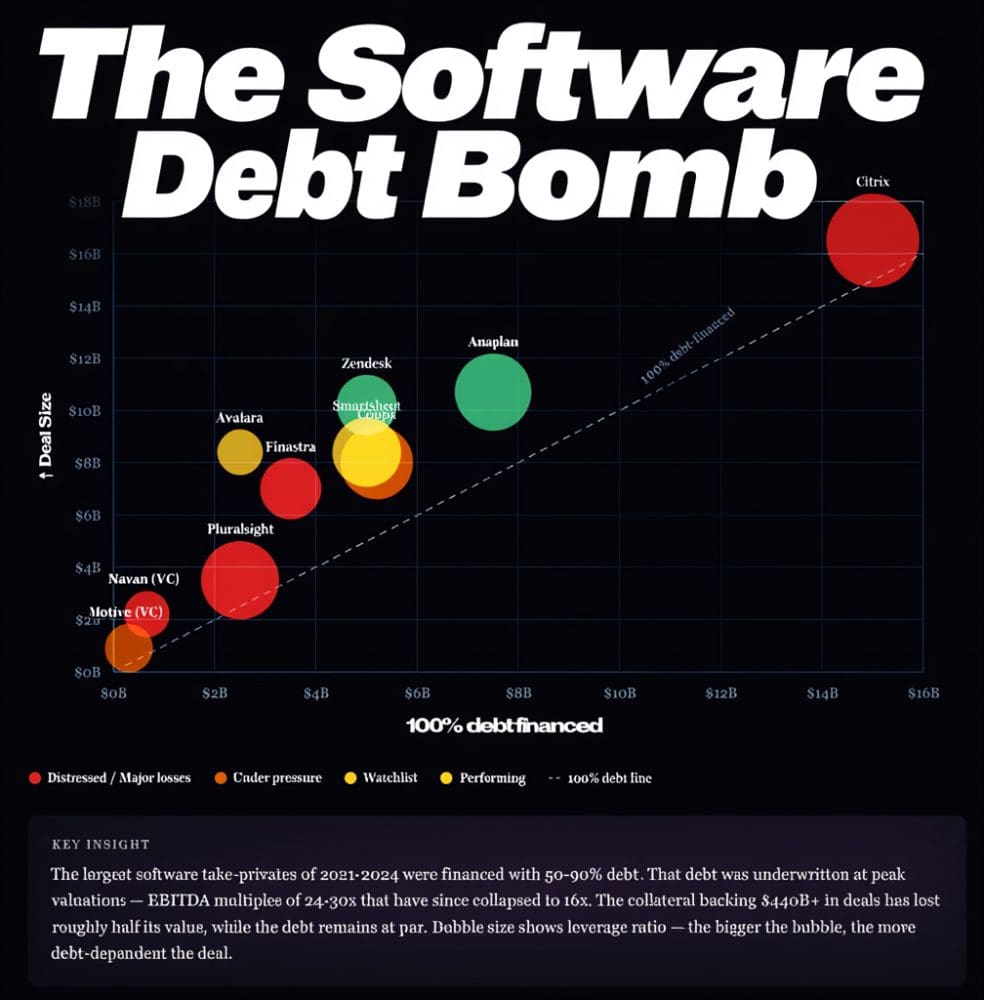
Core Insights - The software stock market has entered a bear phase in 2026, with significant declines in valuations and market capitalizations, raising concerns about the private credit market's exposure to software companies [1][2][52] - The private credit market, valued at $3 trillion, has a substantial portion tied to software, with estimates indicating that 20-35% of private credit deals involve SaaS companies [8][9] - The potential for widespread defaults in private credit could have far-reaching implications for the entire financial ecosystem supporting B2B operations, including venture debt and M&A activities [7][52] Market Performance - The IGV index has dropped over 23% year-to-date, with $285 billion in market cap lost in a single day, and software price-to-sales ratios have decreased from 9x to 6x [1] - Major software IPOs have seen drastic declines, with Figma down over 80% from its peak and Navan down 60% since its IPO [5][27] Private Credit Exposure - Private credit's exposure to software companies is estimated between $600 billion and $750 billion, raising concerns about the reliability of debt repayment [2][52] - The private credit market has financed over $440 billion in software acquisitions from 2015 to 2025, with many loans now under stress due to changing market conditions [9][10] Distressed Debt Levels - As of early February, $46.9 billion in US tech company loans are trading at distressed levels, with a record $25 billion of software-sector loans below the distress threshold [15][16] - The average EBITDA multiples for software companies have collapsed from 30x at the end of 2022 to approximately 16x today, indicating a significant reduction in collateral value for loans [21] Risk of Defaults - Default rates for US private credit could reach 13% if AI disruption accelerates, significantly higher than projected high-yield default rates [30] - The interconnectedness of private credit and the broader financial system poses risks, as tightening credit conditions could lead to a cascade of defaults across the software sector [36][50] Structural Issues - The private credit market operates differently from public equity markets, with illiquid loans often held to maturity and valued by lenders themselves, which can delay the recognition of problems [34] - The potential for a "doom loop" scenario exists, where missed payments lead to markdowns, triggering redemption requests that funds may struggle to meet [37][50] Industry Outlook - The SaaSpocalypse reflects a broader concern about the sustainability of software companies in an AI-driven market, where traditional revenue models may no longer hold [6][52] - The private credit market's heavy reliance on software companies, combined with the current economic climate, suggests a challenging environment ahead for both lenders and borrowers [52][53]


Crypto Sentiment Hits 'Extreme Fear' Amid $2.7 Trillion S&P 500 Wipeout
Yahoo Finance· 2025-11-21 04:45
Market Overview - A significant sell-off in the U.S. stock market resulted in a market-cap wipeout exceeding $2.7 trillion, impacting investor sentiment and pulling Bitcoin down to its lowest level in seven months [1][2] - The S&P 500 index experienced a nearly 4% drop, while Nvidia's stock fell more than 8% following its earnings report [1] Cryptocurrency Impact - Bitcoin's value dropped to around $85,000, marking a revisit to levels not seen since April, with the crypto market experiencing liquidations totaling $829 million [3] - The overall cryptocurrency market cap, which stands just above $3 trillion, saw a 7% decline on the same day [2] Market Dynamics - Analysts attribute the sell-off to a combination of macroeconomic fears and technical market forces, with the upcoming November jobs report being a potential catalyst for the decline [4] - Concerns regarding the AI bubble and private credit risks have been highlighted as under-discussed factors contributing to market volatility [5] Credit Market Insights - U.S. credit spreads have widened slightly, indicating increased investor perception of risk and economic uncertainty, although they remain moderate with limited systemic stress [6]
