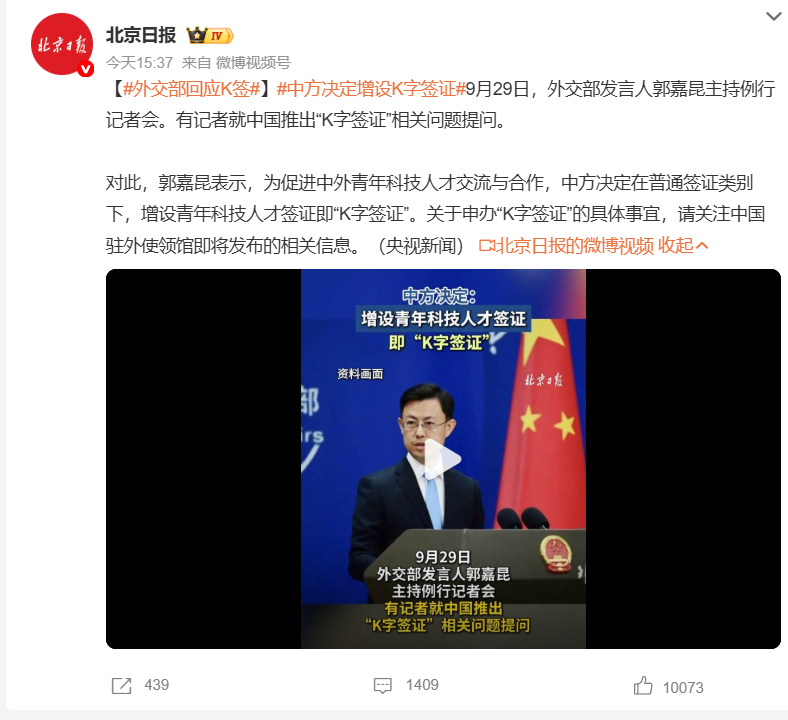
R字签证

Search documents
K签证,会让印度青年来中国抢工作?
虎嗅APP· 2025-09-29 13:19
Core Viewpoint - The introduction of the K visa in China aims to attract foreign young talent in technology and education sectors, but it has sparked concerns about potential competition from Indian professionals in the job market [10][16][18]. Group 1: K Visa Overview - The K visa is a new visa type in China specifically for foreign young technology talents, allowing them to engage in educational, technological, and cultural exchanges, as well as entrepreneurial and business activities [15][16]. - The K visa offers more flexibility in terms of entry frequency, validity period, and duration of stay compared to existing visa types [16]. Group 2: Public Reaction and Concerns - Initial reactions to the K visa were positive, with many seeing it as a way to boost foreign investment and economic growth [18]. - However, a report from an Indian media outlet misrepresented the K visa, leading to fears among Chinese netizens that it would attract a large influx of Indian graduates to compete for jobs in China [19][22][24]. Group 3: Misconceptions and Clarifications - There are misconceptions that any foreigner with a bachelor's degree can easily obtain a K visa; however, the application process will involve strict criteria and standards [31][40]. - The K visa is likely designed to facilitate the return of overseas Chinese and those with Chinese heritage, rather than solely targeting foreign talent [41][42]. Group 4: Comparison with Existing Visa Types - The existing R visa for high-level talent has been criticized for its lengthy approval process and lack of alignment with domestic needs, prompting the introduction of the K visa to address these issues [43][45]. - Experts have suggested that the K visa is part of a broader strategy to attract global talent in key sectors like IT, biotechnology, and AI, in response to demographic challenges and industrial upgrades in China [45][46][47].

K签证,会让印度青年来中国抢工作?
Hu Xiu· 2025-09-29 11:36
Core Viewpoint - The introduction of the K visa in China aims to attract foreign youth in technology and related fields, but it has sparked concerns about an influx of Indian talent potentially competing for jobs in China [3][10][41]. Group 1: K Visa Overview - The K visa is a new visa type in China specifically for foreign youth technology talents [8]. - Holders of the K visa can engage in educational, technological, and cultural exchanges, as well as entrepreneurial and business activities in China, offering more flexibility compared to existing visa types [10]. - The policy was initially viewed positively, with expectations that it would boost foreign investment and GDP [12][11]. Group 2: Public Reaction and Concerns - A report from an Indian media outlet misrepresented the K visa, suggesting it was an open invitation for Indian students to come to China, which raised alarms among Chinese netizens [13][15]. - Concerns were voiced about the potential for Indian students to flood the job market in China, especially given the competitive domestic employment landscape [20][21]. - Some comments suggested extreme reactions, including fears of espionage and job theft [25][26]. Group 3: Visa Application and Eligibility - The application process for the K visa will involve strict review and selection criteria, countering the notion that it is easily obtainable [27][39]. - The majority of highly skilled Indian professionals are likely to prefer opportunities in English-speaking countries rather than China, due to language barriers and negative perceptions of China in Indian media [29][31]. Group 4: Policy Context and Rationale - The K visa is seen as a response to the limitations of the existing R visa system, which has been criticized for its lengthy approval processes and lack of alignment with domestic needs [44]. - The introduction of the K visa may also facilitate the return of overseas Chinese and those born abroad who wish to work in China [41][42]. - Experts have indicated that the K visa policy is the result of extensive research and consideration, rather than a hasty decision [48].