REITs及类REITs

Search documents
沪指17连阳,创业板50ETF成交25.59亿领跑同类!资金逆势布局这些主线
Xin Lang Cai Jing· 2026-01-12 08:16
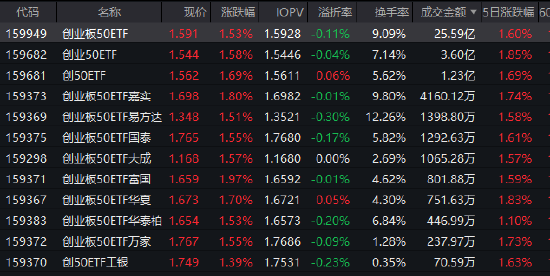
Market Overview - On January 12, all three major A-share indices closed up, with gains exceeding 1%, and the Shanghai Composite Index achieved a 17-day winning streak [1][7] - The ChiNext Index initially fell over 1% in the morning but rebounded to close in the green [1][7] ETF Performance - The Huazhang ChiNext 50 ETF (159949) rose by 1.53%, closing at 1.591 yuan, with a turnover rate of 9.09% and a trading volume of 2.559 billion yuan, ranking first among similar ETFs [1][7] - Over the past 20 trading days, the ChiNext 50 ETF (159949) accumulated a trading volume of 37.816 billion yuan, with an average daily turnover of 1.891 billion yuan [8] - Year-to-date, the ETF has seen a cumulative trading volume of 13.111 billion yuan over six trading days, averaging 2.185 billion yuan per day [8] Fund Flow and Liquidity - The fund experienced a net outflow of 3.39 billion yuan over the last five trading days, while there was a net inflow of 550 million yuan over the past 20 trading days [8] - As of January 9, 2026, the circulating scale of the ETF was 28.155 billion yuan [8] Investment Insights - The chief economist of Industrial Bank, Lu Zhengwei, suggested focusing on opportunities in mergers and acquisitions, overseas expansion of enterprises, and technology innovation [10] - The analysis from GF Securities indicates that the current market does not show signs of overheating and remains in a moderate state, with potential for value allocation [10] - The A-share ROE is expected to rise for the first time in nearly five years in 2026, which will support the stabilization of A-share valuations [10] Long-term Investment Potential - The ChiNext 50 ETF (159949) has provided a return of 46.06% over the past three years, outperforming its benchmark and ranking 370th among 1629 products [11] - Investors can trade the ETF directly through stock accounts or via linked funds, with recommendations for dollar-cost averaging to mitigate short-term volatility [12]