Real spending

Search documents
美国经济-关税开始抑制实际支出-Tariffs start to cool real spending
2025-12-08 15:36
Summary of Key Points from the Conference Call Industry Overview - The conference call primarily discusses the **US Economics** sector, focusing on the impact of tariffs on real spending and inflation trends in North America [1] Core Insights and Arguments - **Core PCE Inflation**: Core PCE inflation rose by **0.20% month-over-month (m/m)** in September, slightly below expectations of **0.22%**. The annual pace was recorded at **2.83%**, which is above the target of **2%** [4][5] - **Goods Prices**: There has been a gradual passthrough of tariffs, with goods prices increasing, which has negatively impacted real goods spending. Real goods spending fell by **0.4% m/m** in September, while services spending rose by **0.2%** [4][21] - **Real Personal Spending**: Real personal spending was flat in September, with nominal spending increasing by **0.3%**. The overall consumption for Q3 is expected to rise by **2.7% quarter-over-quarter (q/q)** [21][22] - **Income Trends**: Real disposable personal income increased by **0.1%**, while nominal personal income rose by **0.4%**. Labor compensation also saw a rise of **0.4%** [26] Additional Important Insights - **Tariff Impact**: The total tariff push to PCE prices has been estimated at about **30 basis points (bp)** so far, with expectations of continued inflationary pressure from tariffs into Q4 and Q1 [7][27] - **Consumer Behavior**: Initial reports on Black Friday spending were better than anticipated, but these do not correlate well with overall spending data, indicating that prices likely influenced nominal sales [27] - **Sector Performance**: Within goods, real durable goods spending fell by **0.6% m/m**, with significant declines in auto spending and furniture. Nondurable goods spending also decreased by **0.3% m/m** [23][24] Conclusion - The overall economic outlook suggests a cooling in real spending due to higher prices driven by tariffs and slower income growth, with expectations of further deceleration in real consumption growth in Q4 [27]
美国经济:关税开始抑制实际消费支出-US Economics-Tariffs start to cool real spending
2025-12-08 00:41
Summary of Key Points from the Conference Call Industry Overview - The conference call primarily discusses the **US Economics** sector, focusing on the impact of tariffs on real spending and inflation trends in North America. Core Insights and Arguments - **Core PCE Inflation**: Core PCE inflation rose by **0.20% month-over-month (m/m)** in September, slightly below expectations of **0.22%** [2][3] - **Goods Prices**: There was an increase in goods prices, indicating a gradual passthrough of tariffs, which is expected to weigh on real goods spending, particularly in the fourth quarter (4Q) [2][5] - **Real Personal Spending**: Real personal spending was flat in September, with a tracking of **3Q real spending** up **2.7% quarter-over-quarter (q/q) seasonally adjusted annual rate (saar)** [2][19] - **Nominal Income**: Nominal income increased by **0.4%**, with labor compensation also up by **0.4%**. Real disposable personal income rose by **0.1% m/m** [2][24] - **Spending Trends**: Real goods spending fell by **0.4% m/m**, while real services spending rose by **0.2% m/m**. This indicates a shift in consumer behavior towards services amidst rising goods prices [20][21] Additional Important Details - **Tariff Impact**: The total tariff push to PCE prices has been estimated at about **30 basis points (bp)** so far, with expectations of continued inflationary pressure from tariffs into 4Q and 1Q [5][25] - **Housing Inflation**: Core services inflation decelerated, particularly in shelter inflation, which is believed to be exaggerated due to regional noise and seasonal factors [6][7] - **Airfares**: A slight underperformance in core inflation expectations was attributed to airfares, which accelerated less than anticipated [7] - **Future Projections**: The forecast for **4Q core PCE** is set at **3.0%**, slightly below the Federal Reserve's forecast of **3.1%** [8] Conclusion - The overall economic outlook indicates a cooling in real spending due to rising goods prices driven by tariffs, with expectations of slower consumption growth in the upcoming quarters. The data suggests a complex interplay between inflation, consumer behavior, and economic policy that will require close monitoring [25]
Core inflation rate rose to 2.9% in July, as expected, key Fed measure shows
CNBC Television· 2025-08-29 13:11
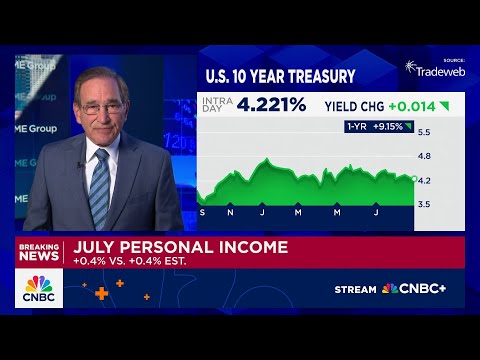
Inflation Metrics - Personal income increased by 04% in July, aligning with expectations [1] - Spending rose by 05% in July, meeting expectations [2] - Real spending, adjusted for inflation, increased by 03%, matching expectations and marking the best performance since March [2] - Month-over-month PCE increased by 02%, consistent with May's level [3] - Year-over-year PCE stood at 26%, precisely as anticipated [3] - Core PCE year-over-year reached 29%, slightly higher than the previous month's 28% [4][5] Trade Balance and Inventories - The trade deficit came in at negative 103 billion, exceeding expectations of negative 902 billion, and approaching the record deficit of negative 161 billion from March [6] - Wholesale inventories increased by 02% in July (preliminary) [6] - Retail inventories also increased by 02% in July [6] Market Reaction - The 2-year Treasury yield decreased slightly from 364% to 363%, compared to last Friday's close of 370% [7] - The 10-year Treasury yield remained relatively stable at 421%, unchanged from yesterday's close but lower than last Friday's close of 426% [7]