Supply and demand

Search documents
Current price of oil as of March 30, 2026
Yahoo Finance· 2026-03-30 12:39
Oil Price Trends - As of March 30, 2026, oil prices are at $111.10 per barrel, reflecting a decrease of 16 cents from the previous day and an increase of $37.69 over the past year [1] - The price of oil has seen significant changes, with a 50.93% increase over the past month and a 51.34% increase over the past year [2] Factors Influencing Oil Prices - The future of oil prices is uncertain and is influenced by various factors, primarily supply and demand dynamics, as well as geopolitical events such as economic downturns and wars [3] - The crude oil price significantly impacts gas prices, which are affected by additional costs along the supply chain, including refining, wholesaling, taxes, and local markups [4][5] U.S. Strategic Petroleum Reserve - The U.S. maintains a Strategic Petroleum Reserve to ensure energy security during emergencies, which can help mitigate severe price increases during supply shocks [6] - This reserve serves as a short-term solution to assist consumers and maintain essential economic functions, rather than a long-term strategy [7] Relationship Between Oil and Natural Gas Prices - Oil and natural gas are interconnected energy sources, where fluctuations in oil prices can lead to changes in natural gas demand, as industries may switch to natural gas when oil prices rise [8]
Gold price today, Monday, March 30: Gold holds strong, opening above $4,500
Yahoo Finance· 2026-03-30 11:11
Group 1: Gold Price Trends - Gold futures opened at $4,520 per troy ounce, which is 0.1% lower than the previous closing price of $4,524.30, but remained above $4,500 in early trading [1] - Gold has increased nearly 4% in just one week, recovering from its lowest price of 2026 [1][2] - The one-year gain for gold was reported at 95.6% as of January 29 [4] Group 2: Oil Prices and Geopolitical Context - Brent Crude prices are up close to 75% for the year due to the ongoing war in Iran [2] - The geopolitical situation is causing traders to assess the legitimacy of U.S. peace talks, impacting market sentiment [2] Group 3: Economic Implications - The rise in fuel prices poses a risk of broader inflation in the U.S. and globally, which could lead to higher interest rates [3] - Higher interest rates typically reduce demand for gold, as it does not yield interest [3] Group 4: Gold Pricing Mechanisms - The spot price of gold is the current market price for physical gold, while gold futures prices are contracts for future transactions [6][8] - The spot price is generally lower than retail prices due to additional costs like premiums for refining and marketing [7]
Gold IRA fees explained: What you'll actually pay
Yahoo Finance· 2026-03-26 19:29
Core Insights - The total cost of owning gold includes not only the market price but also dealer premiums, storage expenses, and account administration fees, particularly when held in a gold IRA [1][2][4] Gold IRA Costs - A gold IRA typically incurs annual maintenance costs ranging from a few hundred dollars, which include custody, storage, a one-time setup fee, and dealer markups [2][11] - Common fee types for gold IRAs include account setup fees ($50 to $300), storage fees ($100 to $300 annually), custodian fees ($75 to $300 annually), dealer premiums (2% to 10% above spot price), and transaction fees ($25 to $100 per transaction) [11][12] Factors Influencing Gold Prices - Gold prices are influenced by supply and demand dynamics, dealer premiums, collectible value, taxes, currency exchange rates, economic conditions, and account fees [2][3] Gold IRA Structure - Gold held in an IRA must meet IRS standards of 99.5% purity and is stored in secure vaults under IRS guidelines, which contributes to additional administrative and storage costs [7][8] Fee Comparison and Structure - Investors should compare fee structures among different gold IRA providers, as fees can be presented differently, with some bundling services into a single annual fee while others list separate charges [14][15] - Factors affecting total costs include the custodian, storage facility, amount of gold purchased, and account size [16][17] Long-term Cost Implications - The long-term cost of owning a gold IRA can accumulate significantly over time, with estimated annual fees ranging from $200 to $600, leading to total estimated fees of $1,000 to $3,000 over five years and $4,000 to $12,000 over twenty years [18][19]
Current price of oil as of March 24, 2026
Yahoo Finance· 2026-03-24 12:11
Core Viewpoint - Oil prices are currently experiencing a significant increase, with Brent crude trading at $102.47 per barrel, reflecting a rise of $1.03 from the previous day and $29.44 from a year ago [1]. Price Changes - The price of oil yesterday was $101.44, marking a 1.01% increase [2] - One month ago, oil was priced at $71.58, showing a substantial increase of 43.15% [2] - A year ago, the price was $73.03, indicating a 40.31% rise over the year [2] Market Dynamics - The future direction of oil prices remains uncertain, influenced by various factors including supply and demand dynamics, potential recessions, and geopolitical tensions [3]. Impact on Gas Prices - Crude oil prices significantly affect gas prices, often constituting more than half of the total cost per gallon at the pump [5]. - When oil prices rise, gas prices typically follow suit, while declines in oil prices do not always lead to immediate reductions in gas prices, a phenomenon referred to as "rockets and feathers" [5]. Strategic Petroleum Reserve - The U.S. maintains a Strategic Petroleum Reserve to ensure energy security during emergencies, such as sanctions or natural disasters, providing quick relief to consumers and supporting essential economic activities [6][5]. Relationship Between Oil and Natural Gas - Fluctuations in oil prices can impact natural gas demand, as industries may substitute natural gas for oil in certain operations when oil prices rise, thereby increasing natural gas demand [7].
Gold price today, Monday, March 23: Gold briefly falls below $4,300, its lowest price of 2026
Yahoo Finance· 2026-03-23 10:49
Core Insights - Gold prices have experienced a significant decline, with April futures opening at $4,515 per troy ounce, which is 1.3% lower than the previous closing price of $4,574.90, and fell below $4,250 during early trading [1][2] Group 1: Market Conditions - Inflation concerns due to the escalating Iran war have contributed to gold's drop to its lowest price in 2026 [2] - Oil prices remain high, with Brent Crude up approximately 75% year-to-date, exacerbating inflation fears [2] - The closure of the Strait of Hormuz has disrupted global oil supply, leading to increased fuel prices and potential broader inflation in the U.S. and globally [3] Group 2: Gold Price Trends - The one-week change in gold prices shows a decrease of 9.7%, while the one-month change is a decline of 11.8%, and the one-year change reflects a gain of 48.8% [8] - The current price of gold has seen a one-year gain of 95.6% as of January 29 [4] Group 3: Factors Influencing Gold Prices - Key factors affecting gold prices include geopolitical events, central bank buying trends, inflation, interest rates, and mining production [12]
A $10 Trillion Shift Most Investors Will Miss
Investor Place· 2026-03-21 16:00
Core Insights - The current market dynamics are influenced more by supply and demand rather than interest rates, which are often the focus of mainstream media [2][3] - Hidden supply bottlenecks, particularly in raw materials like copper, are becoming critical as demand surges due to the AI boom and related infrastructure needs [6][7] - Companies that can navigate these supply constraints are positioned to benefit significantly as capital shifts away from traditional AI winners to those supplying essential materials [11][16] Supply and Demand Dynamics - The AI megatrend is driving increased demand for raw materials, with copper demand expected to rise by approximately 50% by 2040, while the mining industry struggles to find new deposits [6][7] - The Global X Copper Miners ETF (COPX) indicates that demand has already led to price increases, suggesting a long-term uptrend despite recent pullbacks [8] - Power demand from data centers is projected to increase by 50% by 2027 and up to 165% by the end of the decade, highlighting the strain on power systems [9] Critical Components and Constraints - A shortage of memory chips is emerging, affecting major companies and their ability to scale operations, which is not being adequately covered by the media [10] - The upcoming earnings reports from major tech companies are expected to reveal constraints such as delays and rising costs, which could shift investor sentiment [13][14] - Eric Fry's analysis suggests that the market is on the verge of a regime change, where attention will shift to companies at the center of supply bottlenecks [11][12] Investment Opportunities - Companies supplying critical materials and components are likely to emerge as winners in the evolving market landscape, as they are less replaceable than those currently in the spotlight [11] - Early identification of these choke points in the supply chain could provide significant investment opportunities before mainstream media coverage catches up [16] - Eric Fry's FutureProof 2026 event highlighted specific constraints and provided insights into companies positioned to benefit from these emerging trends [15]


How oil's volatility is different from 2021's meme stock craze
Youtube· 2026-03-11 16:30
Core Insights - The article discusses the cyclical nature of crude oil markets, emphasizing that they are driven by real fundamentals such as supply and demand, contrasting with "meme stocks" that are influenced by hype [6]. Group 1: Market Dynamics - Crude oil markets experience dramatic price spikes driven by geopolitical events, as seen in 2008 and 2022, but these surges tend to fade faster than anticipated [6]. - The volatility in oil prices makes it a less favorable option for long-term buy-and-hold investment strategies [6]. Group 2: Investment Considerations - Investors in oil should be aware that the market is influenced by real economic factors rather than speculative trading [6]. - The article suggests that while oil can present short-term trading opportunities, it may not be suitable for long-term investment due to its cyclical nature [6].

Current price of oil as of March 11, 2026
Yahoo Finance· 2026-03-11 13:16
Oil Price Overview - As of March 11, 2026, the price of Brent crude oil is $90.96 per barrel, reflecting a decrease of $1.12 from the previous day and an increase of approximately $21 compared to the same time last year [1] - The price of oil yesterday was $92.08, showing a decline of 1.21%, while the price one month ago was $69.50, indicating a significant increase of 30.87% [2] Factors Influencing Oil Prices - Oil prices are primarily driven by supply and demand dynamics, with external factors such as economic slowdowns and geopolitical conflicts also playing a significant role [3] - The U.S. Strategic Petroleum Reserve serves as a safeguard for energy security during emergencies, helping to mitigate sudden price spikes caused by supply disruptions [5][6] Relationship Between Oil and Gas Prices - Crude oil is the largest contributor to gas pump prices, typically accounting for over half of the cost per gallon, with price increases in oil leading to rapid hikes in gas prices [4][5] - The relationship between oil and natural gas prices is interconnected; an increase in oil prices can lead to higher demand for natural gas as industries may switch to it where feasible [7] Historical Context and Benchmarking - Brent crude oil is recognized as the primary global oil benchmark, providing a better representation of global oil performance compared to West Texas Intermediate (WTI), which is mainly used in North America [8][9]
Corn, Soybeans, and Wheat May Be the ‘Next Silver’ for Traders
Yahoo Finance· 2026-03-09 19:00
Group 1: Grain Futures Performance - May corn futures rose 7 cents to $4.60 1/2, reaching a nearly four-month high, with a weekly increase of 12 cents [1] - May soybean futures increased by 21 1/2 cents to $12.00 3/4, hitting a two-year high, and rose 30 cents for the week [1] - May soft red winter wheat futures gained 33 cents to $6.16 3/4, achieving an eight-month high, with a weekly increase of 25 1/4 cents [1] - May hard red winter wheat rose 31 cents to $6.23 1/2, reaching a nine-month high, and was up 43 cents for the week [1] Group 2: Market Influences - Surging crude oil prices above $90 a barrel are seen as a bullish factor for the grain markets [2] - Speculators are increasingly focusing on grain markets, indicating a shift in investment interest as the metals markets mature [2] - The upcoming USDA supply and demand report is anticipated, although no major changes are expected [3] Group 3: Crop Conditions and Export Dynamics - Good growing conditions are forecasted for corn and soybeans in Brazil, while some dry areas in southern Argentina require rain [4] - U.S. corn export sales and shipments remain strong, but geopolitical tensions and rising fertilizer prices may pose challenges [5]
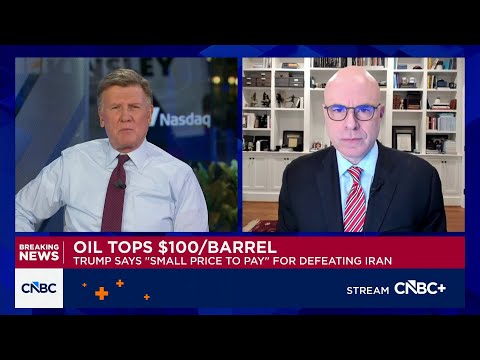
Oil prices will 'destroy' demand until supply goes back up, says ClearView's Kevin Book
CNBC Television· 2026-03-09 13:07
talk about oil and the spike in oil prices. Joining us now is Kevin Book, Clear View uh Energy Partners managing director. Kevin, it it's good to see you.We were a couple weeks ago, we were pretty well supplied the world, was it not. Is that uh not the case anymore. And I guess I'm getting to the difference between spot and futures and whether there is a a premium or a fear premium built into what what could happen versus what's actually happening.>> Good to see you, Joe. Uh the difference I think is also m ...