U型缩放定律

Search documents
DeepSeek V4路线图隐现?梁文锋署名重磅论文发布,聚焦大模型条件记忆模块
Jin Rong Jie· 2026-01-13 04:38
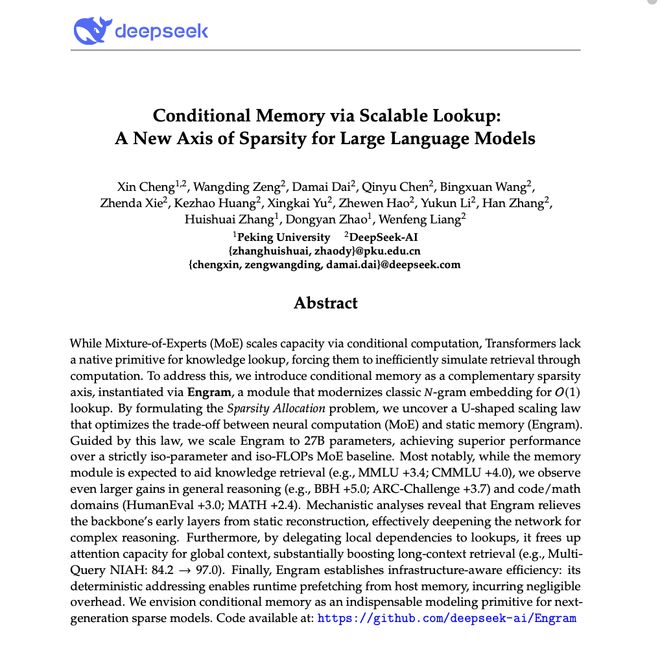
Core Insights - DeepSeek has released a significant research paper focusing on the conditional memory module for large models, indicating it will be a core modeling primitive in the next generation of sparse large models [1][4] - The upcoming flagship model V4 is expected to be unveiled around the Spring Festival, with the recent research results potentially outlining its core research roadmap [1][4] Summary by Sections Research Findings - The paper titled "Conditional Memory via Scalable Lookup: A New Axis of Sparsity for Large Language Models" was co-authored by DeepSeek and Peking University, with DeepSeek's founder Liang Wenfeng among the authors [4] - The core insight of the paper is that large models handle two distinct types of tasks: deep dynamic computation for combinatorial reasoning and static knowledge retrieval [4] - Existing Transformer architectures lack a native knowledge retrieval mechanism, leading to inefficient computation when simulating retrieval processes [4] Proposed Solutions - To address these inefficiencies, DeepSeek proposes the use of conditional memory as a supplementary dimension of sparsity, implemented through a module called Engram [5] - The team discovered a "U-shaped scaling law," indicating that a mixed sparse capacity allocation between MoE experts and Engram memory significantly outperforms pure MoE baseline models [5] - The Engram module is designed to optimize the balance between neural computation (MoE) and static memory, allowing for improved efficiency and performance in various domains, including general reasoning, coding, and mathematics [5] Future Developments - DeepSeek plans to release the next-generation flagship model V4 in February, with preliminary internal tests showing its programming capabilities surpass existing top models [6] - The V4 model is anticipated to be a focal point in the industry, especially following the success of the V3 model released at the end of 2024, which outperformed OpenAI's GPT-5 and Google's Gemini 3.0 Pro in several benchmark tests [6]


DeepSeek论文上新!下一代大模型实现“记忆分离”,V4不远了?
Di Yi Cai Jing Zi Xun· 2026-01-13 03:32
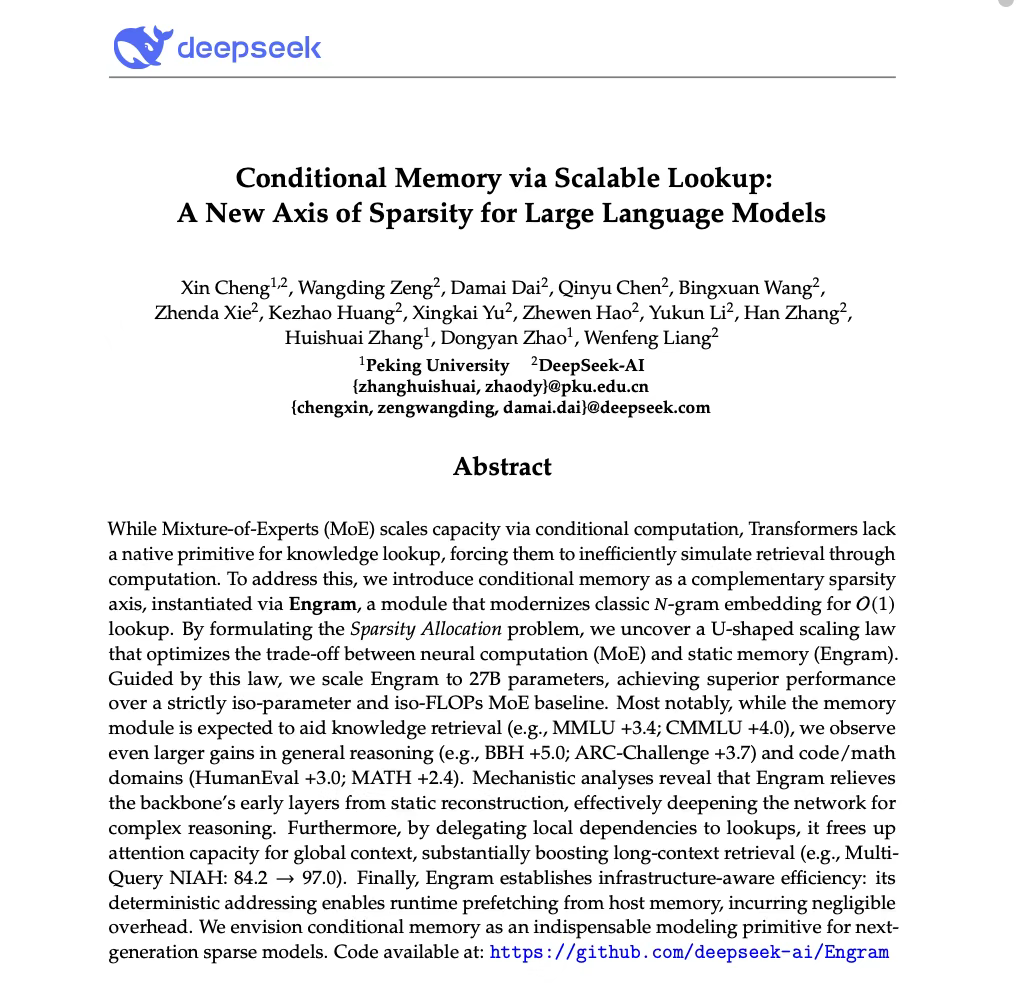
Core Insights - DeepSeek has released a new paper focusing on the conditional memory module of large models, suggesting it will be a core modeling primitive in the next generation of sparse large models [1][4]. Group 1: Research Findings - The new paper, co-authored with Peking University, is titled "Conditional Memory via Scalable Lookup: A New Axis of Sparsity for Large Language Models" and highlights the need for a native knowledge retrieval mechanism in existing Transformer architectures [4]. - The research identifies two distinct tasks in large models: deep dynamic computation for combinatorial reasoning and static knowledge retrieval, indicating that current models inefficiently simulate retrieval processes [4][5]. - DeepSeek introduces conditional memory as a supplementary dimension of sparsity, optimizing the trade-off between mixture of experts (MoE) and static memory (Engram) [4][6]. Group 2: Performance Improvements - The team discovered a U-shaped scaling law, showing that the mixed sparse capacity allocation between MoE experts and Engram memory significantly outperforms pure MoE baseline models [5]. - The introduction of the memory module not only aids knowledge retrieval but also yields notable improvements in general reasoning, coding, and mathematical tasks [5][6]. - The paper essentially proposes a "division of labor" optimization for large models, allowing specialized modules to handle specific tasks, thereby enhancing efficiency and resource allocation [6]. Group 3: Future Developments - Industry speculation suggests that the proposed conditional memory may be integral to the architecture of DeepSeek's upcoming flagship model, DeepSeek V4, expected to be released around February [6]. - Initial tests indicate that V4 may surpass other leading models in programming capabilities, with the previous model, V3, having already outperformed OpenAI's GPT-5 and Google's Gemini 3.0 Pro in various benchmarks [6].