
Urban Village Renovation

Search documents
中国房地产图表集:你需要的全部图表-China Property Chartbook_ All the charts you need. Wed Mar 18 2026
2026-03-24 01:27
Summary of China Property Chartbook Industry Overview - The report focuses on the **Chinese property market**, analyzing various aspects such as sales, construction, supply, policy, and risk assessment [5][6][8]. Key Points National Forecasts - **Sales Value**: The sales value in RMB billion is projected to decline from **12,473** in 2022 to **7,804** in 2026, reflecting a **-31.4%** change in 2022 and a **-7.0%** change in 2026 [8]. - **Residential Sales Volume**: Expected to decrease from **10,956** in 2022 to **6,827** in 2026, with a **-32.7%** change in 2022 and **-6.9%** in 2026 [8]. - **Average Selling Price**: The average selling price per square meter is projected to increase from **10,214** in 2022 to **9,381** in 2026, with a **0.7%** change in 2022 and a **-1.5%** change in 2026 [8]. Sales Trends - **National Residential Sales**: The report compares national residential sales with the top 100 developers' aggregate contracted sales, indicating a significant disparity in performance [11][12][22]. - **Sales by Tier**: The report highlights year-over-year changes in sales across different city tiers, indicating varying market dynamics [26]. Construction Activity - **New Starts**: New residential construction starts are projected to decline from **1,989** million sqm in 2022 to **259** million sqm in 2026, with a **-39.8%** change in 2022 [8][120]. - **Completion Rates**: Residential completions are expected to drop significantly, with a completion of **871** million sqm in 2022 and projected to decline to **343** million sqm by 2026 [8][138]. Supply Dynamics - **Inventory Levels**: The report discusses the inventory months based on sellable resources, indicating a potential oversupply in certain markets [158]. - **Land Sales**: Land sales value is projected to decrease from **3,339** billion RMB in 2022 to **1,608** billion RMB in 2026, reflecting a **-12.0%** year-over-year change [8][164]. Policy Environment - **Policy Easing**: The report notes that policy easing has been observed since January 2021, which may impact market recovery [175]. - **Monetary Policy Tools**: The People's Bank of China (PBOC) has implemented various monetary policy tools as of September 2024 to support the real estate sector [177]. Risk Assessment - **Market Risks**: The report assesses potential risks in the property market, including economic downturns and regulatory changes that could impact sales and construction [5][8]. Long-term Forecasts - **Future Projections**: Long-term forecasts indicate a continued decline in sales and construction activity, with significant implications for the overall health of the property market [5][8]. Additional Insights - **Urban Village Renovation**: The report includes scenario analyses on the impact of urban village renovations on real estate investment and property sales, indicating potential for increased demand if executed effectively [138][146]. - **Market Share**: The market share of state-owned enterprises (SOEs) in land acquisitions and sales is highlighted, showing their dominance in the market [167]. This comprehensive analysis provides a detailed overview of the current state and future outlook of the Chinese property market, highlighting key trends, risks, and policy impacts that investors should consider.
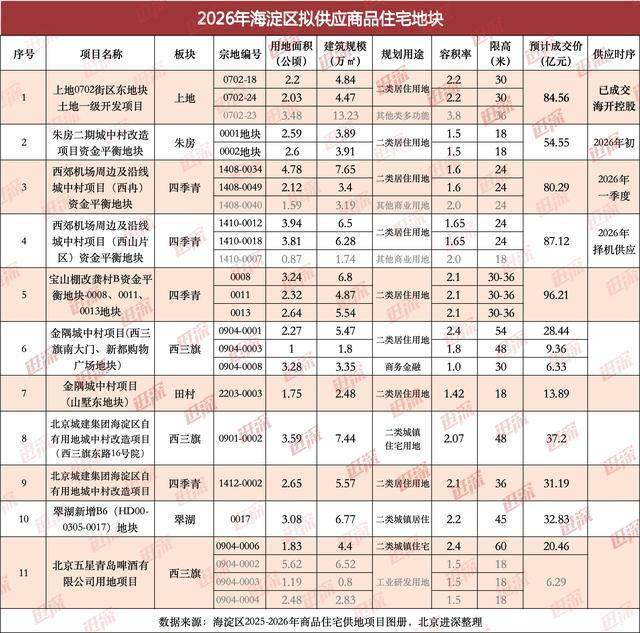
2026年海淀供地计划:朱房、宝山追兵杀到,四季青集中放量
Sou Hu Cai Jing· 2026-01-06 07:10
Core Insights - The article discusses the planned supply of residential land in Haidian District, with a total of 11 plots, including 19 residential land parcels, covering a planned construction area of 517,200 square meters [1][3]. - The expected transaction price for these land parcels is projected to exceed 58 billion yuan [2]. Group 1: Land Supply Details - The Haidian District plans to supply residential land parcels, with specific projects listed, including the Shangdi 0702 block, which has already been sold for 8.456 billion yuan, reflecting a symbolic premium of 0.4% [3][4]. - The supply includes new offerings in the Zhu Fang area and the West Sanqi area, with the latter featuring four pure residential plots, enhancing options for first-time buyers in northern Haidian [4]. Group 2: Project Progress and Requirements - The Zhu Fang second phase urban village renovation project has completed demolition and is currently processing land requisition approvals, with plans to enter the market in early 2026 [11][13]. - The West Airport area projects have obtained necessary planning approvals and are preparing for market entry, with various assessments completed [18][21]. - The Baoshan urban village project has also made significant progress, with demolition nearing completion and various evaluations underway [34][40]. Group 3: Financial Projections - The expected transaction prices for various plots are detailed, with the Baoshan project estimated at 9.621 billion yuan for three plots, while the West Sanqi project is projected at 44.13 billion yuan for multiple parcels [27][33]. - The total expected transaction value for the residential land supply in Haidian District is anticipated to exceed 58 billion yuan, indicating strong demand in the real estate market [2].

投资者报告:中国市场今年秋季的刺激与改革-Investor Presentation Asia Pacific This Fall Stimulus and Reform
2025-09-22 02:02
Summary of Key Points from the Conference Call Industry Overview - The conference call primarily discusses the **Chinese economy** and its macroeconomic indicators, particularly focusing on household savings and consumption patterns. Core Insights and Arguments 1. **GDP Growth Projections**: The GDP growth for Q3 is expected to slow to **4.5%** with a supplementary budget of **Rmb0.5-1 trillion** anticipated in late September or early Q4 [3][4][5] 2. **Infrastructure Investment**: There is a call for increased funding for infrastructure capital expenditure (capex) and modest support for consumption, utilizing multi-fiscal tools to address local government payables to the private sector [3][4] 3. **Housing Market Challenges**: The housing inventory digestion remains a significant challenge, particularly in lower-tier cities, which face elevated inventory levels compared to tier 1-2 cities [6][7] 4. **Household Savings Dynamics**: Chinese households have accumulated approximately **Rmb30 trillion** in excess savings since 2018, with **Rmb6-7 trillion** in excess time deposits noted over the past 2-3 years [12][20][52] 5. **Consumption Potential**: There is a significant potential for consumption growth if excess savings can be unlocked, with a proposed three-stage roadmap to transition these savings into consumption and investment [51][68] 6. **Social Safety Net Issues**: The high household saving rate is attributed to insufficient social safety nets, which has led to structural and cyclical excess savings [16][19] 7. **Policy Implications**: The economic implications of unwinding excess savings could vary significantly based on policy assumptions, with potential consumption boosts ranging from **1-2.2 percentage points** in annual growth from 2026-2030 depending on the reform trajectory [72] Additional Important Insights 1. **Household Asset Allocation**: There is a growing imbalance in household asset allocation, with a notable increase in cash holdings since the housing downturn began [25][27] 2. **Comparative Analysis**: The report compares household saving behaviors in China with those in other major economies, highlighting that Chinese households allocate a larger share of financial assets to cash and deposits [28][29] 3. **Risk Appetite Revival**: Signs of a revival in household risk appetite are emerging, indicated by a narrowing gap between household deposits and M2 money supply [54][56] 4. **Reform Roadmap**: A clearer reform blueprint is expected in the upcoming 15th Five-Year Plan, focusing on social welfare reforms to lower the structurally high household saving rate [69][70] This summary encapsulates the critical points discussed in the conference call, providing insights into the current state and future outlook of the Chinese economy, particularly regarding household savings and consumption dynamics.