Web交互范式

Search documents
谷歌Chrome深夜爆更,Agent不用「装」人了,前端最后防线崩了?
3 6 Ke· 2026-02-11 04:12
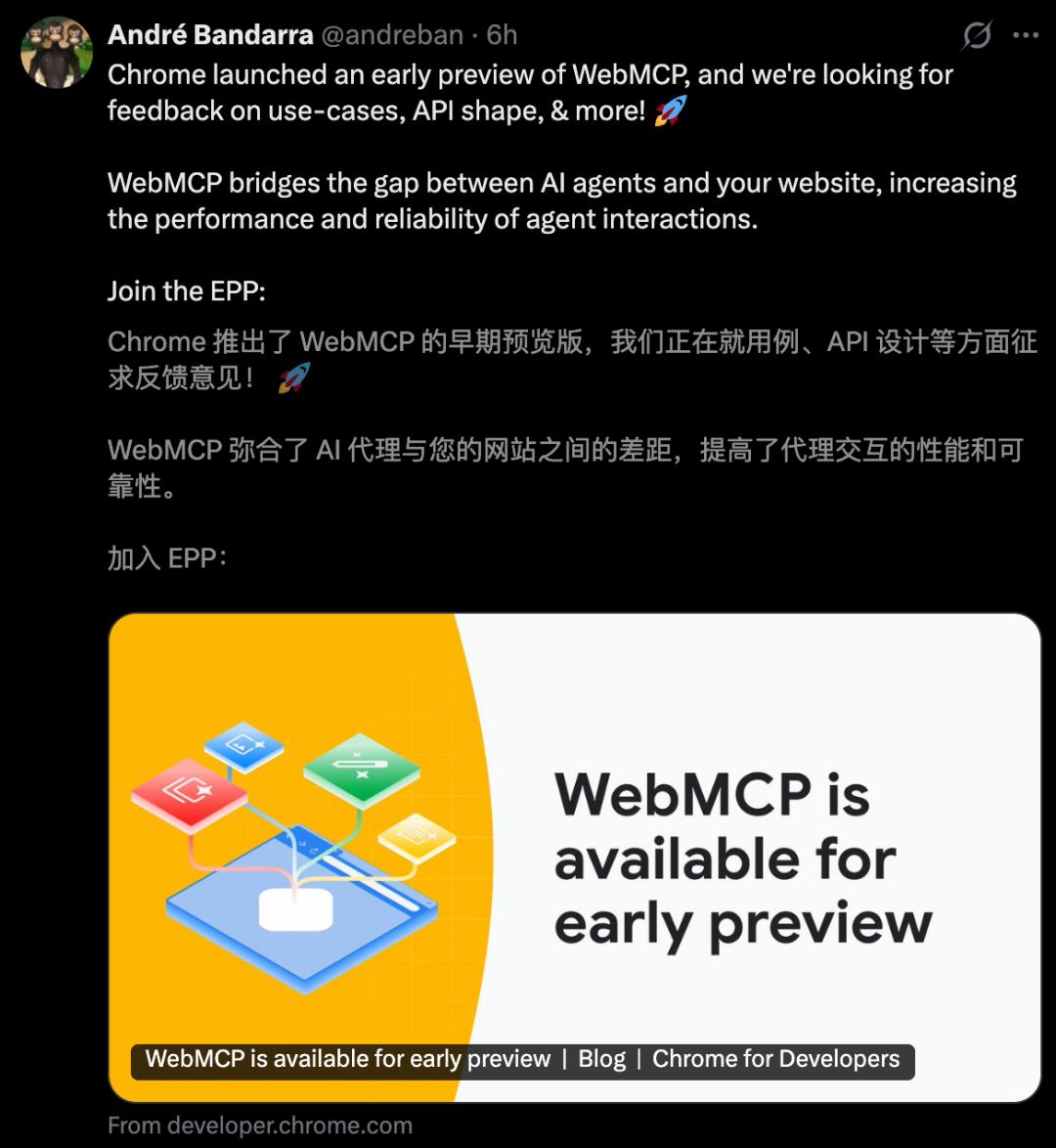
Core Insights - Google Chrome team has introduced WebMCP (Web Model Context Protocol), allowing AI agents to interact directly with websites and web applications, bypassing the human user interface [1][6][7] Group 1: WebMCP Overview - WebMCP enables AI agents to skip visual simulations and interact with web applications through a direct API, enhancing efficiency [6][12] - The protocol represents a significant shift from traditional web interaction paradigms, moving towards a logic-based connection [7][9] - WebMCP is seen as a "superpower" for agents, allowing them to execute commands directly on websites without manual navigation [6][9] Group 2: Advantages of WebMCP - The protocol offers three main advantages: code reuse, unified interface for users and agents, and enhanced accessibility for assistive technologies [27][25] - It allows agents to perform tasks like booking flights or making purchases more efficiently by directly calling functions instead of navigating through UI [28][30] - WebMCP aims to create a collaborative environment where users, web pages, and agents can work together seamlessly [20][25] Group 3: Development and Collaboration - WebMCP is a collaborative project initiated by Google and Microsoft, indicating a joint effort to redefine web interactions [21][23] - Developers are provided with two flexible API access methods: declarative API for standard operations and imperative API for complex interactions [18][19] Group 4: Future Implications - The introduction of WebMCP is expected to accelerate the transition from manual searches to automated execution by AI agents, marking a new era in web interaction [39][38] - The future web may evolve into a two-layer structure, focusing on discovery of tools and clear data schemas, enhancing the interaction between users and AI [36][37]