Nvidia GTC 2025

Search documents
Nvidia CEO Jensen Huang announces new partnerships in GTC keynote, gold extends sell-off
Yahoo Finance· 2025-10-28 21:06
Market Domination anchor Josh Lipton breaks down the latest financial news for October 28, 2025. Nvidia CEO and co-founder Jensen Huang announced a partnership with the United States Department of Energy to build seven new AI supercomputers at the chipmaker's 2025 GTC event on Tuesday.. Huang also announced partnerships with Palantir, Uber, CrowdStrike, and others. Josh speaks with Daniel Newman of Futurum about Jensen Huang's announcements of these partnerships, Nvidia's record stock moves, and what it mea ...



HBM的大赢家
半导体芯闻· 2025-03-20 10:26
Core Viewpoint - SK Hynix has launched the sixth generation of high bandwidth memory (HBM4), which will be utilized in Nvidia's next-generation AI accelerators, showcasing a significant advancement in memory technology [1][2]. Group 1: HBM4 Development and Features - SK Hynix announced the introduction of HBM4, which offers over 2 TB/s bandwidth, capable of processing over 400 full HD movies in one second [1]. - HBM4 is reported to be over 60% faster than its predecessor HBM3E, with improvements in stability through better heat management and chip warping control [1][2]. - The company plans to start mass production of HBM4 12-layer products in the second half of 2024 and HBM4 16-layer products in 2026 [1]. Group 2: Market Position and Competition - SK Hynix holds a 65% share of the global HBM market, followed by Samsung at 32% and Micron at 3%, maintaining its position as the primary supplier for Nvidia's latest AI chips [2]. - The competition among suppliers like SK Hynix, Samsung, and Micron is intensifying as they accelerate the development of HBM technology to meet the growing demand for AI applications [2]. Group 3: Technological Advancements - The development of the sixth generation DDR5 DRAM technology is expected to enhance HBM performance, with a focus on reducing power consumption and improving memory efficiency [3][4]. - SK Hynix aims to leverage the advancements in DRAM technology to increase HBM capacity while maintaining chip size, which will positively impact thermal management [4].

黄仁勋没有告诉我们的细节
半导体芯闻· 2025-03-19 10:34
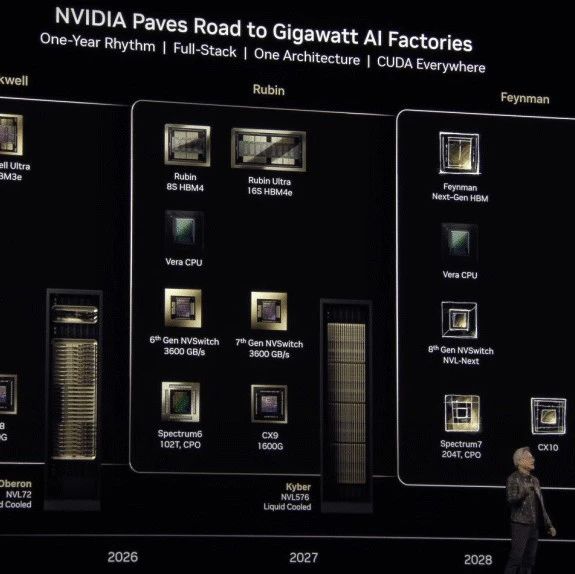
Core Insights - The rapid advancement of AI models is accelerating, with improvements in the last six months surpassing those of the previous six months, driven by three overlapping expansion laws: pre-training expansion, post-training expansion, and inference time expansion [1][3]. Group 1: AI Model Developments - Claude 3.7 showcases remarkable performance in software engineering, while Deepseek v3 indicates a significant reduction in costs associated with the previous generation of models, promoting further adoption [3]. - OpenAI's o1 and o3 models demonstrate that longer inference times and searches yield better answers, suggesting that adding more computation post-training is virtually limitless [3]. - Nvidia aims to increase inference efficiency by 35 times to facilitate model training and deployment, emphasizing a shift in strategy from "buy more, save more" to "save more, buy more" [3][4]. Group 2: Market Concerns and Demand - There are concerns in the market regarding the rising costs due to software optimizations and hardware improvements driven by Nvidia, potentially leading to a decrease in demand for AI hardware and a symbolic oversupply situation [4]. - As the cost of intelligence decreases, net consumption is expected to increase, similar to the impact of fiber optics on internet connection costs [4]. - Current AI capabilities are limited by cost, but as inference costs decline, demand for intelligence is anticipated to grow exponentially [4]. Group 3: Nvidia's Roadmap and Innovations - Nvidia's roadmap includes the introduction of Blackwell Ultra B300, which will not be sold as a motherboard but as a GPU with enhanced performance and memory capacity [11][12]. - The B300 NVL16 will replace the B200 HGX form factor, featuring 16 packages and improved communication capabilities [12]. - The introduction of CX-8 NIC will double network speed compared to the previous generation, enhancing overall system performance [13]. Group 4: Jensen's Mathematical Rules - Jensen's new mathematical rules complicate the understanding of Nvidia's performance metrics, including how GPU counts are calculated based on chip numbers rather than package counts [6][7]. - The first two rules involve representing Nvidia's overall FLOP performance and bandwidth in a more complex manner, impacting how specifications are interpreted [6]. Group 5: Future Architecture and Performance - The Rubin architecture is expected to deliver over 50 PFLOPs of dense FP4 computing power, significantly enhancing performance compared to previous generations [16]. - Nvidia's focus on larger tensor core arrays in each generation aims to improve data reuse and reduce control complexity, although programming challenges remain [18]. - The introduction of the Kyber rack architecture aims to increase density and scalability, allowing for a more efficient deployment of GPU resources [27][28]. Group 6: Inference Stack and Dynamo - Nvidia's new inference stack and Dynamo aim to enhance throughput and interactivity in AI applications, with features like intelligent routing and GPU scheduling to optimize resource utilization [39][40]. - The improvements in the NCCL collective inference library are expected to reduce latency and enhance overall throughput for smaller message sizes [44]. - The NVMe KV-Cache unload manager will improve efficiency in pre-filling operations by retaining previous conversation data, thus reducing the need for recalculation [48][49]. Group 7: Cost Reduction and Competitive Edge - Nvidia's advancements are projected to significantly lower the total cost of ownership for AI systems, with predictions of rental price declines for H100 chips starting in mid-2024 [55]. - The introduction of co-packaged optics (CPO) solutions is expected to reduce power consumption and enhance network efficiency, allowing for larger-scale deployments [57][58]. - Nvidia continues to lead the market with innovative technologies, maintaining a competitive edge over rivals by consistently advancing its architecture and algorithms [61].