
旅游科技

Search documents
WELCOME HOME LIMITED减持飞道旅游科技1186.5万股 每股作价0.055港元
Zhi Tong Cai Jing· 2026-03-03 13:06
香港联交所最新数据显示,1月26日,WELCOME HOME LIMITED减持飞道旅游科技(08069)1186.5万 股,每股作价0.055港元,总金额约为65.26万港元。减持后最新持股数目为3100万股,最新持股比例为 3.80%。 ...
WELCOME HOME LIMITED减持飞道旅游科技(08069)1186.5万股 每股作价0.055港元
智通财经网· 2026-03-03 13:03
智通财经APP获悉,香港联交所最新数据显示,1月26日,WELCOME HOME LIMITED减持飞道旅游科 技(08069)1186.5万股,每股作价0.055港元,总金额约为65.26万港元。减持后最新持股数目为3100万 股,最新持股比例为3.80%。 ...
CHIN HANG增持飞道旅游科技1673.5万股 每股作价0.039港元
Zhi Tong Cai Jing· 2026-01-12 11:47
Core Viewpoint - CHIN HANG has increased its stake in Feidao Tourism Technology (08069) by acquiring 16.735 million shares at a price of HKD 0.039 per share, totaling approximately HKD 652,700, resulting in a new holding of about 42.865 million shares, representing 5.24% of the company [1] Summary by Category Shareholding Activity - CHIN HANG purchased 16.735 million shares of Feidao Tourism Technology at HKD 0.039 per share [1] - The total investment amounted to approximately HKD 652,700 [1] - Following this transaction, CHIN HANG's total shareholding in Feidao Tourism Technology increased to approximately 42.865 million shares, equating to a 5.24% ownership stake [1]
CHIN HANG增持飞道旅游科技(08069)1673.5万股 每股作价0.039港元
智通财经网· 2026-01-12 11:42
Group 1 - CHIN HANG increased its stake in Feidao Tourism Technology (08069) by acquiring 16.735 million shares at a price of HKD 0.039 per share, totaling approximately HKD 652,700 [1] - After the acquisition, CHIN HANG's total shareholding in Feidao Tourism Technology reached approximately 42.865 million shares, representing a holding percentage of 5.24% [1]
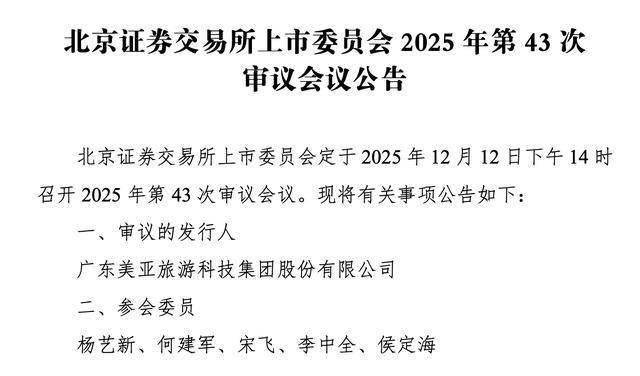
美亚科技IPO状态变更为通过
Xin Lang Cai Jing· 2025-12-12 14:19
Group 1 - The core point of the article is that Guangdong Meiya Tourism Technology Group Co., Ltd. has successfully transitioned its IPO status from "inquiry" to "approved" as of December 12, 2025 [1] Group 2 - The approval of the IPO indicates a significant step forward for the company in its capital-raising efforts [1] - This change in status may enhance the company's visibility and credibility in the market [1] - The approval could potentially lead to increased investment interest and opportunities for growth within the tourism technology sector [1]
美亚科技IPO“迎考”:两对夫妻合计控制66%表决权,广发证券保荐
Sou Hu Cai Jing· 2025-12-08 08:27
Core Viewpoint - Meiya Technology is set to hold its IPO meeting on December 12, 2023, under the sponsorship of GF Securities [1] Group 1: Company Overview - Meiya Technology is a comprehensive solution provider for the travel industry, with three main business segments: Meiya Air Travel, Meiya Business Travel, and Meiya Travel, offering digital travel services covering ticketing, business travel management, and incentive travel [3] - The company reported revenues of 457 million yuan in 2022, with projections of 354 million yuan in 2023, 401 million yuan in 2024, and 183 million yuan for the first half of 2025 [3] Group 2: Financial Performance - The total assets of Meiya Technology are projected to reach approximately 1.18 billion yuan by June 30, 2025, up from 762.61 million yuan in 2022 [4] - The net profit attributable to the parent company is expected to increase from 40.33 million yuan in 2022 to 77.40 million yuan in 2024, with a forecast of 36.28 million yuan for the first half of 2025 [4] - The company’s gross profit margin is projected to be 55.47% in the first half of 2025, compared to 32.00% in 2022 [4] Group 3: Shareholding Structure - The shareholding structure of Meiya Technology is dispersed, with no single shareholder holding more than 50% of the shares, thus no controlling shareholder exists [6] - The actual controllers of the company include Wu Junxiong (30.13% ownership), Chen Peigang (23.01%), Chen Lianjiang (6.02%), and Cai Jiewen (3.77%), collectively controlling 66.29% of the voting rights [5][6] - Wu Junxiong and Chen Lianjiang are married, as are Chen Peigang and Cai Jiewen, indicating familial ties among the major shareholders [5][6] Group 4: Governance Agreements - To ensure long-term stability and control, the actual controllers signed a joint action agreement in January 2017, which was extended in November 2024 for an additional 15 years [7] - The agreement stipulates that the parties must jointly exercise their shareholder rights and communicate effectively to reach consensus on shareholder meeting decisions [7]


美亚科技12月12日北交所首发上会 拟募资3.6亿元
Zhong Guo Jing Ji Wang· 2025-12-05 13:48
Core Viewpoint - Beijing Securities Exchange will review the initial public offering (IPO) of Guangdong Meiya Tourism Technology Group Co., Ltd. on December 12, 2025, aiming to raise approximately 359.99 million yuan for various business projects [1] Group 1: IPO Details - Meiya Technology plans to raise 359.99 million yuan for projects including smart travel business development, international business expansion, brand promotion, and working capital [1] - The sponsor for the IPO is GF Securities Co., Ltd., with representatives Chen Shengzhen and Guo Guo [1] Group 2: Shareholding Structure - As of the signing date of the prospectus, the company's shareholding structure is dispersed, with no single shareholder holding more than 50% of the shares, indicating no controlling shareholder [1] - The actual controllers of the company include Wu Junxiong (30.13% direct ownership), Chen Peigang (23.01%), Chen Lianjiang (6.02%), and Cai Jiewen (3.77%) [1] - Wu Junxiong and Chen Lianjiang are spouses, while Chen Peigang and Cai Jiewen are also spouses, and Chen Lianjiang and Chen Peigang are siblings [2]
飞道旅游科技:王琛维辞任执行董事
Zhi Tong Cai Jing· 2025-12-02 10:03
Core Viewpoint - Feidao Tourism Technology (08069) announced that Mr. Wang Chenwei will resign from his position as executive director effective December 2, 2025, to dedicate more time to his other business commitments [1] Group 1 - The resignation of Mr. Wang Chenwei is a strategic decision to focus on other business ventures [1]
飞道旅游科技发布中期业绩 股东应占亏损378.8万港元 同比增长610.69%
Zhi Tong Cai Jing· 2025-11-26 12:39
Group 1 - The company, Feidao Tourism Technology (08069), reported a revenue of HKD 140 million for the six months ending September 30, 2025, representing a year-on-year decrease of 19.2% [1] - The loss attributable to the company's owners for the period was HKD 3.788 million, which is a significant increase of 610.69% compared to the previous year [1] - The basic loss per share was HKD 0.53 [1]
飞道旅游科技(08069)发布中期业绩 股东应占亏损378.8万港元 同比增长610.69%
智通财经网· 2025-11-26 12:36
Group 1 - The company, Feidao Tourism Technology (08069), reported a revenue of HKD 140 million for the six months ending September 30, 2025, representing a year-on-year decrease of 19.2% [1] - The loss attributable to the company's owners for the period was HKD 3.788 million, which is a significant increase of 610.69% compared to the previous year [1] - The basic loss per share was HKD 0.53 [1]