
Restaurants

Search documents
Is Dutch Bros Winning the Coffee Wars With Traffic, Not Pricing?
ZACKS· 2026-01-12 15:40
Core Insights - Dutch Bros Inc. (BROS) is focusing on traffic growth rather than aggressive pricing strategies to differentiate itself in the competitive coffee market [1][5] Sales Performance - In Q3 2025, same-shop sales increased by 5.7%, primarily driven by a 4.7% rise in transactions, with pricing contributing about two points [2][8] - The company's traffic growth is attributed to the Order Ahead feature, which accounted for 13% of sales, and the Dutch Rewards program, which made up approximately 72% of system transactions [3][8] Operational Efficiency - Improvements in labor deployment and throughput have enabled Dutch Bros to manage long drive-thru lines effectively without compromising service quality [4][8] - The early-stage food rollout is contributing to increased morning visits, enhancing overall traffic [4] Market Positioning - Dutch Bros is gaining market share by fostering customer habits rather than relying on price elasticity, positioning itself as a more sustainable model in the coffee industry [5] Stock Performance and Valuation - BROS shares have decreased by 1.7% over the past six months, compared to a 5.2% decline in the industry, with competitors like Starbucks and Chipotle experiencing larger declines [6] - The forward price-to-sales (P/S) multiple for BROS is 5.03, higher than the industry average of 3.58, while competitors have lower P/S multiples [9] Earnings Estimates - The Zacks Consensus Estimate for BROS' 2026 earnings per share has risen to 88 cents, indicating a projected 29.8% increase in earnings [12]




Krispy Kreme(DNUT) - 2026 FY - Earnings Call Transcript
2026-01-12 15:02
Financial Data and Key Metrics Changes - The company has not yet released its 2025 results, but it is expected to announce its fourth quarter and full-year 2025 results in late February [2] - The company operates in over 40 countries with approximately 2,100 company-owned and franchise shops, selling more than 1 billion donuts annually [2] Business Line Data and Key Metrics Changes - The company is focusing on a capital-light growth strategy, emphasizing refranchising and off-premise distribution to grocery and convenience stores [4][5] - A recent hub opened in Minneapolis achieved $1 million in profitable sales from one donut shop in just 17 days, marking a record-breaking opening for the company [11] Market Data and Key Metrics Changes - The company has seen significant growth in digital commerce, which now represents about 20% of retail sales, with a 17% growth in digital sales in the third quarter of the previous year [34][35] - The company is in less than half of the store networks of major partners like Target and Walmart, indicating substantial growth opportunities [24] Company Strategy and Development Direction - The company has implemented a turnaround plan focused on refranchising, driving returns on invested capital (ROIC), expanding margins, and achieving quality growth [5][10] - The company aims to leverage existing production capacity and reduce capital expenditures while improving free cash flow generation [14] Management's Comments on Operating Environment and Future Outlook - Management expressed confidence in the brand's growth potential, citing high brand awareness and a relatively low penetration rate in the U.S. market [3] - The leadership team is focused on sustainable and profitable growth while deleveraging the balance sheet [41][42] Other Important Information - The company has a loyalty program with 16 million members in the U.S., which helps engage customers and promote new product offerings [37][38] - The company is continuously innovating its product offerings, including limited-time offerings and seasonal menu items, to maintain consumer interest [28][29] Q&A Session Summary Question: Why is Krispy Kreme evolving to a capital-light international franchise model? - The company has a proven global franchise model and aims to grow faster using outside capital [6] Question: What are the implications for average weekly sales of the doors added versus those eliminated? - New doors are performing better in average weekly sales compared to the eliminated ones, with Walmart locations achieving over $1,000 in weekly sales [25] Question: How is the company approaching digital sales and its loyalty program? - Digital sales represent about 20% of retail sales, and the loyalty program has been effective in engaging customers and promoting new products [34][37]
Krispy Kreme(DNUT) - 2026 FY - Earnings Call Transcript
2026-01-12 15:02
Financial Data and Key Metrics Changes - The company has not yet released its fourth quarter and full-year 2025 results, which are expected in late February [2] - The company operates in over 40 countries with approximately 2,100 company-owned and franchise shops, selling more than 1 billion donuts annually [2] Business Line Data and Key Metrics Changes - The company is focusing on a capital-light growth strategy, emphasizing refranchising and off-premise distribution to grocery and convenience stores [4][5] - A new hub opened in Minneapolis, achieving $1 million in profitable sales from one shop in just 17 days, marking a record-breaking opening [11] Market Data and Key Metrics Changes - The company has seen significant growth in digital commerce, which now represents about 20% of retail sales, with a 17% increase in the third quarter of the previous year [34][35] - The company is in less than half of the store networks of major partners like Target and Walmart, indicating substantial growth opportunities [24] Company Strategy and Development Direction - The company has implemented a turnaround plan focused on refranchising, improving returns on capital, expanding margins, and ensuring quality growth [5][10] - The company aims to leverage existing production capacity while reducing capital expenditures, with a focus on operational improvements [14] Management's Comments on Operating Environment and Future Outlook - Management expressed confidence in the brand's growth potential, citing low household penetration in the U.S. and the need for improved access to products [3][4] - The leadership team is committed to executing the turnaround plan and achieving long-term profitable growth [41][42] Other Important Information - The company has a loyalty program with 16 million members in the U.S., aimed at enhancing customer engagement and driving sales [38] - The company is focusing on its iconic Original Glazed donut, which represents more than half of its sales and is a key driver of profitability [27] Q&A Session Summary Question: Why is Krispy Kreme evolving to a capital-light international franchise model? - The company has a proven global franchise model and aims to grow faster using outside capital [6] Question: What are the implications for average weekly sales of the doors added versus those eliminated? - New doors are performing better than the average, with Walmart locations achieving over $1,000 in weekly sales [25] Question: How is the company approaching digital sales and its loyalty program? - Digital sales are increasing, representing 20% of retail sales, and the loyalty program has been relaunched to engage customers effectively [34][37]
Krispy Kreme(DNUT) - 2026 FY - Earnings Call Transcript
2026-01-12 15:00
Financial Data and Key Metrics Changes - The company has not yet released its 2025 results, and discussions are limited to public disclosures [2] - The company operates in over 40 countries with approximately 2,100 shops and 15,000 global points of access, selling over 1 billion donuts annually [2] Business Line Data and Key Metrics Changes - The company is focusing on a capital-light growth strategy, emphasizing refranchising and improving returns on invested capital (ROIC) [4][5] - A new hub opened in Minneapolis, achieving $1 million in profitable sales within 17 days, marking a record-breaking opening for the company [12] Market Data and Key Metrics Changes - The company has seen significant growth in digital commerce, representing about 20% of retail sales, with a 17% increase in digital sales in the third quarter of the previous year [35][36] - The company is working to expand its presence in major retailers like Walmart and Target, currently reaching less than half of their store networks [25] Company Strategy and Development Direction - The company has implemented a turnaround plan focused on sustainable and profitable growth, which includes refranchising, driving ROIC, expanding margins, and quality growth [4][5] - The company aims to leverage existing capacity and reduce capital expenditures (CapEx) while improving free cash flow generation [15] Management's Comments on Operating Environment and Future Outlook - Management expressed confidence in the brand's growth potential, citing low household penetration in the U.S. and the need for improved access to products [3][4] - The leadership team is committed to executing the turnaround plan and achieving long-term profitable growth [42][43] Other Important Information - The company has a loyalty program with 16 million members in the U.S., which helps engage customers and promote new products [39][40] - The company is focusing on its iconic Original Glazed donut, which represents more than half of its sales and is a key driver of profitability [28][30] Q&A Session Summary Question: How is Krispy Kreme evolving to a capital-light international franchise model? - The company has a proven global franchise model and is focusing on partnerships with capable operators to grow faster using outside capital [6][7] Question: Would the company consider refranchising select markets within the U.S.? - The company is not ruling out selective refranchising in the U.S. but is currently focused on improving profitability and efficiency in its company-owned operations [10] Question: What are the implications for average weekly sales of the doors added versus those eliminated? - New doors are performing better in average weekly sales compared to the eliminated ones, with Walmart being a strong partner achieving over $1,000 in weekly sales [26]
Ditch the Resolutions, Keep the Savings: Denny’s Launches NEW Slammin’ Meal Deals Starting at $5.99
Globenewswire· 2026-01-12 15:00
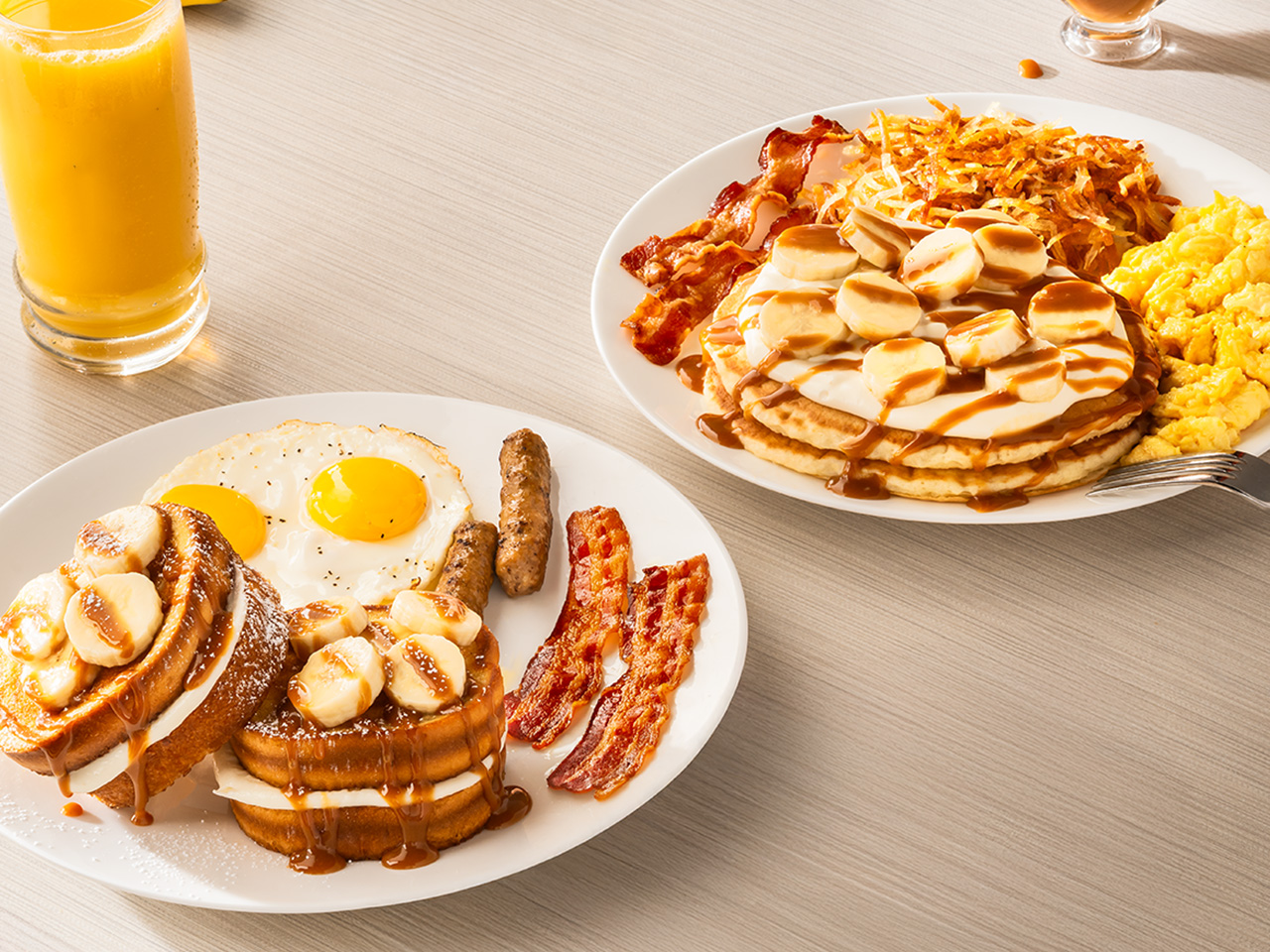
Core Insights - Denny's is promoting comfort food during the "un-resolution" season, coinciding with Quitter's Day, by offering a new Value Menu and bringing back the Salted Caramel Banana Slams [1][3] Group 1: New Menu Offerings - Denny's has introduced the "Slammin' Meal Deals" starting at $5.99, featuring a variety of full meals for breakfast, lunch, and dinner [2][3] - The Salted Caramel Banana Slams are returning, available in pancake or French toast options, appealing to customers looking for indulgent flavors [4][12] Group 2: Customer Engagement and Rewards - Denny's Rewards program allows members to earn 10 Booth Bucks for every dollar spent, redeemable for free food, and offers exclusive deals throughout the year [5] - New customers signing up for Denny's Rewards receive a welcome offer for immediate use, enhancing customer loyalty [5] Group 3: Company Overview - Denny's has over 70 years of experience in the family dining sector, emphasizing a commitment to providing craveable meals at a meaningful value [7] - As of September 24, 2025, Denny's operates 1,459 restaurants globally, with 1,397 being franchised [8]

Take the Zacks Approach to Beat the Markets: Indivior, FIGS & Ulta Beauty in Focus
ZACKS· 2026-01-12 14:46
Market Overview - U.S. stock markets ended positively with the Nasdaq Composite, Dow Jones Industrial Average, and S&P 500 gaining 1.18%, 1.08%, and 0.93% respectively despite mid-week volatility [1] - Market direction was influenced by U.S. policy developments regarding Venezuela, enthusiasm for AI-linked technology stocks, and mixed economic data [1] Economic Indicators - The manufacturing Purchasing Managers' Index (PMI) fell to 47.9 in December 2025, the lowest since October 2024, indicating contraction [2] - Conversely, the Services PMI unexpectedly rose to 54.4 in December from 52.6 in the previous month, indicating expansion [2] - Nonfarm Payrolls increased by 50,000 jobs in December, below expectations, while the unemployment rate slightly declined to 4.4% from 4.5% in November [2] - Average Hourly Earnings increased by 3.8% year-over-year, up from 3.6% in November [2] Stock Performance - Indivior PLC shares rose 21.7% since being upgraded to Zacks Rank 1 (Strong Buy) on October 31, outperforming the S&P 500's 2% increase [4] - FormFactor, Inc. shares increased by 15.9% since its upgrade to Zacks Rank 2 (Buy) on October 31, also outperforming the S&P 500 [5] - An equal-weight portfolio of Zacks Rank 1 stocks outperformed the equal-weight S&P 500 index by 7 percentage points, returning +17.81% compared to +10.85% for the index [5] Focus List and Model Portfolios - The Zacks Focus List portfolio returned +22.1% in 2025, outperforming the S&P 500 index's +17.9% gain [12] - The Focus List has consistently outperformed the S&P 500 over various time frames, including a +22.1% return in the last year compared to +17.9% for the index [14] - The Earnings Certain Admiral Portfolio (ECAP) returned -1.67% in 2025, underperforming the S&P 500's +17.9% gain [15] - The Earnings Certain Dividend Portfolio (ECDP) returned -0.6% in 2025, also underperforming compared to the S&P 500 [19] Notable Stock Recommendations - FIGS, Inc. shares surged 56.8% since being upgraded to Outperform on November 7, significantly outperforming the S&P 500's 3.5% increase [8] - Five Below, Inc. shares increased by 21.7% since its upgrade on October 29, again outperforming the S&P 500 [8] - Mettler-Toledo International Inc. and Accenture plc saw returns of 16.6% and 16.5% respectively over the past 12 weeks [14]







Shake Shack(SHAK) - 2026 FY - Earnings Call Transcript
2026-01-12 14:32
Financial Data and Key Metrics Changes - The company experienced a slow start in Q1 2024, achieving only positive comp sales, but gained momentum throughout the year, with Q3 showing almost 5% comp sales and over 2% traffic growth [3][4] - The company increased its average build cost from approximately $2.4 million two years ago to just under $2 million in 2024, reflecting a 10% decrease in build costs without compromising quality [5][6] - The company achieved over 100 basis points of restaurant-level margin expansion in 2024, with guidance for an additional 50 basis points in 2025 [22][28] Business Line Data and Key Metrics Changes - The international business grew at a pace consistent with revenue growth in North America, indicating strong performance despite a challenging environment [7] - The company is focusing on menu innovation and premium offerings while also running price point promotions to attract new customers [12][13] Market Data and Key Metrics Changes - The company is investing heavily in targeted digital media to reach potential customers within five miles of each Shack, rather than national advertising [9][10] - Digital sales remained healthy even during adverse weather conditions in December, showcasing the brand's strong demand [10] Company Strategy and Development Direction - The company aims to build a foundation for future growth by improving operations, increasing margins, and enhancing guest experiences [4][5] - The development team is optimizing build costs and exploring smaller footprint formats to penetrate new markets and enhance returns [27][34] Management's Comments on Operating Environment and Future Outlook - Management acknowledged headwinds in 2024 but expressed confidence in the operational improvements and marketing strategies that will drive future growth [3][4] - The company is optimistic about maintaining quality and consistency in its supply chain while mitigating risks associated with single-sourcing ingredients [19][20] Other Important Information - The company is testing new kitchen equipment to improve throughput and maintain quality, with expectations for additional innovations in 2025 [23][25] - Management emphasized that the increase in G&A is primarily due to underinvestment in marketing capabilities, not inefficiencies [29][30] Q&A Session Summary Question: What are the key changes made in labor deployment? - Management highlighted a disciplined approach to labor deployment, achieving over 90% labor attainment compared to 50% previously, which improved guest satisfaction metrics [15][16] Question: How does the company ensure quality in supply chain changes? - Management stated that quality and consistency are top priorities, and they are diversifying suppliers to mitigate risks while maintaining product quality [19][20] Question: What is the outlook for commodity inflation in 2025? - The company forecasts continued elevated pricing on beef but expects some deflation in other input costs, allowing for margin improvements [28]

BJ’s(BJRI) - 2026 FY - Earnings Call Transcript
2026-01-12 14:02
Financial Data and Key Metrics Changes - The company reported impressive average unit volumes (AUVs) nearing $6.5 million, with five consecutive quarters of positive traffic growth, indicating strong operational performance [1][9][21] - Restaurant margins are anticipated to increase by nearly 100 basis points this year, contributing to raised EBITDA guidance for 2025 [21][22] Business Line Data and Key Metrics Changes - The Pizookie Meal Deal has been a significant driver of traffic, providing both existing and new customers with a value entry point into the brand, which has positively impacted frequency and sales [11][18] - The company has focused on foundational operations and product innovation, including a pizza category refresh and seasonal Pizookies, which are expected to enhance customer experience and drive sales [14][15] Market Data and Key Metrics Changes - The company has seen improvements in Net Promoter Scores (NPS), team member retention, and value scores, which are correlated with sales and profitability [10][22] - The late-night segment has experienced outsized growth, contributing to overall traffic increases despite a smaller average check size [18][19] Company Strategy and Development Direction - The company is focused on four strategic priorities: team member experience, menu management, operational excellence, and customer experience, which are foundational to its growth strategy [4][15] - There is a plan to resume unit growth, with two new units expected to open in the second half of the year and a potential target of 425 units in the future, emphasizing a careful analysis of market opportunities [26][31] Management's Comments on Operating Environment and Future Outlook - Management expressed confidence in the company's trajectory, emphasizing the importance of consistency and foundational strategies to build a durable business [36] - The company aims to leverage its cash flow for strategic initiatives, including remodels and potential new unit growth, while maintaining a disciplined approach to share repurchases [33][34] Other Important Information - The company has implemented a robust outlier management program to improve operational efficiency and accountability, which has contributed to margin expansion [22][23] - Management is open to exploring different restaurant formats and locations to optimize growth and returns, reflecting a flexible approach to expansion [30] Q&A Session Summary Question: What foundational changes have been made to improve operations? - Management highlighted alignment and accountability as key changes, focusing on team member experience and operational execution [3][4] Question: What attracted the new CFO to the company? - The CFO was drawn to the strong business model, high AUVs, and the opportunity to build on recent successes [7][8] Question: What are the drivers of recent traffic growth? - Improved operational execution, NPS scores, and the Pizookie Meal Deal have been significant contributors to traffic increases [10][11] Question: How does the company view average check trends? - Management noted that while the Pizookie Meal Deal has driven traffic, it has also introduced new customer cohorts, which may affect average check size but is not necessarily a headwind [16][19] Question: What are the biggest drivers of improving margins? - Foundational operational improvements and accountability measures have been key to enhancing restaurant margins [21][22] Question: What is the outlook for unit growth? - Management is optimistic about resuming unit growth, with a focus on strategic locations and potential for market expansion [26][31]

BJ’s(BJRI) - 2026 FY - Earnings Call Transcript
2026-01-12 14:02
Financial Data and Key Metrics Changes - The company reported impressive average unit volumes (AUVs) nearing $6.5 million, with five consecutive quarters of positive traffic growth, indicating strong operational performance [1][10] - Restaurant margins are anticipated to increase by nearly 100 basis points this year, contributing to raised EBITDA guidance for 2025 [20][21] Business Line Data and Key Metrics Changes - The Pizookie Meal Deal has been a significant driver of traffic, providing both existing and new customers with a value entry point into the brand, which has positively impacted frequency and sales [12][19] - The company has focused on foundational operations and product innovation, including a pizza category refresh and seasonal Pizookies, which are expected to enhance customer experience and drive sales [14][23] Market Data and Key Metrics Changes - The company has seen outsized growth in late-night sales, contributing to overall traffic increases, although these checks may be smaller in absolute terms [18][19] - The management noted that there is still significant headroom for growth in most markets, indicating potential for expansion without cannibalization [27][29] Company Strategy and Development Direction - The company is focused on foundational strategies that emphasize operational excellence, team member experience, and product innovation, aiming for sustainable growth and profit expansion [15][34] - There is a strategic shift towards unit growth, with plans to open two new units in the second half of the year and a longer-term goal of reaching approximately 425 units [25][29] Management's Comments on Operating Environment and Future Outlook - Management expressed confidence in the company's trajectory, emphasizing the importance of consistency and long-term planning over short-term results [34] - The leadership team is committed to building a more durable business model that can support new unit growth while maintaining operational efficiency [32][34] Other Important Information - The company has implemented a structured share buyback program, which has been more aggressive this year compared to historical levels, reflecting confidence in the stock's valuation [31][33] - Management highlighted the importance of investing in remodels and capital improvements to ensure team members have the necessary tools to deliver quality service [32] Q&A Session Summary Question: What foundational changes have been made to improve operations? - Management discussed alignment and accountability as key focuses, leading to improved team member experience and operational execution [3][4] Question: What attracted the new CFO to BJ's? - The CFO highlighted the strong business model, high AUVs, and positive traffic-driven sales growth as major attractions [7][8] Question: What are the drivers of recent traffic growth? - Management attributed traffic growth to improved operational execution, enhanced NPS scores, and effective marketing strategies around the Pizookie Meal Deal [11][12] Question: How does the company view average check trends? - Management noted that while the Pizookie Meal Deal may compress average checks, it brings in new customers and drives overall traffic, which is beneficial in the long run [17][19] Question: What are the biggest drivers of improving margins? - The focus on foundational operations and accountability at all levels has led to improved restaurant margins [21][22] Question: What is the outlook for unit growth? - Management indicated a cautious but optimistic approach to unit growth, with plans to analyze past performance and market conditions before committing to a specific number [26][29]
Krispy Kreme(DNUT) - 2026 FY - Earnings Call Presentation
2026-01-12 14:00
Company Overview - Krispy Kreme operates in over 40 countries with approximately 2,100 shops[6] - The company sells over 1 billion doughnuts annually[6] - Doughnuts account for over 90% of sales[6] - Krispy Kreme has generated over 100 billion media impressions[8] U.S. Sales Channel - Retail accounts for 76% of U.S sales[8] - Fresh Delivery accounts for 24% of U.S sales[8] - Digital sales are part of the Retail channel[8] - U.S. household penetration is approximately 13%[8, 9] Turnaround Plan - The company expects approximately $65 million in proceeds from refranchising in Japan, which will be used for debt reduction[12] - U.S. network utilization is approximately 25%[17] - 54% of U.S. logistics have been outsourced[19]