
水利工程

Search documents
南水北调东线启动2025至2026年度全线调水
Ren Min Ri Bao· 2026-01-16 00:55
南水北调东线一期工程正式通水以来,统筹优化利用当地水、淮河水、长江水,顺利完成12个年度调水 任务,累计抽江水量529亿立方米,其中,向山东省调水80.9亿立方米,北延工程向河北、天津供水超8 亿立方米,为沿线受水区经济社会高质量发展提供了充足水源保障,助推区域水生态环境持续向好。 北京1月15日电 记者从中国南水北调集团有限公司获悉:1月15日,位于山东省枣庄市的台儿庄泵站开 机运行,南水北调东线一期工程2025至2026年度全线调水工作正式启动。根据水利部印发的水量调度计 划,2025至2026年度,南水北调东线一期工程计划向受水区净增供水量16.38亿立方米,创历史新高, 其中江苏、安徽、山东分别净增供水量6.62亿立方米、0.46亿立方米和9.30亿立方米;苏鲁省际台儿庄 泵站计划向山东省调水13.21亿立方米。 ...
南水北调东线启动2025至2026年度全线调水 计划向受水区净增供水量16.38亿立方米
Ren Min Ri Bao· 2026-01-15 22:11
记者从中国南水北调集团有限公司获悉:1月15日,位于山东省枣庄市的台儿庄泵站开机运行,南水北 调东线一期工程2025至2026年度全线调水工作正式启动。根据水利部印发的水量调度计划,2025至2026 年度,南水北调东线一期工程计划向受水区净增供水量16.38亿立方米,创历史新高,其中江苏、安 徽、山东分别净增供水量6.62亿立方米、0.46亿立方米和9.30亿立方米;苏鲁省际台儿庄泵站计划向山 东省调水13.21亿立方米。 南水北调东线一期工程正式通水以来,统筹优化利用当地水、淮河水、长江水,顺利完成12个年度调水 任务,累计抽江水量529亿立方米,其中,向山东省调水80.9亿立方米,北延工程向河北、天津供水超8 亿立方米,为沿线受水区经济社会高质量发展提供了充足水源保障,助推区域水生态环境持续向好。 (文章来源:人民日报) ...
国家水网覆盖范围占国土面积比例达80.3%
Xin Lang Cai Jing· 2026-01-15 19:28
Core Viewpoint - The national water network has achieved an 80.3% coverage of the country's land area, providing water security for major national strategies, economic zones, urban clusters, energy bases, major grain production areas, key ecological function areas, and important water transport corridors [3][4]. Group 1: National Water Network Construction - The Ministry of Water Resources has accelerated the construction of the national water network, contributing to flood safety, water supply security, food security, and ecological safety [4]. - During the 14th Five-Year Plan period, a total of 5.68 trillion yuan was invested in water conservancy construction, with over 1 trillion yuan invested annually since 2022 [4]. - Significant achievements include the commencement of 181 major water conservancy projects, an increase of 65 projects compared to the previous five-year period, and the completion of 94 major projects [4][5]. Group 2: Future Plans and Major Projects - In 2026, the Ministry of Water Resources plans to initiate several major water conservancy projects, including the follow-up phase of the Taihu Taipu River project and the Hubei Jiangjiang supplementary water project [5]. - These projects aim to enhance flood discharge capacity, provide water supply security for millions of people, and improve irrigation capabilities in various regions [5]. Group 3: Comprehensive Benefits - The national water network has significantly improved flood safety, with 2.21 million dispatch orders issued, resulting in the storage of 120.2 billion cubic meters of floodwater and the prevention of flooding in 1,082 towns [6]. - The South-to-North Water Diversion Project has delivered over 85 billion cubic meters of water to northern cities, benefiting 195 million people [6]. - By the end of 2025, the irrigated area of farmland is expected to reach 109 million acres, with a corresponding increase in grain production [6]. Group 4: Financing and Investment - The Ministry of Water Resources has focused on both government and market mechanisms to finance water conservancy projects, achieving a total investment of 5.68 trillion yuan during the 14th Five-Year Plan [7]. - Local government special bonds, bank loans, and social capital accounted for 2.05 trillion yuan, representing 36.1% of the total investment [7]. - The attraction of social capital for water conservancy projects reached 548.5 billion yuan, an increase of 86.4% compared to the previous five-year period [7].

水利部发布2项水利行业标准
Zhong Guo Xin Wen Wang· 2026-01-15 02:09
Core Viewpoint - The Ministry of Water Resources of China has released two new industry standards for the water conservancy sector, which will take effect on March 31, 2026, aimed at enhancing the quality and integration of water culture in engineering projects [1][2]. Group 1: New Standards - The first standard, "Guidelines for Water Culture Design in Water Engineering" (SL/T 859—2025), is a newly established standard consisting of five chapters, focusing on the design requirements and integration of water culture in large and medium-sized water conservancy projects [1]. - The second standard, "Design Specifications for Reservoir Bottom Cleaning in Water and Hydropower Engineering" (SL 644—2014), is a revised version of the previous standard, containing 12 chapters and one appendix, aimed at improving the design quality of reservoir bottom cleaning [2]. Group 2: Objectives and Benefits - The new guidelines are intended to promote the integration of cultural elements into water conservancy projects, enhancing the cultural value and functionality of engineering works [1]. - The revised cleaning specifications will ensure the safety of reservoir operations, protect the ecological environment, and prevent water quality pollution, thereby creating favorable conditions for economic and social development in reservoir areas and downstream regions [2].
长江水利委员会调研长三角一体化发展水利支撑保障工作
Shui Li Bu Wang Zhan· 2026-01-15 01:00
Core Viewpoint - The Yangtze River Water Resources Commission emphasizes the importance of water management in supporting the integrated development of the Yangtze River Delta region, which is crucial for China's economic growth and modernization efforts [1][2]. Group 1: Research and Development - The research team conducted field investigations in various locations to assess water management needs, including flood control, water supply, and ecological safety in the Yangtze River Delta [1]. - The team acknowledged the water management efforts of Shanghai and Anhui provinces, highlighting the strategic significance of the Yangtze River Delta in national development [1]. Group 2: Strategic Recommendations - The team stressed the need for a comprehensive design aimed at the 2030 and 2035 development plans for the Yangtze River Delta, focusing on water safety and management tasks [2]. - There is a call to address shortcomings in flood defense systems, particularly in the context of recent large floods, by advancing key project implementations [2]. - The integration of flood control, water supply, ecology, and transportation needs is essential for high-quality economic and social development in the region [2]. - The importance of scientific research and monitoring systems for hydrology, sediment, and river conditions was highlighted to support the protection and management of the Yangtze River estuary [2].
中国电建:下属子公司签约海水淡化项目合同,合同金额约171.93亿元
Ge Long Hui A P P· 2026-01-14 09:57
Core Viewpoint - China Electric Power Construction announced the signing of a contract for the Basra seawater desalination project in Iraq, valued at approximately 17.193 billion RMB [1] Group 1: Project Details - The project is located in the Fao area of Basra Province, Iraq [1] - It involves the design and construction of a seawater desalination plant with a daily output of 1 million cubic meters [1] - The project includes a water supply system capable of delivering 1 million cubic meters per day, featuring approximately 240 kilometers of pipelines, one main pumping station, and nine receiving pumping stations [1] - A self-supplied power station with a total installed capacity of 300 MW will also be constructed as part of the project [1] Group 2: Project Timeline - The project has a limited construction period of 6 months and a main engineering period of 1350 days [1] - There is a defect liability period of 24 months following the completion of the project [1]

中国电建:下属子公司签订约171.93亿元海水淡化项目合同
Zheng Quan Shi Bao Wang· 2026-01-14 09:41
Group 1 - The core point of the article is that China Electric Power Construction (601669) has signed a contract for the Basra seawater desalination project in Iraq, with a contract value of approximately 17.193 billion RMB [1] - The project includes a limited construction period of 6 months and a main engineering period of 1350 days, with a defect liability period of 24 months [1] Group 2 - The contract was signed between China Electric Power Construction's subsidiary, China Electric Power Construction Group International Engineering Co., Ltd., and the Basra provincial government [1] - This project highlights the company's involvement in international engineering projects, particularly in the water treatment sector [1]
福建一抽水蓄能电站偷工减料问题处罚决定:三家企业被罚!
Bei Jing Ri Bao Ke Hu Duan· 2026-01-14 09:31
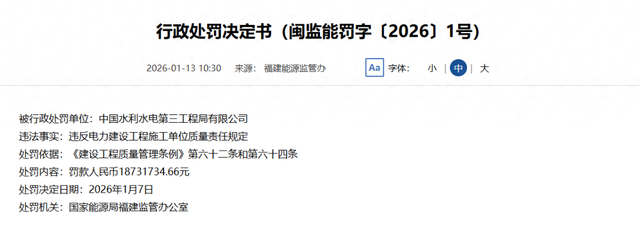
Group 1 - The National Energy Administration's Fujian Regulatory Office issued administrative penalty decisions against three companies, imposing fines of 18,731,734.66 yuan, 50,000 yuan, and 1,000,000 yuan respectively [1] - The issues regarding the Fujian Yong'an Pumped Storage Power Station's lower reservoir construction, such as insufficient anchor pile length and inadequate grouting, were exposed in November 2025, raising public concern about the quality of major infrastructure [1] - China Power Construction Corporation, which owns the China Water Resources and Hydropower Third Engineering Bureau, announced on November 29, 2025, that it has established an investigation team to thoroughly investigate and address the quality issues reported by the media [1]
福建一抽水蓄能电站偷工减料问题处罚决定:三家企业被罚!
中国能源报· 2026-01-14 08:59
Core Viewpoint - The article discusses the administrative penalties imposed by the Fujian Regulatory Office of the National Energy Administration on three companies involved in the construction of the Fujian Yong'an Pumped Storage Power Station due to quality issues in the project [1]. Group 1: Administrative Penalties - The Fujian Regulatory Office issued administrative penalty decisions with fines of 18,731,734.66 yuan for China Water Resources and Hydropower Third Engineering Bureau Co., Ltd., 50,000 yuan for Fujian Mintou Yong'an Pumped Storage Co., Ltd., and 1,000,000 yuan for Zhejiang East China Engineering Consulting Co., Ltd. [1]. Group 2: Quality Issues - The quality problems, including insufficient length of anchor piles and inadequate grouting, were exposed in November 2025, raising public concern about the quality of major infrastructure projects [1]. - In response to media reports regarding the quality issues during the construction of the Fujian Yong'an Pumped Storage Power Station, China Electric Power Construction Group announced the establishment of an investigation team to thoroughly investigate and handle the situation according to laws and regulations [1].

趋势研判!2025年中国城市大水网建设行业政策、发展现状、供水情况、管道长度及未来发展趋势分析:全域水网加速构建,智慧生态赋能韧性未来[图]
Chan Ye Xin Xi Wang· 2026-01-14 01:07
Core Insights - The construction of urban water networks is a comprehensive infrastructure project aimed at enhancing urban water security resilience through multi-system coordination and smart control [1][2] - The industry is entering a new phase of systematic advancement, driven by top-level policies and continuous growth in water conservancy investment, with significant investments in major national water network projects expected to reach 42.5% in 2024 [1][8] - The market for smart water management is rapidly expanding, projected to exceed 30 billion yuan by 2025, driving digital transformation in water network operations [1][11] Industry Overview - Urban water network construction integrates various systems, including water source management, supply, drainage, flood control, and ecological protection, to address challenges such as water scarcity and pollution [2][3] - The industry is characterized by a closed-loop collaborative structure, comprising upstream supply, midstream engineering integration, and downstream operational services [5][6] Development Background - The urban water network is a critical infrastructure for urban operation, supported by a series of national policies aimed at promoting high-quality development and systematic advancement in water network construction [6][8] - Investment in water conservancy construction has shown steady growth, with total investment rising from 818.2 billion yuan in 2020 to 1,352.9 billion yuan in 2024, reflecting a compound annual growth rate of 13.4% [8][10] Investment Structure - In 2024, the investment in flood control engineering is expected to reach 522.3 billion yuan, accounting for 38.6%, while major national water network projects will attract 574.7 billion yuan, representing 42.5% of total investment [8][10] - The investment structure indicates a shift from a focus on engineering to a more integrated approach that includes ecological and smart solutions [8][10] Water Resource Management - In 2024, the total water usage in China is projected to be 5,928 billion cubic meters, with agricultural water accounting for 61.6%, indicating significant potential for efficiency improvements [10][11] - The supply structure shows that surface water remains the primary source, while unconventional water sources utilization has reached 25.16 billion cubic meters, reflecting diversification in water resource management [10][11] Future Trends - The urban water network construction will evolve towards system collaboration, digital empowerment, and ecological resilience, aiming for a modern development framework that is intelligent, efficient, and sustainable [12][13] - Digital twin technology will play a crucial role in integrating physical and digital water networks, enhancing management capabilities through proactive monitoring and predictive analytics [14][15] - Ecological design will be integrated throughout the construction process, promoting green technologies and enhancing the resilience of water systems against extreme climate events [15]


