Mortgage Lending

Search documents
Mortgage and refinance interest rates today, January 6, 2026: Bubbling just above and below 6%
Yahoo Finance· 2026-01-06 11:00
Core Insights - Mortgage rates are currently stable, with the average 30-year fixed rate at 6.04% and the 15-year fixed rate at 5.41% [1][14] - Refinance rates are generally higher than purchase rates, with the average 30-year refinance rate at 6.09% [14] - Economists do not anticipate significant drops in mortgage rates before the end of 2026, with expectations of rates hovering around 6% [13][15] Current Mortgage Rates - The average rates for various mortgage types are as follows: - 30-year fixed: 6.04% - 20-year fixed: 5.91% - 15-year fixed: 5.41% - 5/1 ARM: 6.12% - 7/1 ARM: 6.10% - 30-year VA: 5.54% - 15-year VA: 5.11% - 5/1 VA: 5.24% [5] Refinance Rates - Current refinance rates are typically higher than purchase rates, with the average 30-year refinance rate at 6.09% [14] Long-term Rate Predictions - The Mortgage Bankers Association (MBA) forecasts the 30-year mortgage rate to remain near 6.4% through 2026, with a slight dip to 5.9% in Q4 2026 [15] - For 2027, the MBA predicts rates around 6.3% for most of the year, increasing to 6.4% in Q4, while Fannie Mae expects rates near 5.9% for the entire year [16] Mortgage Payment Insights - A $400,000 mortgage at a 30-year term with a 6.04% rate results in a monthly payment of approximately $2,409, accumulating $467,059 in interest over the term [8] - Conversely, a 15-year mortgage at a 5.41% rate would require a monthly payment of about $3,249, resulting in $184,867 in interest [8] Fixed vs. Adjustable Rates - Fixed-rate mortgages lock in the interest rate from the start, while adjustable-rate mortgages (ARMs) have a fixed rate for an initial period before adjusting based on market conditions [10][11] - ARMs may start with lower rates than fixed rates, but there is a risk of rate increases after the initial period [12]
These 2 Mortgage Stocks Are Set to Rise as Rate Pain Fades, Says Jefferies
Yahoo Finance· 2026-01-06 10:58
Company Overview - Walker & Dunlop has been operational since 1937, establishing itself as a significant player in the real estate industry with a market cap of $2 billion and a total transaction volume of $40 billion last year [2] - The company specializes in commercial real estate capital provision, with a diverse portfolio that includes multifamily, industrial, office, retail, and hospitality properties [3] Recent Performance - In the last reported period, 3Q25, Walker & Dunlop's quarterly revenue reached $337.7 million, reflecting a 15.5% increase year-over-year and exceeding expectations by $16.2 million [9] - The company reported a year-to-date total transaction volume of $36.5 billion, marking a 38% year-over-year increase [9] Market Challenges - Walker & Dunlop's shares have declined by 27% over the last three months due to concerns over potential fraudulent loan activities originating during the COVID pandemic [1] - Management has indicated that these issues are not unique to Walker & Dunlop, and underwriting practices have been tightened since the pandemic [1] Analyst Insights - Jefferies analyst Matthew Hurwit notes that Walker & Dunlop has historically maintained positive returns even in challenging rate environments, supported by its fee-based servicing and advisory franchises [10] - Hurwit maintains a Buy rating with a price target of $75, suggesting a potential one-year gain of 23% from the current share price of $58.72 [11] Industry Trends - The Federal Reserve has shifted to an easing mode, implementing a series of interest rate cuts, which may positively impact mortgage demand and originator earnings power [5][8] - Fannie Mae forecasts a 40 basis point decline in the 30-year fixed-rate mortgage by the end of 2026, potentially driving origination volumes to $2.3 trillion in 2026 and $2.5 trillion in 2027 [5]


Real Matters to Hold Virtual Annual and Special Meeting on February 5, 2026
Globenewswire· 2026-01-05 14:30
Core Points - Real Matters Inc. will hold its Annual and Special Meeting on February 5, 2026, at 10:00 a.m. Eastern Standard Time, conducted online via audio webcast [1] - Registered shareholders and duly appointed proxyholders will be entitled to vote during the live audio webcast, while non-registered shareholders can attend but not vote [2] - The Meeting webcast will be archived, and a transcript will be available on the company's website following the meeting [3] Company Overview - Real Matters is a leading network management services provider for the mortgage lending and insurance industries, combining proprietary technology with a network of independent qualified field professionals [4] - The company serves top 100 mortgage lenders in the U.S. and major banks and insurance companies in Canada, specializing in residential real estate appraisals and title and mortgage closing services [4] - Real Matters is headquartered in Markham, Ontario, with principal offices in Buffalo, New York, and Middletown, Rhode Island, and is listed on the Toronto Stock Exchange under the symbol REAL [4]



Mortgage and refinance interest rates today, January 5, 2026: Rates barely above 6% but look for even lower offers
Yahoo Finance· 2026-01-05 11:00
Core Viewpoint - Current mortgage rates are slightly above 6%, with some lenders offering rates in the mid-5% range, indicating a competitive lending environment [1]. Current Mortgage Rates - The national average for a 30-year fixed mortgage rate is 6.01%, while the 15-year fixed rate is 5.44% [1][18]. - Other mortgage rates include: - 20-year fixed: 5.95% - 5/1 ARM: 6.23% - 7/1 ARM: 6.51% - 30-year VA: 5.52% - 15-year VA: 5.14% - 5/1 VA: 5.22% [5]. Mortgage Payment Insights - For a $300,000 mortgage at a 30-year term with a 6.01% rate, the monthly payment would be approximately $1,800, totaling $348,209 in interest over the loan's life [8]. - A 15-year mortgage at a 5.44% rate would result in a monthly payment of $2,442, with total interest paid being $139,508 [10]. Adjustable Mortgage Rates - Adjustable-rate mortgages (ARMs) typically start with lower rates than fixed-rate mortgages but can increase after the initial period [11]. - The 5/1 ARM has a fixed rate for the first five years, after which it adjusts annually [11]. - Recent trends show that ARM rates can be similar to or even higher than fixed rates, necessitating careful comparison among lenders [13]. Factors Influencing Mortgage Rates - Lenders offer lower rates to borrowers with higher down payments, excellent credit scores, and low debt-to-income ratios [14]. - Options for reducing interest rates include paying for discount points at closing or utilizing temporary buydowns [15]. Future Rate Predictions - The Mortgage Bankers Association (MBA) forecasts the 30-year mortgage rate to remain around 6.4% through 2026, while Fannie Mae predicts rates above 6% next year, potentially dipping to 5.9% in Q4 2026 [20].
Mortgage and refinance interest rates today, January 4, 2026: Still in a holding pattern
Yahoo Finance· 2026-01-04 11:00
Core Insights - National average mortgage rates remain stable, with the 30-year fixed mortgage rate at 6.01% and the 15-year fixed rate at 5.44% [1][17] Current Mortgage Rates - The current national average mortgage rates include: - 30-year fixed: 6.01% - 20-year fixed: 5.95% - 15-year fixed: 5.44% - 5/1 ARM: 6.23% - 7/1 ARM: 6.51% - 30-year VA: 5.52% - 15-year VA: 5.14% - 5/1 VA: 5.22% [5] Mortgage Comparison - The average monthly payment for a $300,000 mortgage at a 30-year term with a 6.01% rate is approximately $1,800, resulting in $348,209 in interest over the loan's life - In contrast, a 15-year mortgage at a 5.44% rate would have a monthly payment of $2,442, with total interest paid being $139,508 [8][6] Adjustable vs. Fixed-Rate Mortgages - Fixed-rate mortgages lock in the interest rate for the entire loan term, while adjustable-rate mortgages (ARMs) have a fixed rate for an initial period before adjusting based on market conditions [9][10] - ARMs typically start with lower rates than fixed rates, but there is a risk of rate increases after the initial period [11] Factors for Low Mortgage Rates - Lenders offer the lowest rates to borrowers with higher down payments, excellent credit scores, and low debt-to-income ratios - Improving personal finances is suggested as a more effective strategy for securing lower rates than waiting for market rates to drop [12][13] Choosing a Mortgage Lender - It is advisable to apply for mortgage preapproval with multiple lenders within a short time frame to facilitate accurate comparisons without significantly impacting credit scores [14] - When comparing lenders, the annual percentage rate (APR) should be considered as it reflects the true annual cost of borrowing, including interest and fees [15] Future Rate Expectations - The Mortgage Bankers Association (MBA) forecasts the 30-year mortgage rate to remain around 6.4% through 2026, while Fannie Mae predicts rates above 6% for the next year, potentially dipping to 5.9% in Q4 2026 [19]
“Locked-in” Homeowners Nevertheless Pay Off Below-4% Mortgages: their Share Drops to Lowest since Q4 2020
Wolfstreet· 2026-01-04 01:25
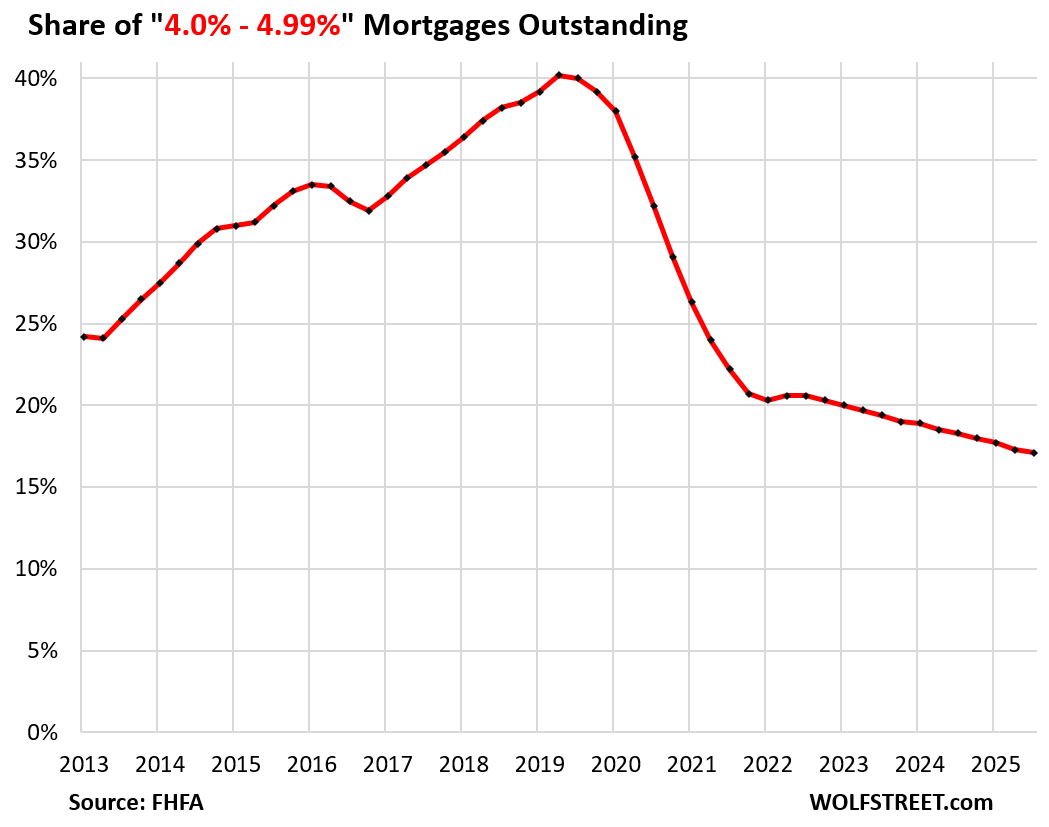
Core Insights - The share of below-3% mortgages has decreased to 20.0% in Q3, the lowest since Q1 2021, down from 24.6% at the peak in Q1 2022 [1] - The overall share of mortgages below 4% has dropped to 51.5%, the lowest since Q4 2020, as homeowners are selling their homes due to life changes [5] - The share of 6%-plus mortgages rose to 21.2% in Q3, the highest since Q3 2015, indicating a significant shift in the mortgage landscape [17] Mortgage Rate Trends - The share of 3% to 3.99% mortgages has declined to 31.5%, the smallest since Q2 2019, reflecting a broader trend of rising mortgage rates [2] - The share of 4.0% to 4.99% mortgages has decreased to 17.1%, the lowest since 2013, showing that many homeowners have refinanced into lower-rate categories [12] - The share of Adjustable-Rate Mortgages (ARMs) has remained low, dipping to 4.0% in Q3, down from over 10% in 2013 [8] Market Dynamics - The "lock-in effect" is causing homeowners with ultra-low interest rates to hesitate in selling their homes, impacting real estate transactions and mortgage originations [21][22] - Despite the lock-in effect, life events are still prompting some homeowners to sell, gradually unlocking the housing market [25] - The ultra-low mortgage rates, which were below inflation, contributed to a significant increase in home prices, creating a challenging environment for potential buyers [20][26][27]
Experts Reveal the Exact Credit Score Needed for the Best Mortgage Rates in 2026
Yahoo Finance· 2026-01-02 15:26
Core Insights - The credit score required for securing the best mortgage rates may be higher than expected, but it is influenced by various financial factors [1] Group 1: Importance of Credit Score - Credit score is a significant factor in determining mortgage rates, but it is not the only one; lenders consider at least ten critical factors [2] - A middle credit score above 720 provides borrowers with significantly more options compared to a score of 580, despite both being eligible for a mortgage [3] Group 2: Factors Influencing Mortgage Rates - Key factors affecting mortgage rates include credit score, debt-to-income ratio, loan-to-value ratio, liquid reserves, property type, transaction type, loan type, lender-specific cutoffs, closing date, and mortgage insurance [7] - Establishing a strong relationship with a mortgage professional is essential for understanding loan options and long-term wealth building [4] Group 3: Data on Credit Scores and Mortgage Rates - Average 30-year conventional mortgage rates vary by FICO score, with a score of 620 resulting in an average rate of 7.89%, while a score of 780+ achieves a rate of 7.07% [5][8] - Rates show diminishing returns for scores above 780, indicating that further increases may not lead to significantly better rates [8]
6 Mortgage Myths Homebuyers Still Believe
Yahoo Finance· 2026-01-01 15:01
Core Insights - Mortgage rates are declining due to recent Federal Reserve rate cuts, with potential for further decreases in the coming months [1] Group 1: Mortgage Myths - Pre-qualification and pre-approval are not the same; pre-approval involves underwriting review, simplifying the loan process [2][3] - An excellent credit score is beneficial but not mandatory for mortgage qualification; scores above 579 may still allow for loan approval [4] - Lenders are increasingly focusing on total financial health rather than solely on credit scores [5] Group 2: Mortgage Options - A 30-year fixed mortgage is not always the best choice; alternatives may offer better rates or faster payoff options [6] - The common belief that a 20% down payment is necessary is a myth; many conventional loans allow down payments as low as 3% to 5% [7][8]
U.S. Mortgage Rates Hit Lowest Point Since October 2024, Boosting Homebuyer Sentiment
Stock Market News· 2025-12-31 17:38
Core Insights - U.S. mortgage rates have reached their lowest point in over a year, with the average 30-year fixed-rate mortgage at 6.15% for the week ending December 31, 2025, down from 6.18% the previous week and significantly lower than 6.91% a year ago [2][8] - The 15-year fixed-rate mortgage also decreased to an average of 5.44%, down from 5.50% last week and lower than 6.13% a year ago, indicating a positive trend in borrowing costs [3][8] Market Impact - The decline in mortgage rates is expected to boost the housing market, which has been struggling with affordability issues throughout the year [3] - Freddie Mac's Chief Economist, Sam Khater, noted that the reduction in rates has led to a 10% increase in homebuyer purchase applications compared to the same period last year, reflecting growing consumer confidence in homeownership [4] Economic Factors - Mortgage rates are influenced by the Federal Reserve's interest rate policies and bond market expectations regarding the economy and inflation, suggesting a favorable environment for buyers and those looking to refinance [5]

UWM Holdings CEO Sells 1.6 Million Shares for $9.4 Million After Strong Q3
The Motley Fool· 2025-12-31 12:29
Core Viewpoint - UWM Holdings Corporation, a leading wholesale mortgage lender, experienced significant insider selling by President and CEO Mat Ishbia amid a challenging year for its share price, with the sale amounting to approximately $9.4 million [1][3]. Transaction Summary - Mat Ishbia sold 1,629,785 shares of UWM Holdings, valued at around $9.4 million, leaving him with 279,989 shares worth approximately $1.6 million post-transaction [2][3]. Company Overview - UWM Holdings reported a total revenue of $2.7 billion and a net income of $16.89 million for the trailing twelve months (TTM), with a dividend yield of 9.05% and a 1-year price change of -10.82% [4]. - The company focuses on conforming and government loan products, utilizing a broad broker network to maximize distribution and maintain operational efficiency through a technology-driven platform [4][6]. Market Performance - As of November 28, 2025, UWM Holdings had a market capitalization of $8.9 billion, with the recent insider sale being a minor fraction of this total [3]. - The stock price was reported at $4.42, with a year-to-date decline of 10%, although it had previously seen lows of 34% to 40% earlier in the year [9]. Recent Financial Results - UWM reported a record total loan origination volume of $41.7 billion in the third quarter, with total revenue of $843.3 million and a net income of $12.1 million, coinciding with a recent rate cut by the Federal Open Market Committee [8].