
Commercial Real Estate

Search documents
Wisconsin man $1.8M in debt with a rental portfolio worth $4.4M — Dave Ramsey says his real estate strategy ‘sucks’
Yahoo Finance· 2025-11-05 13:00
Core Insights - A real estate investor, Ryan, is facing significant financial losses with a $4.4 million portfolio, currently $1.8 million in debt due to insufficient rental income to cover mortgage obligations [1][2] - The investor's initial success in commercial real estate has not translated into ongoing profitability, with the pandemic exacerbating vacancy rates in commercial properties [2] - Financial advice suggests selling unprofitable properties over the next three years to alleviate debt, with a focus on calculating cash-on-cash returns to determine which properties to retain [3] Investment Returns - The expected cash-on-cash return for residential real estate investors should be between 8% to 10%, while commercial property investors should aim for a return of 10% to 14% [4] - The advisor, Dave Ramsey, reports achieving cash-on-cash returns "up in the 20s" on his own commercial investments, indicating a benchmark for successful investment performance [5] - Including property appreciation and tax deductions in calculations can yield an internal rate of return (IRR) of 15% to 20% for real estate investments [5]
Dream Industrial REIT Reports Strong Q3 2025 Financial Results
Businesswire· 2025-11-04 22:19
Core Insights - Dream Industrial REIT reported strong financial results for Q3 2025, with significant growth in funds from operations (FFO) and comparative properties net operating income (CP NOI) [3][6][16] Financial Highlights - Diluted FFO per Unit increased by 4.3% to $0.27 in Q3 2025 from $0.26 in Q3 2024 [6] - CP NOI on a constant currency basis rose by 6.4% to $103.8 million in Q3 2025 compared to $97.5 million in Q3 2024 [6][16] - Net rental income for Q3 2025 was $98.4 million, an 8.8% increase from $90.5 million in Q3 2024 [6][16] - Total assets reached $8.5 billion as of September 30, 2025, a 4.2% increase from $8.1 billion at the end of 2024 [6][16] Leasing Activity - The Trust signed 2.0 million square feet of new leases and renewals with a weighted average rental spread of 28% from the beginning of Q3 2025 until October 31, 2025 [6][8] - In-place occupancy was 94.5% as of September 30, 2025, up 40 basis points from June 30, 2025 [6][16] Acquisitions and Dispositions - The Trust closed over $107 million in acquisitions in its wholly-owned portfolio and $460 million in private ventures since the start of 2025, adding over 2.8 million square feet of gross leasable area [6][13] - The Trust is pursuing over $150 million in dispositions, with $5 million already firmed up [13][14] Development and Growth Initiatives - The Trust continues to advance its solar program, with five new projects under construction across Ontario, Alberta, and the Netherlands [21] - The Trust has identified over 120 MW of additional solar generation potential, translating into over $190 million of potential investment volume [21][23] Capital Strategy - The Trust ended Q3 2025 with available liquidity of $828.5 million, including $81.9 million in cash and cash equivalents [27] - The net total debt-to-total assets ratio was 38.7% as of September 30, 2025 [27]


Dissecting Retail Real Estate: Insights on Investment, Growth and Consumer Behavior
Yahoo Finance· 2025-11-04 21:10
Core Insights - The retail industry is evolving to align with consumer trends and demographic shifts, emphasizing the importance of understanding customer behavior in real estate investments [1][2][3] Group 1: Retail Real Estate Evolution - The session at the Apparel & Retail CEO Summit highlighted the need for retail real estate to adapt to a rapidly changing market [2] - A holistic approach that combines real estate analytics with consumer trends is essential for success in retail investments [3] Group 2: Retail-Landlord Relationships - A synergistic relationship between retailers and landlords is crucial, focusing on mutual growth rather than an adversarial approach [4] - Leveraging landlords' lower capital costs can facilitate faster expansion for retailers, with tenant improvements (TIs) identified as growth opportunities [4] Group 3: Industry Challenges - The retail sector faces a talent deficit, with 40% of commercial real estate professionals expected to retire in the next decade, creating a "talent cliff" [5] - CBRE is actively working on succession strategies to ensure sustainable growth targets amidst these challenges [5]

Commercial real estate deals are slowing, but these two beleaguered sectors are shining
CNBC· 2025-11-04 16:59
Core Insights - Commercial real estate (CRE) dealmaking is experiencing a downturn in 2025, with transaction values significantly below pre-Covid levels, despite a 5% increase from the previous year as of Q3 [2] - Key trends include a flight to quality in property investments, economic uncertainty impacting the hotel sector, and renewed interest in office and retail spaces [3][5] Transaction Trends - The average dollar size of sales in September increased to $12.7 million, compared to $11.2 million over the previous two years, indicating a flight to quality [3] - Among the top 50 deals, 29 transactions exceeded $100 million, with the volume of such deals rising by 35% year-over-year in Q3, while smaller deals have remained flat or decreased [4] Sector Performance - The hotel sector is notably weak, with deal values down 30% in September compared to the same month in 2024, attributed to reduced international and business travel [6] - Investors are showing more confidence in higher quality properties, leading to increased investment from various sources, including sovereign debt funds [5]

Gladstone mercial (GOOD) - 2025 Q3 - Earnings Call Transcript
2025-11-04 14:30
Financial Data and Key Metrics Changes - FFO and core FFO per share for Q3 2025 were both $0.35, down from $0.38 in Q3 2024 [12] - Total operating revenues for Q3 2025 were $40.8 million, compared to $39.2 million in Q3 2024, while operating expenses decreased from $28.5 million to $26 million [13][14] - Net assets increased from $1.21 billion to $1.265 billion due to portfolio acquisition [14] Business Line Data and Key Metrics Changes - The company acquired a six-facility industrial manufacturing portfolio for $54.5 million, increasing industrial concentration to 69% of annualized straight-line rents from 63% at the start of the year [6][19] - The portfolio achieved a 99.1% occupancy rate, the highest since Q1 2019, with a weighted average lease term of 7.5 years [8] Market Data and Key Metrics Changes - The Federal Reserve reduced the funds rate by 50 basis points, contributing to a downward trend in long-term rates [5] - Asking cap rates showed a gradual downward trend, aligning with long-term Treasury yields [5] Company Strategy and Development Direction - The company focuses on growing its industrial concentration, managing existing portfolio assets, and strategically disposing of non-core assets [6][10] - Plans to continue acquiring high-quality industrial assets and support tenant growth through lease extensions and capital improvements [10] Management's Comments on Operating Environment and Future Outlook - Management expressed confidence in the stability of the capital markets and the company's ability to execute its strategy effectively [5][11] - The company remains aware of challenges in the office environment and will strategically evaluate its portfolio for potential disposals [10] Other Important Information - The company increased its credit facility to $600 million, extending and laddering debt maturities [9][19] - The common stock dividend remains at $0.30 per share per quarter [18] Q&A Session Summary Question: Future of Industrial Allocation - Management anticipates increasing industrial allocation beyond 70% in the foreseeable future [24] Question: Increase in Operating Expenses - Operating expenses have risen due to inflation and insurance costs, which are being passed on to tenants where possible [28][31] Question: Capital Expenditure Insights - Higher capital expenditures were driven by renewals, which are expected to be accretive to the company [32] Question: Dividend Confidence Amid CapEx - Management believes that the capital expenditures are accretive and do not negatively impact the dividend [36] Question: Acquisitions Pipeline for 2026 - Management is optimistic about matching 2025 acquisition levels, with two transactions currently in the pipeline [37] Question: Lease Termination Details - A lease termination occurred with a small tenant, but a new tenant has already taken over the space [44][50] Question: Automotive Exposure and Bankruptcy Concerns - Management maintains confidence in their automotive exposure, emphasizing robust underwriting practices [51][53] Question: Leverage and Asset Sales - The company plans to manage leverage through capital recycling and may issue more equity to reduce leverage [55] Question: Cap Rate Trends - Management sees cap rates compressing and anticipates taking advantage of favorable conditions in the market [61] Question: Impact of Government Shutdown - No significant impact from the government shutdown has been reported by tenants [62]

CNBC Property Play: CRE transactions stalling below pre-Covid levels
CNBC Television· 2025-11-04 13:32
Commercial Real Estate Market Overview - Commercial real estate deal making is experiencing a challenging 2025 [1] - Transaction volume remains significantly below pre-COVID levels [2] - Overall dollar volume has increased by only 5% year-over-year as of Q3 [2] Key Trends in September - A "flight to quality" is observed, with increased investment in higher-value properties [2] - Economic uncertainty is negatively impacting the hotel sector [2] - Signs of recovery are emerging in the office and open-air retail sectors [2] Deal Size and Volume - The average dollar size of sales in September increased to $127 million, compared to an average of $1122 million over the past two years [3] - 29 of the top 50 deals closed were over $100 million [3] - The volume of deals exceeding $100 million in Q3 increased by 35% year-over-year [3] - The volume of smaller deals has remained flat or decreased [3] Office Sector Activity - Apple invested $365 million in an office property portfolio in Sunnyvale, California [4] - Nvidia acquired a single office building in Santa Clara, California for $83 million [4] - Metlife secured an approximately 39% discount on an office property in Newport Beach, California [4] Strategic Acquisitions - Large tech companies with substantial cash reserves are strategically acquiring their own campuses at relatively lower costs [5]

Office vacancies turn corner, driven by small occupiers: CBRE
Yahoo Finance· 2025-11-04 11:00
Core Insights - U.S. office vacancies have shown their first year-over-year decline since the pandemic, driven by a slowdown in new construction and the demolition and conversion of older office spaces [1][2] Vacancy Rates - The vacancy rate in Q3 was 18.8%, down from 19% a year prior, marking a significant improvement in the office sector as it begins to recover from the impacts of remote and hybrid work [2] Leasing Activity - Leasing activity increased by 15% quarter-over-quarter and 11% year-over-year, totaling 59.8 million square feet; however, total square footage fell by 4% and average lease size dropped by 24% compared to pre-pandemic levels [3][4] Demand Drivers - Small occupiers are driving demand, with leases between 10,000 and 20,000 square feet making up 56% of year-to-date activity; renewals are above pre-pandemic averages due to higher moving and construction costs [4] Market Dynamics - The national VTS office demand index finished Q3 at 72, reflecting a 16% year-over-year increase, indicating a market caught between opposing macroeconomic forces such as the federal government shutdown and a 25-basis-point interest rate cut by the U.S. Federal Reserve [5][6] Regional Demand Variations - Demand for remote-heavy markets surged by 47% quarter-over-quarter, while non-remote-heavy markets saw a decline of 26%, highlighting a bifurcation in market performance based on industry reliance on remote work [6][7]
Simon® Acquires Remaining Interest in Taubman Realty Group
Prnewswire· 2025-11-03 14:00
Core Viewpoint - Simon Property Group has acquired the remaining 12% interest in The Taubman Realty Group Limited Partnership for 5.06 million limited partnership units, which is expected to be accretive to Simon and aligns with its strategy of owning high-quality assets and driving innovation [1]. Group 1: Acquisition Details - The acquisition of the remaining interest in TRG allows Simon to fully capitalize on new growth opportunities and increase net operating income [1]. - The transaction was finalized with the exchange of 5.06 million limited partnership units in Simon Property Group L.P. [1]. Group 2: Leadership Statements - David Simon, Chairman and CEO, expressed satisfaction with the transaction, highlighting its alignment with the company's strategic goals [1]. - Robert Taubman, Chairman and CEO of TRG, acknowledged the successful partnership over the past five years and expressed commitment to being significant shareholders in Simon [1]. Group 3: Company Overview - Simon is a real estate investment trust focused on premier shopping, dining, entertainment, and mixed-use destinations, and is part of the S&P 100 [3]. - The company operates properties across North America, Europe, and Asia, generating billions in annual sales [3].


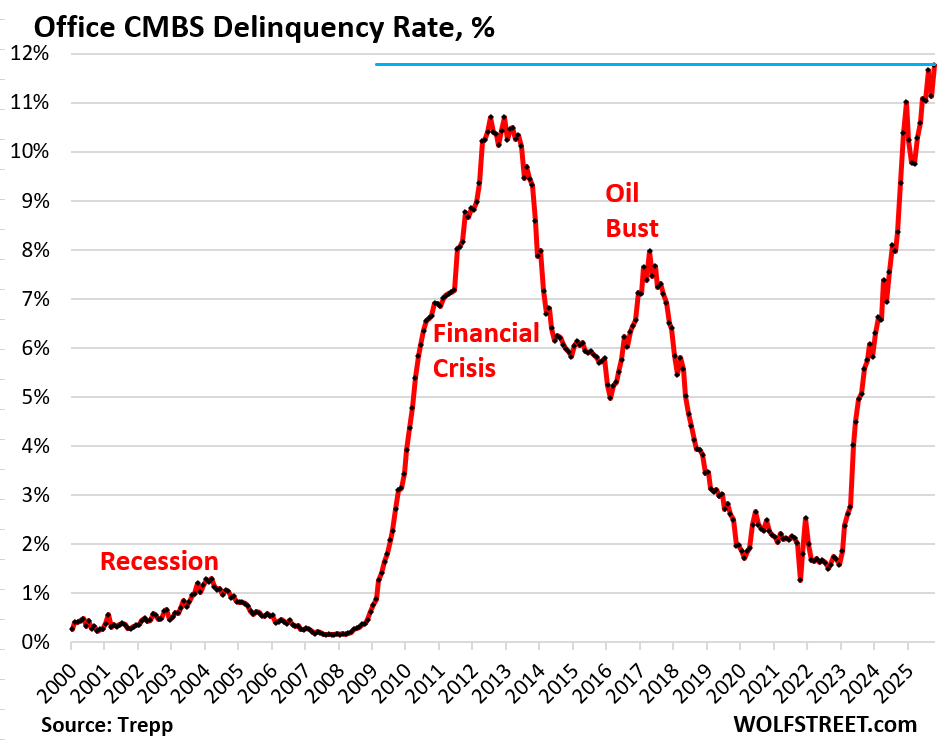
Office CMBS Delinquency Rate Hits Record 11.8%, Much Worse than Financial Crisis. Multifamily Delinquencies Soar to 7.1%
Wolfstreet· 2025-11-02 00:58
Core Insights - The delinquency rate for office mortgages securitized into CMBS reached an unprecedented 11.8% in October, surpassing the peak during the Financial Crisis [1][5] - The multifamily CMBS delinquency rate increased to 7.1%, the highest since December 2015 [6] Group 1: Office CMBS - The office CMBS delinquency rate rose dramatically from 1.8% in October 2022 to 11.8% in October 2023, a 10 percentage point increase [5] - Older office buildings are facing significant challenges due to a shift towards higher-quality spaces and corporate downsizing, exacerbated by the stagnation of return-to-office initiatives [5] - Notable delinquent loans include a $304 million mortgage on Bravern Office Commons in Bellevue, WA, which became vacant after Microsoft did not renew its lease [10][11] Group 2: Multifamily CMBS - The multifamily CMBS delinquency rate of 7.1% is the worst since December 2015, indicating a troubling trend in rental apartment property mortgages [6] - The delinquency rate's peak in December 2015 was influenced by the default of a significant loan on Stuyvesant Town–Peter Cooper Village, which was later resolved through a sale [6] Group 3: Loan Defaults and Curing Processes - Loans are classified as delinquent when borrowers fail to make payments or do not pay off the loan at maturity [9] - The process of "curing" delinquent loans can involve various strategies, including payment of interest, loan modifications, or foreclosure [14] - An example of a "cured" loan is the $96 million office loan backed by HP Plaza, which was fully leased and negotiated a maturity extension after becoming delinquent [15][16]
Battersea Power Station tries to defy London luxury slump with £2bn sale
Yahoo Finance· 2025-10-31 06:30
Core Viewpoint - The owners of Battersea Power Station are exploring a potential £2 billion sale amid economic challenges and a declining luxury market in London, with the sale serving as a significant test for the property market [5][4][3]. Group 1: Economic Context - Rising employer National Insurance and minimum wage have negatively impacted retailers, contributing to a challenging environment for businesses [1]. - Investment in London's shops and offices has drastically decreased, with only £6 billion invested in 2023 compared to nearly £15 billion in 2012, reflecting a downturn in the property market [6]. - The economic landscape is characterized by rising taxes, inflation, and a stagnant economy, leading to a shift in investor sentiment towards London properties [6][18]. Group 2: Property Market Dynamics - The Battersea Power Station project has faced significant cost overruns, with the budget increasing from £8 billion to £9 billion, and restoration costs rising from £750 million to over £1.1 billion [9][7]. - The luxury market in London is experiencing a slump, exacerbated by the end of VAT-free shopping for overseas visitors, impacting high-end retailers within the power station [3][10]. - The potential sale of the power station is seen as a litmus test for the broader London property market, with fewer buyers likely to emerge compared to previous years [4][15]. Group 3: Ownership and Sale Considerations - The Malaysian government’s investment fund and the Employees' Provident Fund are seeking offers for the power station, indicating a strategic move to monetize a valuable asset [5][21]. - The sale would include significant components such as a 500,000 sq ft office leased to Apple and a 420,000 sq ft shopping center, but not the entire campus [12][13]. - There is skepticism about finding a single buyer for the £2 billion asset, with suggestions that a club deal involving multiple investors may be necessary [16][18]. Group 4: Investor Sentiment - Interest from traditional buyers, such as mainland Chinese and Hong Kong investors, has diminished due to a property crisis in their home markets [19]. - US investors are emerging as potential buyers, with recent activity indicating a willingness to invest in prime London properties [19][20]. - The owners have stated that there are no immediate plans to proceed with a sale, emphasizing their commitment to realizing the full potential of the investment [21][22].