
Cryptocurrency

Search documents
'Improving Risk Sentiment' Driving Bitcoin's $90K Retest: QCP
Yahoo Finance· 2025-11-27 11:09
Core Insights - Bitcoin's price surged past $90,000 for the first time in nearly a week, driven by improving risk sentiment rather than a specific crypto catalyst [1] - The cryptocurrency is currently trading close to $91,500, reflecting a 5.3% increase over the past 24 hours [2] - The bullish turnaround in Bitcoin has led to significant short liquidations, totaling $241 million, which is more than triple the amount of long liquidations [2] Market Sentiment - The S&P 500 index confirmed a fourth consecutive up-close candlestick, aligning with Bitcoin's bullish movement [3] - There is an 85% probability of a Federal Reserve interest rate cut by a quarter point in December, as indicated by the CME FedWatch tool [3] - Users on the prediction market Myriad also place an 83% chance on the Fed cutting the interest rate by 25 basis points in December [4] Risks and Outlook - Despite a shift towards easing in Fed commentary, there are still mixed signals from officials, with some remaining neutral or opposed to cuts [5] - Bitcoin's performance is increasingly reflective of broader financial market sentiment, influenced by macroeconomic factors [5] - Potential risks include the delisting of MicroStrategy from the S&P 500 index, which could negatively impact Bitcoin [6] - Institutional flows in options markets indicate a likelihood of Bitcoin remaining range-bound, with $2 billion observed this week [6] - Analysts suggest that Bitcoin may face challenges in rallying beyond $95,000 due to ETF-related distribution, while the $80,000 to $82,000 zone serves as a key support area [8]
Bitcoin Munari's $0.22 Round 2 Approaches Completion Amid BlackRock's $92M ETH ETF Reversal
Globenewswire· 2025-11-27 11:00
Core Insights - Bitcoin Munari is currently in Phase 2 of its public presale, maintaining a fixed price of $0.22 per token, with the presale nearing completion ahead of its January 2026 launch as a Solana SPL token [3][4] - The presale is structured with predetermined pricing increments, aiming for a projected return of 2,627% based on a reference price of $6.00 [4] - The project emphasizes a fixed supply of 21 million BTCM tokens, ensuring predictability and stability in its economic model [7][13] Presale Details - The presale operates through a fixed-stage distribution model, with all tokens unlocking simultaneously at launch without vesting requirements [3][4] - Each round of the presale follows a consistent pricing and allocation structure, avoiding dynamic adjustments based on market conditions [5][4] Market Context - The presale coincides with renewed institutional interest in Ethereum, highlighted by significant net inflows into US spot ETH ETFs, totaling $92.28 million, with BlackRock's ETHA fund contributing $88.22 million [5][6] - This shift in institutional engagement is seen as a positive indicator for the broader digital asset market, including emerging projects like Bitcoin Munari [6] Economic Model - Bitcoin Munari's economic model is anchored by a fixed supply of 21 million BTCM, with allocations for presale distribution, validator rewards, and team segments governed by vesting schedules [7][13] - The project follows the MUNARI framework, which emphasizes a Modern, Unified, Network, Autonomous, Resilient Infrastructure [8][13] Development Plans - The project will initially launch on Solana to facilitate high-throughput transactions and compatibility with existing DeFi infrastructure, while concurrently developing an independent Layer-1 blockchain [9][13] - A public testnet is scheduled for 2026, with plans for validation trials and performance testing before the mainnet rollout in 2027 [10][11] Migration and Integrity - Tokens distributed during the presale will migrate to the mainnet on a one-to-one basis, preserving the fixed supply and initial distribution structure [11] - Independent evaluations, including smart contract audits and KYC verification, have been completed to support Bitcoin Munari's development [12]

Cathie Wood Says Crypto ‘Liquidity Squeeze’ Will Reverse, Reiterates $1.5M Bitcoin Bull Case
Yahoo Finance· 2025-11-27 10:15
Cathie Wood has kept immense optimism for the crypto market | Source: CCN / Derek Fenech Key Takeaways Liquidity pressures may ease soon, says Cathie Wood. The investor’s $1.5 million Bitcoin bull price remains intact. Wood has continued to buy the dip of several crypto companies. Ark Invest founder Cathie Wood says tightening liquidity conditions that have weighed on crypto markets may soon ease, while reaffirming the firm’s long-term bullish $1.5 million price prediction for Bitcoin. Liquidity ...
Why I Hate Bitcoin (Hint: 0% Dividends) and What I’m Buying Instead – The Contrary Investing Report
Contraryinvesting· 2025-11-27 10:00
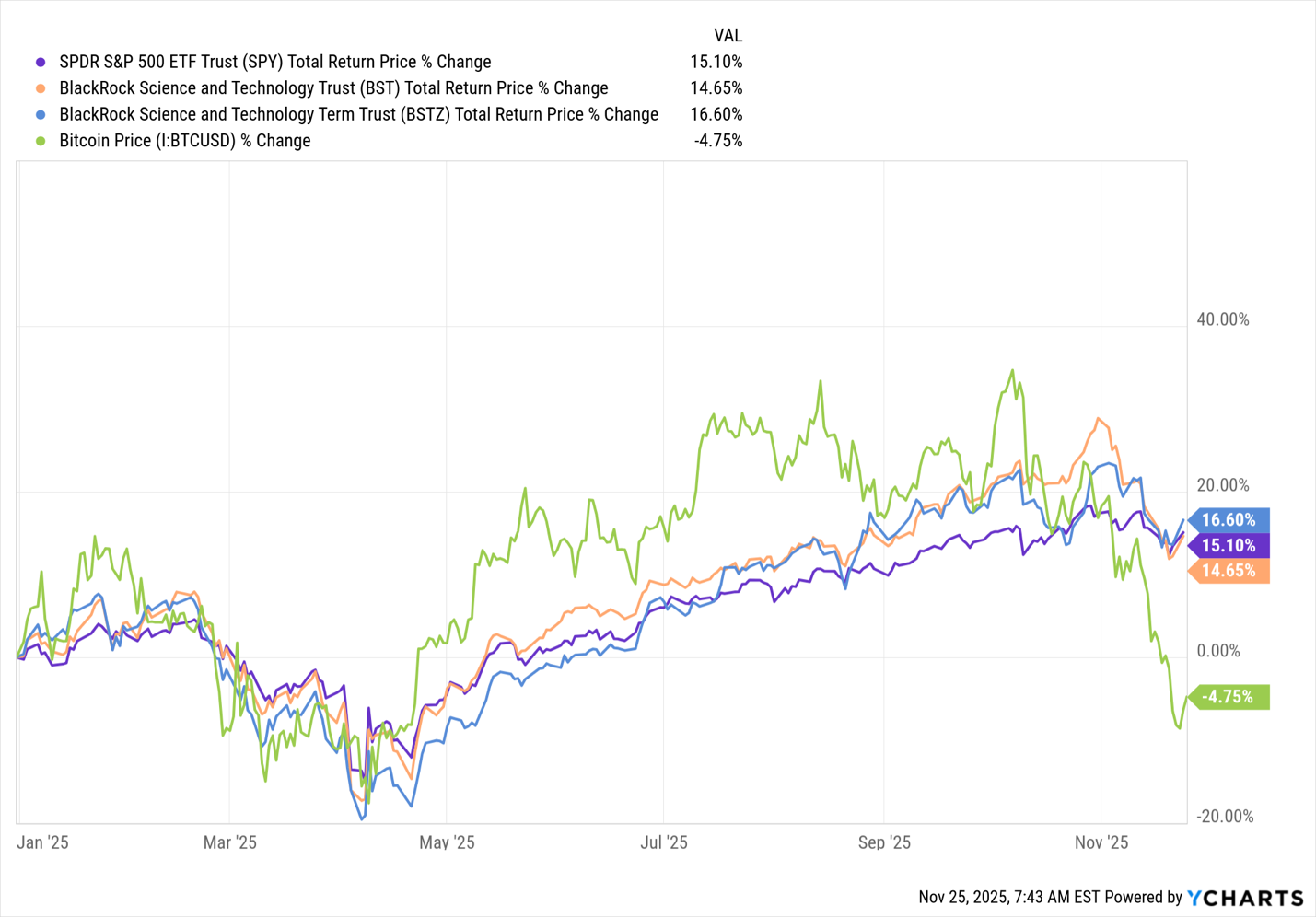
Core Viewpoint - The article emphasizes the volatility and lack of income associated with cryptocurrencies like Bitcoin, contrasting them with high-yielding closed-end funds (CEFs) that provide reliable dividends and less volatility [2][14]. Cryptocurrency Insights - Bitcoin has experienced significant declines in 2025 despite initial bullish signals from political endorsements and family investments, leading to losses for many investors [4][7]. - The article suggests that while crypto can yield vast riches through well-timed bets, such strategies are not sustainable for building lasting wealth [3][4]. Investment Alternatives - The focus shifts to two specific CEFs: BlackRock Science and Technology Trust (BST) and BlackRock Science and Technology Term Trust (BSTZ), which yield 7.7% and 9% respectively, while investing in top-quality tech stocks [8][9]. - These funds have been performing similarly to the S&P 500, providing both stock-like performance and bond-like income, making them attractive to disciplined investors [9][11]. Market Dynamics - Both BST and BSTZ are currently trading at an average discount of around 9.6% to their net asset value (NAV), which has widened recently, presenting a buying opportunity for investors [11][12]. - The article advocates for a strategy of purchasing these funds during market panics to benefit from their dividends and potential price recovery during bull runs [13][14]. Income Strategy - The article highlights a mini-portfolio of five monthly dividend funds with an average yield of 9.3%, suggesting that now is an opportune time to invest in these funds to benefit from consistent income streams [15][16][17].


ISO 20022-Compliant Stablecoins—Are USDT, USDC Compatible With TradFi Standards?
Yahoo Finance· 2025-11-27 09:30
Core Insights - ISO 20022 has become the universal standard for financial messaging, replacing SWIFT's legacy format on November 22 [1][5] - The integration of stablecoins and tokenized deposits is a significant advantage of the new standard, allowing for a broader range of digital asset transactions [1][5] - Not all stablecoins are equally integrated into ISO 20022 systems, highlighting the need for standardized identifiers for effective use [5][6] Summary by Sections How ISO 20022 Treats Stablecoins - ISO 20022 is asset-agnostic, allowing for the description of various settlement assets, including traditional fiat transfers, tokenized swaps, and stablecoin payments [2] - The standard does not endorse or prohibit any specific stablecoin, functioning instead as a messaging language for banks and market infrastructures [2] Identifier Codes for Crypto - The traditional ISIN system is being supplemented by ISO 24165, which provides unique alphanumeric codes for blockchain-based digital assets [3] - Most mainstream stablecoins now possess Digital Token Identifiers (DTI) for each instance across different networks, facilitating their identification [3] Compliance and Integration - The notion that some blockchains are compatible with ISO 20022 while others are not is misleading; the focus should be on whether a stablecoin can be clearly identified within ISO 20022 flows [6] - For deep integration into traditional finance, stablecoins require universally accepted DTI registrations that are mapped to an official ISIN [6]
Dogecoin Leaps From Internet Meme To NYSE As Two Spot ETFs Begin Trading
Benzinga· 2025-11-27 08:36
Group 1 - Grayscale has launched the first Dogecoin spot exchange-traded fund (ETF) in the U.S., which began trading on NYSE Arca [3] - The Grayscale Dogecoin Trust ETF (NYSE:GDOG) has accumulated inflows of $2.16 million and total assets under management of $3.92 million as of November 26 [3] - Bitwise has also launched its Dogecoin ETF (NYSE:BWOW), which achieved a trading volume of $2.83 million on its first day, surpassing Grayscale's debut volume [4] Group 2 - Combined, the Grayscale and Bitwise ETFs have total assets under management of $6.48 million, representing 0.03% of Dogecoin's total market value [4] - Following the launch of the new ETFs, Dogecoin's price increased by 1.39% to $0.1542 over the last 24 hours, with a weekly gain of 4.4% [5] - The Grayscale ETF closed 1.60% higher at $18.29, while the Bitwise DOGE ETF closed at $25.51, up 3.1% [5]


TradFi: The Tokenization Tightrope
Yahoo Finance· 2025-11-27 08:22
Core Insights - Tokenized real-world assets (RWAs) are evolving capital markets but face regulatory adaptation rather than complete overhaul [1][4] - The primary challenge in scaling tokenization lies in the architectural incompatibility between traditional finance (TradFi) systems and blockchain technology [4][10] - Tokenization is seen as a pathway to a programmable economy, yet it remains largely in the proof-of-concept stage [5][6] Regulatory and Compliance - Tokenized assets are generally classified as securities, necessitating compliance with existing securities regulations, including KYC/AML obligations [7][11] - Regulatory frameworks like the EU's MiCA and Germany's eWpG are crucial for institutional comfort, but operational challenges persist [1][4] - The integration of automated identity verification and blockchain analytics is becoming common to meet compliance standards [7] Operational Challenges - The transition to tokenization requires a complete re-engineering of risk management, custody, and compliance processes within financial institutions [2][10] - Current tokenization efforts are often self-contained ecosystems with limited interoperability, relying on traditional infrastructure for settlement and custody [8][9] - Programmable custody and automated compliance are essential for tokenization to evolve from pilot projects to a fully operational market [10][15] Market Potential and Risks - Tokenization of illiquid assets like private credit and corporate debt offers increased liquidity and tradability for institutional investors [17][18] - Retail investors gain access to previously inaccessible asset classes through fractional ownership, but face risks such as illiquidity and regulatory uncertainty [18][19] - The introduction of private assets into a high-speed trading environment poses untested risks, particularly under volatile market conditions [18] Technological Integration - The integration of blockchain with existing financial systems is complex, requiring a shift in operational norms and a cultural change within institutions [16][27] - High-quality data oracles can publish verified economic data to the blockchain, but operationalizing this data within regulated systems remains a challenge [14][16] - The need for secure, compliant, and scalable on-chain data storage is critical for the successful tokenization of private credit and other illiquid assets [19] Private Chains and Interoperability - Private, permissioned blockchains are emerging as regulatory sandboxes for financial institutions to experiment with tokenization while maintaining compliance [20][21] - These private chains serve as a bridge to public infrastructure, but there is a risk of creating isolated liquidity silos that undermine the goals of open finance [22][24] - The long-term success of private chains hinges on their ability to interoperate with public networks, facilitating access to global liquidity [25][24] Future of Tokenization - The winning architecture for tokenization will merge TradFi governance with DeFi programmability, enabling automated compliance and settlement [26][27] - Initiatives like SWIFT's interoperability pilots and BNY Mellon's asset management experiments are paving the way for programmable finance [27][28] - The ultimate goal is to build a financial infrastructure that minimizes friction, maximizes liquidity, and upholds security through deterministic, programmable finance [29]
Naver's payment arm to acquire South Korean crypto exchange operator in $10 billion deal
Yahoo Finance· 2025-11-27 06:38
Core Viewpoint - Naver Financial has agreed to acquire Dunamu, operator of Upbit, South Korea's largest cryptocurrency exchange, in an all-stock deal valued at 15.13 trillion won ($10.27 billion) to secure future growth in digital assets [1][2]. Group 1: Acquisition Details - The acquisition involves Naver's fintech subsidiary issuing 2.54 shares for every one share of Dunamu [2]. - This deal is one of the largest in Asia for the year and aims to enhance Naver's growth in the booming cryptocurrency market [1][2]. Group 2: Market Position and Synergy - Upbit holds approximately 70% market share in South Korea's cryptocurrency exchange market and is highly profitable [3]. - Naver is expected to leverage its user traffic to drive engagement with Upbit, targeting primarily the younger generation [3]. Group 3: Market Reaction and Future Plans - Following the acquisition announcement, Naver's shares initially rose by over 7% but later fell by 4.2% due to concerns over a significant cryptocurrency withdrawal from Upbit [4][5]. - Naver's CEO indicated that there are no immediate plans for a Nasdaq listing, emphasizing a focus on enhancing shareholder value if such a decision is made in the future [4].
Asia Morning Briefing: Bitcoin's Fragile Rally Is Built on Shrinking Liquidity
Yahoo Finance· 2025-11-27 02:35
Market Overview - Bitcoin (BTC) is trading above $90,500, but this increase is accompanied by rising realized losses and weakening demand across the market [1][5] - Investors are exiting positions at a loss, indicating a potential exhaustion in the market rather than a recovery [2] - Large deposits are driving the latest BTC inflows to exchanges, with the average deposit value significantly increasing as whales sell their coins [3] On-Chain Analysis - The recent surge in deposits coincides with weakening liquidity conditions, raising concerns about the market's ability to absorb supply [4] - Realized losses have reached levels similar to previous cycle lows, and the short-term holder profit and loss ratio has collapsed, indicating a lack of buying momentum [5] Price Movements - Bitcoin is holding above the $90,000 level, but on-chain and derivatives data suggest the rebound lacks conviction and is vulnerable without stronger demand [6] - Ether (ETH) is trading near the $2,900 zone, with rising large-holder deposits and weak demand signals indicating a fragile rebound [6] - Gold has climbed above $4,170, driven by expectations for lower U.S. interest rates boosting demand for the metal [6] Stock Market Performance - Asia-Pacific stocks have risen, with Japan's Nikkei 225 up 1.42%, influenced by Wall Street's rebound on rising hopes for Fed rate cuts [7]
China’s Crypto Traders Panic as S&P Downgrades Tether’s USDT
Yahoo Finance· 2025-11-27 02:34
China Crypto Ban. Photo by BeInCrypto S&P Global Ratings downgraded Tether’s USDT stablecoin stability score from constrained to weak, citing increased exposure to volatile assets like Bitcoin. This move triggered intense debate on Chinese social media, with traders expressing concerns ranging from skepticism to outright panic. The timing is critical for China’s underground crypto market. Over 20 million participants depend on USDT as their primary route to digital asset trading, even after the country’s ...