Beverages

Search documents
The Motley Fool's Just-Released Report Shows U.S. Inflation Is at 2.7%. Here's How 2 Consumer Goods Staples Are Faring.
The Motley Fool· 2025-08-02 10:27
Core Viewpoint - Consumer staple companies may benefit from higher inflation due to their ability to pass on cost increases to customers, but consumer resistance to price hikes is a concern [2]. Group 1: PepsiCo - PepsiCo's second-quarter revenue increased by 2%, driven entirely by higher prices, which contributed 4 percentage points, while lower volume subtracted about 1.5 percentage points [5]. - Adjusted operating income for PepsiCo fell by 3%, indicating that price hikes were insufficient to offset rising costs [5]. - PepsiCo's share price dropped by 16.9% over the past year, contrasting with a 16.8% gain in the S&P 500 index during the same period [6]. - The price-to-earnings (P/E) ratio for PepsiCo increased from 19 to 26, which is still lower than the S&P 500's P/E of 30, suggesting potential for patient investors [7]. Group 2: Procter & Gamble - Procter & Gamble's fiscal third-quarter adjusted sales grew by only 1%, with higher prices accounting for the entire increase and volumes remaining flat [9]. - In the fourth quarter, adjusted sales increased by 2%, with higher prices and mix each contributing 1 percentage point, while volume remained constant [10]. - Procter & Gamble's stock price decreased by 7.9% over the past year, and its P/E multiple contracted from 28 to less than 25 [10].


1 Top Dividend ETF I Can't Wait to Buy More of in August
The Motley Fool· 2025-08-02 08:16
Core Viewpoint - The Schwab U.S. Dividend Equity ETF focuses on high-quality, high-yielding dividend stocks, which have historically outperformed non-dividend payers by more than two to one over the past 50 years, delivering a 10.2% average annualized return [1][2]. Group 1: ETF Strategy and Performance - The ETF aims to closely track the Dow Jones U.S. Dividend 100 Index, which measures the performance of 100 top high-quality, high-yielding U.S. dividend stocks [4]. - The index's 100 holdings had an average dividend yield of 3.8% and increased their payouts at an average annual rate of 8.4% over the past five years, positioning the ETF for attractive total returns [4]. - The Schwab U.S. Dividend Equity ETF has delivered double-digit annualized total returns over the past five- and ten-year periods, with an 11.5% annualized total return since its inception in late 2011 [12]. Group 2: Key Holdings - Chevron is the top holding in the ETF, accounting for 4.4% of its net assets, with a 4.5% dividend yield and a history of increasing dividends for 38 consecutive years [7][8]. - PepsiCo is another significant holding, representing 4.2% of the fund's assets, with a 4% dividend yield and a 53-year streak of dividend increases [9]. Group 3: Dividend Characteristics - The ETF currently offers a dividend yield of around 3.8%, which is more than three times higher than the S&P 500, providing a strong and growing base return as its holdings increase their dividend payments [13]. - The ETF's focus on companies with strong financial profiles supports the sustainability of high-yielding and steadily rising dividends [15].
Should You Buy, Hold or Sell TLRY Stock Post Q4 Earnings Release?
ZACKS· 2025-08-01 13:15
Core Insights - Tilray Brands reported its fourth-quarter results for fiscal 2025, with earnings exceeding estimates but sales falling short, both declining compared to the previous year [1][10] - Adjusted EPS was 2 cents, down 50% year over year, while revenues decreased by 2% to $224.5 million, primarily due to weak performance in cannabis and beverages [2] - The company expects adjusted EBITDA for fiscal 2026 to be between $62 million and $72 million, indicating a growth of 13-31% over the prior year [3] Financial Performance - Fiscal 2025 revenues reached $821 million, a 4% increase year over year, largely driven by non-cannabis business diversification [4] - Non-cannabis segments accounted for approximately 70% of total sales, with beverages contributing 29%, distribution 33%, and wellness 8% [5] - Beverage sales rose 19% year over year to $240.6 million, despite SKU rationalization efforts [6] Market Position and Strategy - Tilray has established a strong presence in the hemp market, holding nearly 60% branded market share in the U.S. and 80% in Canada [7] - The company is focusing on enhancing its global supply chain and cultivation footprint to meet growing demand, with expectations of benefiting from Project 420 in the second half of fiscal 2026 [8] - The cannabis segment saw a 9% decline in revenues to $249 million, with international cannabis sales growing 19%, although still a small portion of total cannabis sales [11] Competitive Landscape - Tilray faces intense competition from peers like Aurora Cannabis, Canopy Growth, and Curaleaf Holdings, all pursuing international expansion and cost optimization [12] - The company's stock has dropped 56% year to date, contrasting with a 6% growth in the industry, reflecting ongoing financial challenges and uncertainty around U.S. marijuana legalization [13] Investment Considerations - While Tilray's diversification into craft beverages and THC drinks shows strategic foresight, the decline in its core cannabis business and competitive pressures remain significant near-term challenges [15]

X @Bloomberg
Bloomberg· 2025-08-01 10:10
Financial Impact - France's wine and spirits industry anticipates a €1 billion loss due to a potential 15% import tariff imposed by the US [1]
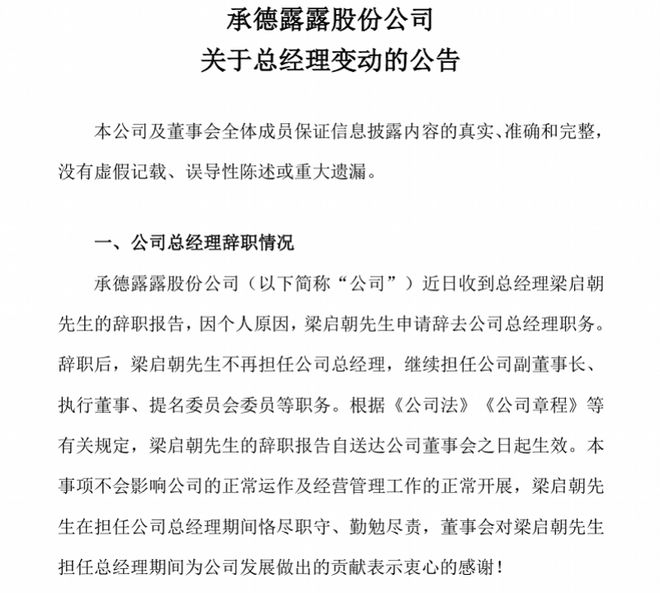
承德露露高管换血背后:挖掘新增点,养生水能否解业绩之渴?
Nan Fang Du Shi Bao· 2025-08-01 07:20
Core Viewpoint - The frequent management changes at Chengde Lulule are indicative of the company's struggles with performance and the need for internal transformation, as the new CEO Ding Xingxian takes over amid declining sales and a shift towards new product lines like health water [1][6][10]. Group 1: Management Changes - Chengde Lulule has experienced its sixth core executive change in 2024, with General Manager Liang Qichao resigning for personal reasons and being replaced by Ding Xingxian, who was previously the Deputy General Manager [1][2][5]. - Ding Xingxian is the fifth General Manager of the company, with a history closely tied to the controlling shareholder, Wanxiang Group, which has held a 41.61% stake since 2006 [5][6]. - The rapid turnover in management reflects the board's urgency to find new growth avenues as traditional business lines face stagnation [6][10]. Group 2: Performance Challenges - Chengde Lulule's revenue has been under pressure, with a reported 18.36% year-on-year decline in Q1 2025 revenue, totaling 1 billion yuan, and a 12.53% drop in net profit to 215 million yuan [6][10]. - The company's reliance on almond beverage products, which account for over 90% of total revenue, poses a risk due to market saturation and changing consumer preferences [7][9]. Group 3: Strategic Transformation - To address declining performance, Chengde Lulule is diversifying its product offerings, including the introduction of health water products, which have begun to receive positive market feedback [1][9]. - The health water market is projected to grow significantly, with estimates indicating a surge from 450 million yuan in 2023 to 3 billion yuan in 2024, representing a growth rate of 566% [9][10]. - Despite the potential of the health water segment, the company faces intense competition from established brands, and the strong association of the "Lulule" brand with almond beverages may hinder the acceptance of new product lines [10].

2 Magnificent Dividend Stocks to Buy in August
The Motley Fool· 2025-08-01 07:07
The following companies have churned out consistent sales and profits for decades and can help you secure growing cash deposits in your account for a lifetime. Investors don't have to settle for a 1.18% dividend yield from an S&P 500 index fund. Investors looking to build their passive income are choosing the right time to do so. While the average yield on the S&P 500 has sunk to a measly 1.18%, top consumer brands with a long history of dividend increases are paying yields that are double the market averag ...


X @Investopedia
Investopedia· 2025-07-31 21:00
U.S.-listed shares of AB InBev sank 12% Thursday as the world's biggest beermaker's volume and sales missed estimates on soft demand in China and Brazil. https://t.co/sDynFFPpFr ...
AB InBev CEO: Brands such as Michelob Ultra and Busch Light are leading our growth
CNBC Television· 2025-07-31 18:31
Market Share & Growth - The company experienced one of its best quarters in years in the US [1] - The company's market share continues to accelerate, reaching an inflection point last year [1] - Mikabultra and Bush Light are leading the company's growth [1] - Michelob Ultra is the fastest-growing brand in the US [1] - Bush Light is the second fastest-growing brand in the US [1] - Michelob Ultra Zero (29 calories zero alcohol beer) and Bush Light Apple (seasonal beer) became the third fastest-growing brands in the US industry within a month [2] Innovation Impact - Innovations are hitting a sweet spot with consumers [1]
Will PepsiCo's Focus on Premium Drinks Drive the Next Leg of Growth?
ZACKS· 2025-07-31 18:31
Core Insights - PepsiCo is enhancing its competitive position in the beverage sector by focusing on premium and functional drinks to align with changing consumer preferences [1][2] - The company is shifting its beverage portfolio away from traditional colas towards health-conscious options, including no-sugar colas, functional hydration, and energy drinks [1][8] - Strategic partnerships, such as the alliance with Celsius, are being leveraged to support the premium drink strategy and enhance distribution [3] Company Strategy - PepsiCo's success with Gatorade and Propel indicates its capability to scale health-focused beverages, with premium hydration becoming a key growth area [2] - The introduction of liquid protein products is anticipated in late 2025 and early 2026, emphasizing taste and natural ingredients [2] - The company's focus on cleaner formulations and no artificial ingredients reflects a broader shift in its portfolio to meet evolving consumer expectations [2] Competitive Landscape - PepsiCo faces strong competition from Coca-Cola and Keurig Dr Pepper, both of which are investing heavily in premium and health-conscious beverages [4][5][6] - Coca-Cola is expanding its zero-sugar variants and functional beverages, while KDP is enhancing its premium beverage offerings through strategic partnerships and a balanced portfolio [5][6] Financial Performance - PepsiCo's shares have declined approximately 8.3% year to date, contrasting with the industry's growth of 4.6% [7] - The company trades at a forward price-to-earnings ratio of 17.33X, slightly below the industry average of 17.53X [9] - The Zacks Consensus Estimate indicates a projected decline of 1.9% in 2025 earnings, with a subsequent growth of 5.3% in 2026 [10]