Industrial Automation

Search documents
博杰股份股价跌5.1%,华夏基金旗下1只基金位居十大流通股东,持有213.23万股浮亏损失695.14万元
Xin Lang Cai Jing· 2025-09-23 03:24
Group 1 - The core point of the news is that Bojie Co., Ltd. experienced a 5.1% drop in stock price, closing at 60.64 CNY per share, with a trading volume of 408 million CNY and a turnover rate of 6.13%, resulting in a total market capitalization of 9.721 billion CNY [1] - Bojie Co., Ltd. is located in Zhuhai, Guangdong Province, and was established on May 30, 2005, with its listing date on February 5, 2020. The company's main business involves the research, development, production, sales, and related technical services of industrial automation equipment and accessories [1] - The revenue composition of Bojie Co., Ltd. is as follows: 83.72% from industrial automation equipment, 8.27% from equipment accessories, and 8.00% from technical services [1] Group 2 - Among the top ten circulating shareholders of Bojie Co., Ltd., one fund under Huaxia Fund, the Huaxia CSI Robotics ETF (562500), entered the top ten in the second quarter, holding 2.1323 million shares, which accounts for 2.01% of the circulating shares. The estimated floating loss today is approximately 6.9514 million CNY [2] - The Huaxia CSI Robotics ETF (562500) was established on December 17, 2021, with a latest scale of 14.471 billion CNY. Year-to-date, it has achieved a return of 39.56%, ranking 1125 out of 4220 in its category; over the past year, it has returned 94.18%, ranking 680 out of 3814; and since inception, it has returned 8.43% [2] Group 3 - The fund manager of the Huaxia CSI Robotics ETF (562500) is Hualong. As of the report, Hualong has a cumulative tenure of 3 years and 34 days, with the current total asset scale of 42.926 billion CNY. The best fund return during the tenure is 96.93%, while the worst return is -15.08% [3]

港迪技术9月22日获融资买入318.61万元,融资余额8781.27万元
Xin Lang Cai Jing· 2025-09-23 01:40
Group 1 - The core viewpoint of the news is that Gangdi Technology's stock performance and financial metrics indicate a decline in both revenue and net profit, alongside changes in shareholder structure and financing activities [1][2]. Group 2 - On September 22, Gangdi Technology's stock fell by 1.13%, with a trading volume of 39.42 million yuan. The financing buy-in amount was 3.19 million yuan, while the financing repayment was 4.79 million yuan, resulting in a net financing buy of -1.61 million yuan. The total financing and securities balance reached 87.81 million yuan, accounting for 8.13% of the circulating market value [1]. - As of September 10, the number of shareholders for Gangdi Technology was 9,693, an increase of 3.82% from the previous period. The average circulating shares per person decreased by 3.68% to 1,436 shares [2]. - For the first half of 2025, Gangdi Technology reported a revenue of 210 million yuan, a year-on-year decrease of 1.82%, and a net profit attributable to shareholders of 18.42 million yuan, down 16.02% year-on-year [2]. - Since its A-share listing, Gangdi Technology has distributed a total of 55.68 million yuan in dividends [2]. - As of June 30, 2025, notable changes in institutional holdings included the exit of Dongfang Alpha Preferred Mixed A (007518) and Hong Kong Central Clearing Limited from the top ten circulating shareholders [2].
Lianhe Sowell Secures $4.3 Million Multiple 3D AOI Equipment Orders with AI-Powered Inspection Technology for Midea Group's SMT Production Lines
Globenewswire· 2025-09-22 13:30
Core Viewpoint - Lianhe Sowell International Group Ltd has signed supply agreements with Shenzhen Hechuan Intelligent Electronics Co., Ltd to provide AI-driven 3D automatic optical inspection solutions to Midea Group, totaling approximately USD 4,300,000 in sales [1][2]. Group 1: Company Developments - Lianhe Sowell has successfully expanded its industrial vision business by supplying advanced AOI systems to Midea Group, a leading home appliance manufacturer in China [3][4]. - The company has already delivered USD 970,000 worth of equipment, indicating strong execution capabilities in fulfilling large-scale customer orders [1][3]. Group 2: Technology and Innovation - The AOI systems utilize artificial intelligence, optical imaging, and machine-learning algorithms to detect surface defects and ensure high precision in manufacturing, thereby enhancing quality control in Midea's operations [2][4]. - The deployment of these systems represents a significant advancement in Lianhe Sowell's industrial intelligence vision inspection technology, showcasing the company's commitment to innovation and sustainable solutions [4][5].



中国自动化_走出困境-China Automation_ Out of the woods
2025-09-22 01:00
Summary of Key Points from the Equity Research Report on China's Industrial Automation Market Industry Overview - **Industry**: China's Industrial Automation Market - **Expected Growth**: The market is anticipated to resume growth in 2026-27 after a downturn in 2024-25, with forecasts of 0% growth in 2025, 2% in 2026, and 3% in 2027 [2][12][38]. Core Insights - **Market Segmentation**: Factory automation is expected to outperform process automation due to its early-cycle nature, with projected growth of 7% in 2026 for factory automation compared to a 1% decline for process automation [3][13]. - **Capex Turnarounds**: Significant capital expenditure (capex) turnarounds are expected in key industries such as PCB, consumer electronics, auto & auto parts, and lithium-ion batteries (LIB) [2][26][29]. - **Positive Indicators**: Orders for metal-cutting machines from Japan increased by 18% year-on-year in 7M25, indicating a positive trend in manufacturing [12][18]. Company-Specific Insights Inovance - **Rating Upgrade**: Inovance has been upgraded to "Buy" from "Hold" with a target price raised to RMB96.00 from RMB72.00, reflecting a positive outlook on its market leadership in factory automation [4][38]. - **Earnings Growth**: Expected earnings CAGR of 22% from 2024-27, driven by strong demand in factory automation and expansion into new product categories [14][38]. - **New Product Opportunities**: The company plans to supply components for humanoid robots and is expanding its product line to include software and other automation solutions [39][40]. Supcon - **Rating Downgrade**: Supcon has been downgraded to "Hold" from "Buy" with a target price cut to RMB58.00 from RMB68.00 due to a weaker outlook for process industries [4][35]. - **Earnings Estimates**: Earnings estimates for 2025-26 have been reduced by 39-44% due to a declining capex outlook [4]. Estun - **Rating Maintenance**: Estun's rating remains "Hold" with a target price raised to RMB23.70 from RMB17.90, reflecting ongoing challenges in the industrial robot market [4][35]. - **Earnings Estimates**: Earnings estimates for 2025-26 have been cut by 22-46% due to intense price competition [4]. Additional Insights - **Market Dynamics**: The factory automation market is expected to benefit from rising utilization rates in discrete industries, while the process automation market faces challenges due to overcapacity [3][13]. - **Investment Opportunities**: The report highlights potential investment opportunities in companies like Inovance, which is well-positioned to capitalize on the recovery in factory automation and the expansion into new markets [14][38]. Risks and Considerations - **Downside Risks**: Key risks include weaker-than-expected demand in automation and intense competition that could impact margins [36][53]. - **Market Sentiment**: The overall market sentiment is cautiously optimistic, with expectations of recovery in the industrial automation sector driven by domestic expansion and overseas market opportunities [2][12][38]. This summary encapsulates the critical insights and projections regarding the industrial automation market in China, focusing on key players and their expected performance in the coming years.

8 Dividend Growth Stocks Every Investor Should Consider
The Motley Fool· 2025-09-19 09:45
Core Insights - The article emphasizes the importance of companies that consistently increase their dividends at a rate faster than inflation, rather than focusing solely on high-yield stocks [1][2] Dividend Growth Companies - Parker-Hannifin (PH) has a five-year dividend growth rate of 14.3% with a low payout ratio of 24.6%, showcasing its potential for future increases after 69 consecutive years of dividend growth [4] - Procter & Gamble (PG) offers a 2.64% yield with a 62% payout ratio and has maintained 69 consecutive years of dividend increases, demonstrating resilience through economic downturns [5] - Coca-Cola (KO) yields 3.03% with a 70.5% payout ratio and has increased dividends for 63 years, benefiting from emerging market expansion and premium products [6][7] - Johnson & Johnson (JNJ) provides a 2.93% yield with a 53.4% payout ratio and has averaged 5.3% annual dividend growth over the past five years, supported by its diversified operations [8] - Altria Group (MO) yields 6.5% with a high payout ratio of 78.9%, managing to increase dividends at a 4.04% rate despite declining cigarette volumes [9] - Lowe's Companies (LOW) has raised its dividend by 16.9% over the past five years, with a conservative payout ratio of 38.1% and a history of 25 consecutive years of increases [10] - W.W. Grainger (GWW) yields 0.91% with a 21.3% payout ratio and has achieved 8.06% annual dividend growth, reflecting its essential role in various industries [11] - Abbott Laboratories (ABT) has increased its dividend by 10.6% annually over the past five years, with a 28.6% payout ratio and a strong position in continuous glucose monitoring [12]


中国工业指标_8 月制造业固定资产投资进一步放缓;覆盖企业订单整体平稳,局部强劲-China Industrial Indicators_ Manufacturing FAI decelerated further in Aug; coverage companies' orders broadly steady with selective strength
2025-09-18 13:09
Summary of Key Points from the Conference Call Industry Overview - **Industry**: Manufacturing and Industrial Automation in China - **Key Indicators**: Manufacturing Fixed Asset Investment (FAI) and production metrics for various sectors Core Insights 1. **Manufacturing FAI Decline**: Manufacturing FAI decreased by **-2.0% year-on-year (yoy)** in August, a significant drop from **-0.2% yoy** in July, primarily due to declines in electronics and basic materials FAI [3][51] 2. **Chemical and Steel FAI**: Chemical FAI was reported at **-5.2% yoy** and steel FAI at **-4.1% yoy**, negatively impacting companies like Supcon and Baosight [3][24][26] 3. **Industrial Robot and Machine Tool Production**: Industrial robot production increased by **14% yoy** but remained flat month-on-month (mom). Machine tool production rose by **16% yoy**, also flat mom, indicating a stable production environment [3][40] 4. **Export Trends**: Key equipment exports remained stable, with PIMM export value and volume increasing by **24% yoy** and **34% yoy**, respectively. Machine tools saw a value increase of **19% yoy** but a volume decrease of **20% yoy** [4][29][34] 5. **Order Trends for Coverage Companies**: Orders for coverage companies were broadly steady in August, with notable growth in Inovance's IA orders at **+20-30% yoy**. However, Yiheda's orders were impacted by a **-12% yoy** decline in the automotive sector [4][20][11] Additional Important Insights 1. **Capex Financing Weakness**: Capex financing showed a **-12% yoy** decline in August, following a drastic **-96% yoy** drop in July, indicating a tightening investment environment [64] 2. **Profitability Metrics**: The profit before tax (PBT) margin for industrial enterprises with revenue over **Rmb20 million** was **5.5%** in Q2 2025, slightly down from **5.6%** in Q1 2025 [71] 3. **Electricity and Cement Production**: Electricity generation increased by **3.2% yoy** in August, while cement production saw a decline of **-6.2% yoy** [81][88] 4. **Consumer Market Trends**: Passenger vehicle retail sales and production increased by **5%** and **11% yoy**, respectively, indicating a recovery in the automotive sector [90] 5. **NEV and Renewables**: Electric vehicle (EV) sales and production surged by **27% yoy** in August, reflecting strong demand in the new energy vehicle market [107] Conclusion The manufacturing sector in China is experiencing a mixed environment with declining FAI, stable production metrics, and selective strength in orders. The overall economic backdrop remains challenging, with significant declines in capex financing and profitability metrics, while certain sectors like EVs show robust growth.
岳阳首富朱兴明再赠女儿7.7亿元股份,累计赠与14.53亿元
Cai Jing Wang· 2025-09-18 03:22
Group 1 - The actual controller of Huichuan Technology, Zhu Xingming, plans to transfer up to 9,602,113 shares to his daughter Zhu Hanyue through block trading, representing 0.36% of the company's total share capital, valued at approximately 770 million yuan based on an internal transfer price of 80.14 yuan per share [1][5] - After the completion of this transfer, Zhu Xingming will hold 34.99 million shares of Huichuan Technology, accounting for 1.3% of the total share capital, while Zhu Hanyue will hold 20.60 million shares, representing 0.76% of the total share capital [1][5] - The transfer fulfills Zhu Xingming's obligations under the gift agreement signed with Zhu Hanyue in 2021, and he will still control 19.33% of the voting rights of Huichuan Technology [1][5] Group 2 - The gift agreement originated in 2021 when Zhu Xingming transferred 70,300,300 shares to his ex-wife, valued at approximately 5.39 billion yuan based on the stock price at the time of their divorce [2][6] - In September 2021, Zhu Xingming signed a gift agreement with Zhu Hanyue to transfer 20,602,113 shares and 21.70% equity in Huichuan Investment to her, which was completed in 2022 [2][6] - An additional transfer of 11 million shares is planned for December 2024, valued at approximately 683 million yuan based on an internal transfer price of 62.06 yuan per share, bringing the total value of shares transferred to Zhu Hanyue to approximately 1.453 billion yuan [2][6] Group 3 - Huichuan Technology, founded in 2003, specializes in the research, production, and sales of industrial automation control products, providing electric drive and power systems for the new energy vehicle industry [3][7] - The company was ranked 42nd in the "2022 Hurun China 500 Strong Private Enterprises" list and is recognized for its significant market presence [3][7] - As of 2023, Zhu Xingming and Zhu Hanyue ranked 1181st on the global billionaire list with a combined wealth of 19 billion yuan [3][7] Group 4 - As of September 18, Huichuan Technology's stock price was 84.16 yuan per share, with a market capitalization of 226.99 billion yuan [8]

行业聚焦:全球工业温度控制器市场头部企业份额调研(附Top10 厂商名单)
QYResearch· 2025-09-12 05:35
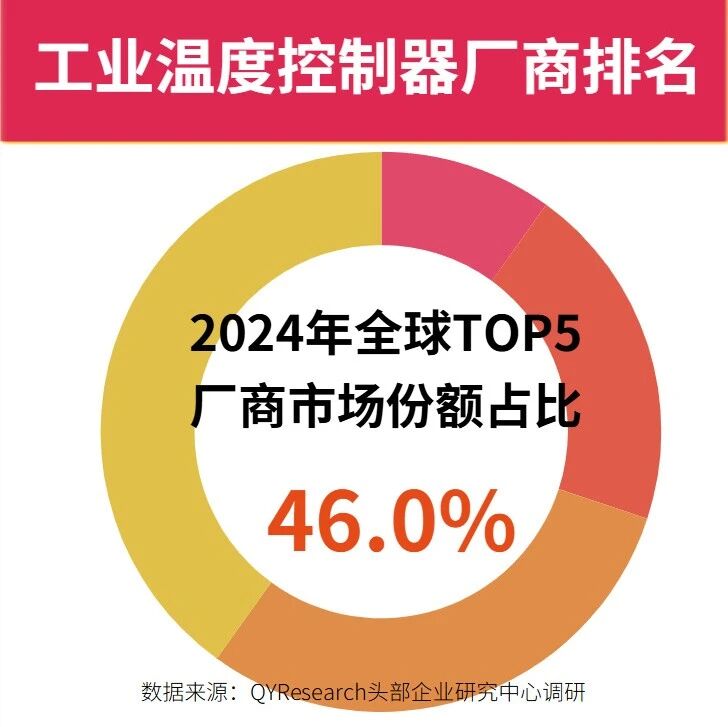
Core Viewpoint - The industrial temperature controller market is experiencing growth driven by increasing automation, quality control, and energy efficiency demands across various industries, with a projected market size of $1.39 billion by 2031 and a CAGR of 4.2% from 2025 to 2031 [3][4]. Market Overview - Industrial temperature controllers are essential devices for maintaining preset temperature levels in industrial processes, widely used in sectors such as plastic manufacturing, food processing, HVAC systems, chemical production, and packaging [2]. - The market is benefiting from the rising complexity of manufacturing systems and the need for precise temperature control, particularly in pharmaceuticals, food and beverage, semiconductors, petrochemicals, and automotive manufacturing [2][3]. Technological Integration - The integration of smart technologies in industrial environments is reshaping the functionality of temperature controllers, with many modern devices supporting remote monitoring, cloud connectivity, and real-time data analysis [3]. - The trend towards energy efficiency and sustainability is prompting companies to upgrade to more efficient control systems to reduce energy consumption and operational costs [3]. Regional Insights - The Asia-Pacific region, particularly China, Japan, South Korea, and India, is experiencing rapid market growth due to accelerated industrialization and ongoing investments in manufacturing infrastructure [3]. - North America and Europe, as mature markets, focus more on equipment modernization and compliance with stringent regulatory standards [3]. Market Share and Key Players - According to QYResearch, the top five manufacturers in the global industrial temperature controller market hold approximately 46.0% market share, with key players including Omron, RKC Instruments, Xiamen Yudian, Watlow, and Honeywell [8][18]. - Multi-loop controllers are the leading product type, accounting for about 36.9% of the market share, while industrial manufacturing is the largest downstream market, representing approximately 36.2% [9][11]. Driving Factors - The demand for process automation is rising, particularly in manufacturing, chemicals, food and beverage, and pharmaceuticals, driving the need for precise temperature control [13]. - Increasingly stringent quality and safety regulations from government agencies necessitate strict temperature control in critical processes, especially in medical, food processing, and semiconductor industries [13]. - The rapid development of the Industrial Internet of Things (IIoT) enhances the value of temperature controllers in smart factories through remote control and data-driven decision-making [13]. Challenges - High initial investment costs for advanced temperature control systems may hinder adoption among small and medium-sized enterprises [14]. - The complexity of integrating temperature control technology into older equipment or complex production lines poses deployment challenges [14]. - Limited awareness of temperature control precision and automation value in some emerging markets restricts market penetration [14]. Opportunities - The fusion of smart temperature control with AI and machine learning offers predictive control and self-calibration, providing new directions for product upgrades and differentiation [17]. - The push for green manufacturing and carbon emission control is expected to create growth opportunities for temperature control systems that support sustainability [17]. - Rapid industrial development in emerging economies such as Southeast Asia, Africa, and Latin America presents significant market potential for temperature controller manufacturers [17].
港迪技术9月11日获融资买入2097.62万元,融资余额8966.86万元
Xin Lang Cai Jing· 2025-09-12 02:23
Group 1 - The core viewpoint of the news is that Gangdi Technology's stock performance and financial metrics indicate a slight decline in revenue and profit, alongside changes in shareholder structure and financing activities [1][2][3] Group 2 - On September 11, Gangdi Technology's stock fell by 1.16%, with a trading volume of 132 million yuan. The financing buy-in amount was 20.9762 million yuan, while the net financing buy-in was 11.1275 million yuan, leading to a total financing balance of 89.6686 million yuan, which represents 7.85% of the circulating market value [1] - As of September 10, the number of shareholders increased by 3.82% to 9,693, while the average circulating shares per person decreased by 3.68% to 1,436 shares [2] - For the first half of 2025, Gangdi Technology reported a revenue of 210 million yuan, a year-on-year decrease of 1.82%, and a net profit attributable to shareholders of 18.4186 million yuan, down 16.02% year-on-year [2] - Since its A-share listing, Gangdi Technology has distributed a total of 55.68 million yuan in dividends [3] - As of June 30, 2025, notable changes in institutional holdings occurred, with Oriental Alpha Preferred Mixed A and Hong Kong Central Clearing Limited exiting the top ten circulating shareholders [3]
Rockwell Automation, Inc. (ROK) Presents at Morgan Stanley's 13th Annual Laguna Conference
Seeking Alpha· 2025-09-11 17:52
Core Insights - Rockwell Automation is enhancing its traditional value sources by integrating software, high-value consulting services, and additional hardware solutions like mobile robots and industrial PCs [2][3] - The company has implemented considerable redundancy in its operations to adapt to environmental volatility, allowing for quicker price changes and a more resilient manufacturing footprint [2] - Rockwell Automation is focused on creating cohesive solutions that simplify integration for customers, refresh its corporate culture, and expand margins through strategic pauses in new acquisitions [3]