汽车配件

Search documents
江苏南京:带数千万美元订单,近50家境外采购商来“淘货”
Xin Lang Cai Jing· 2025-04-13 18:23
Core Viewpoint - Chinese manufacturing is actively seeking to diversify its markets and reduce reliance on the U.S. amid tariff pressures, leveraging cross-border e-commerce platforms to connect with global buyers and secure orders [1][5][11]. Group 1: Market Diversification - Chinese manufacturers are exploring "second markets" to stabilize orders and expand their global footprint, as evidenced by a recent trade event in Nanjing where nearly 50 international buyers participated [1][3]. - The platform China Manufacturing Network is facilitating direct interactions between overseas buyers and Chinese companies, allowing for more efficient procurement processes [5][6]. - Companies are increasingly focusing on markets outside the U.S., with some reallocating resources to regions like Africa and Southeast Asia to mitigate risks associated with U.S. tariffs [9][11]. Group 2: Technological Integration - The China Manufacturing Network is utilizing digital technologies to streamline traditional trade processes, enhancing the efficiency of supply chain connections [5][12]. - The platform has recorded significant traffic and engagement, with 2.68 billion annual visits and 43.6 million registered buyer behaviors, indicating a robust ecosystem for international trade [5][12]. - The integration of AI tools is being employed to match Chinese manufacturers with global market demands more accurately [5][12]. Group 3: Product Innovation and Value Addition - Companies are encouraged to enhance their product offerings by increasing technological content and reducing price sensitivity to improve competitiveness in global markets [11][12]. - Specific examples include innovative products like rainwater collection modules and resin concrete drainage systems, which offer cost-effective solutions compared to traditional materials [12]. - The focus on high-margin products and differentiated competitive advantages is seen as essential for sustaining growth in international markets [12]. Group 4: Emerging Market Trends - The platform has reported significant growth in business opportunities in emerging markets, with notable increases in traffic and opportunities in the Middle East and Latin America [12]. - In the first quarter of 2025, overall business opportunities on the platform surged by 42.7%, with the Middle East, South America, and East Asia showing the highest growth rates [12]. - The emphasis on leveraging cross-border e-commerce for precise customer acquisition and building private traffic is becoming a strategic focus for Chinese exporters [12].


中国反制美国“对等关税”,懂王这回踢到铁板了
Hu Xiu· 2025-04-06 04:37
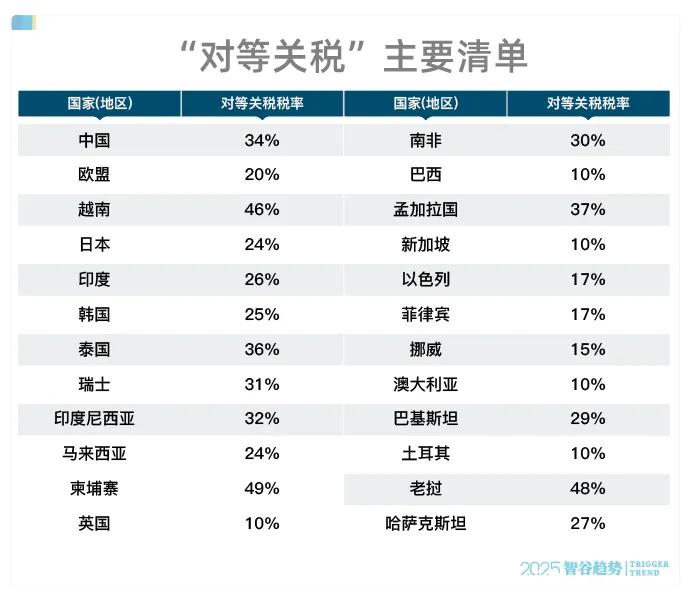
Group 1 - China's response to the US's tariff increase is a significant and historic move, imposing a 34% tariff on all imports from the US, affecting approximately $162 billion in imports [1][4][7] - The rapid and substantial reaction from China indicates that it was well-prepared for this situation, with sufficient tools and measures in place to counteract US actions [3][11] - The US stock market experienced a dramatic decline, with major indices dropping over 5.5%, marking the largest single-day drop since 2000, resulting in a market value loss of nearly $6.5 trillion [4][5][6] Group 2 - The current geopolitical climate has shifted, with China feeling more confident and equipped compared to previous years, allowing for a stronger stance against US tariffs [7][21] - The imposition of tariffs by the US is seen as a broad attack on all trade partners, which could disrupt the global trade system and lead to increased protectionism [14][15][18] - The potential for a global trade war is rising, with warnings that similar situations in the past have escalated into armed conflicts [19][20] Group 3 - The impact of the tariffs is expected to be severe, particularly for companies reliant on exports to the US, with some facing effective tax rates as high as 81.5% on their products [32][34] - Companies are considering relocating production bases to mitigate the effects of the tariffs, indicating a significant shift in global supply chains [36][37] - The uncertainty created by these tariffs necessitates that businesses adopt flexible strategies and increase redundancy to navigate the challenging environment [35][37]