
Defense

Search documents
X @The Economist
The Economist· 2026-03-03 11:20
Whereas long-established contractors account for much of defence spending in America, in Europe there is more scope for young defence-tech firms https://t.co/AcxgP93nv3 ...
Wall St futures slide as Middle East conflict stokes inflation worries
Yahoo Finance· 2026-03-03 10:40
Market Overview - U.S. stock index futures declined as investors reacted to U.S. and Israeli strikes on Iran, raising concerns about inflation and global trade impacts [1] - The Strait of Hormuz, a critical oil passage, is threatened by Tehran's vow to close it, which has led to increased global crude prices and shipping rates [1] Industry Impact - Industries sensitive to crude prices, such as airlines and travel, experienced declines for a second consecutive day, with Delta and Royal Caribbean each falling approximately 3% [2] - Higher oil prices are feared to exacerbate inflation, complicating monetary policy for central banks already facing tariff-driven price increases [2] Treasury and Interest Rates - The U.S. 10-year Treasury yield reached its highest level in over a week, with expectations for a 25-basis-point interest rate cut by the Federal Reserve being pushed back to September [3] Federal Reserve Signals - The market is anticipating new signals from the Federal Reserve, with key officials scheduled to speak, amidst ongoing discussions about the future path of interest rates [4] Futures and Volatility - Dow E-minis fell by 707 points (1.45%), S&P 500 E-minis dropped by 106 points (1.54%), and Nasdaq 100 E-minis decreased by 511 points (2%) [5] - The CBOE volatility index spiked to a three-month high of 25.56 points, indicating increased market fear [5] Sector Performance - Oil and gas, along with defense stocks, were among the few gainers, with Occidental rising by 3% and Cheniere Energy climbing by 8% [6] - AI-related stocks, including Nvidia and Microsoft, also faced declines amid uncertainties regarding AI's impact on traditional businesses [6] Company-Specific News - MongoDB shares plummeted by 27% after the company forecasted quarterly profits below market expectations [7]
The Iran Conflict Widens But Not All Defense Stocks Are Rising. Here's Why.
Barrons· 2026-03-03 10:07
Lockheed Martin and RTX both rack up gains in premarket trading as the broader market frets about a drawn-out conflict. ...


Global shares are mostly lower as investors focus on the Iran war's impact on energy supplies
ABC News· 2026-03-03 09:30
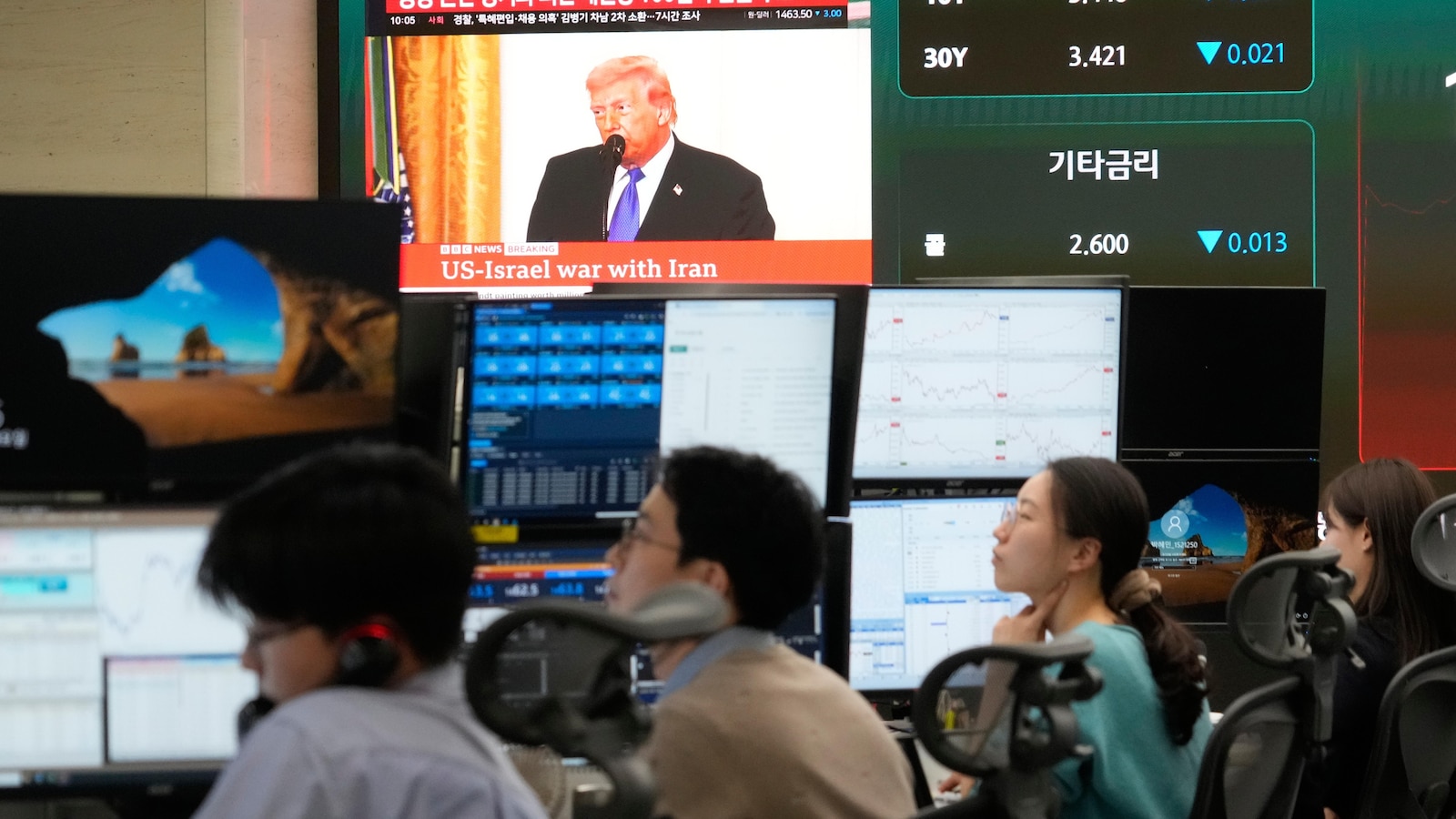
Market Overview - Global shares mostly declined due to concerns over energy supply threats from the Iran war [1] - U.S. futures also fell, with the S&P 500 down 1.5% and the Dow Jones Industrial Average down 1.6% [2] Regional Market Performance - In early European trading, France's CAC 40 dropped 2.2% to 8,207.10, Germany's DAX sank 2.9% to 23,935.62, and Britain's FTSE 100 declined 2.2% to 10,546.30 [2] - South Korea's Kospi plunged 7.2% to 5,791.91 as markets reopened after a holiday [2] - Japan's Nikkei 225 sank 3.1% to finish at 56,279.05, with concerns over oil supply impacting resource-poor countries [3] Oil Prices - Benchmark U.S. crude rose by $3.24 to $74.47 per barrel, while Brent crude increased by $3.56 to $81.30 per barrel [3] - Analysts noted that Japan has a sizable stockpile of oil lasting more than 200 days, mitigating immediate threats [4] Airline Industry Impact - Airline stocks, including American Airlines, United, and Delta, were among the biggest losers due to rising fuel costs and airport closures [5] - In Asia, ANA stock fell 3.3%, Japan Airlines dropped 6.4%, Korean Air declined 10.3%, and Qantas Airways lost 1.8% [6] Historical Context - Past military conflicts in the Middle East have not led to long-term declines in U.S. stocks, with significant oil price increases needed to cause sustained market impacts [7] - Historical data shows that energy shocks do not automatically derail equities unless they are severe and sustained [8]

World’s hottest stock market suddenly blows cold with a 7% tumble
Yahoo Finance· 2026-03-03 09:19
Market Overview - Foreign investors have sold more than $7 billion in Korean shares over the last two trading sessions, leading to significant losses in the South Korean stock market [2] - The Kospi Composite index experienced a 7% correction, prompting market regulators to implement a short-term suspension of program trading due to triggered circuit breakers [3] Currency and Commodities - The Korean won depreciated by 1.34% against the U.S. dollar amid a risk-off sentiment towards emerging-market currencies, influenced by rising crude oil prices following U.S.-Israeli strikes on Iran [4] - South Korea, as one of the largest importers of crude oil, requires approximately 2.7 million barrels daily, with around 70% of its supplies sourced from the Middle East [4] Major Companies Impacted - Samsung Electronics and SK Hynix, the world's largest memory-chip manufacturers, saw their shares decline by 9.88% and 11.5%, respectively [5] - Despite these declines, the Korean market has shown healthy returns of 37% year-to-date in 2026 and 128% over the last 12 months, although recent trading activity indicated speculative behavior among retail traders [5] Investor Behavior - Data from the Korean exchange indicated that international investors began reducing their exposure, with a net outflow of 7 trillion won ($4.7 billion) on the last trading day of February, followed by another net selling of 5.4 trillion won [6] - The recent drop in the benchmark index marked the largest one-day decline since the volatility caused by the yen carry trade unwind in August 2024 [6] Sector Performance - Certain sectors, including shipping companies like Korea Line Corp. and STX Green Logis, defense stocks such as Hanwha Systems and Lig Nex1 Co, and energy companies like Daesung Energy, experienced upward movement amid the broader market decline [7]
Ondas: From Penny Stock To Defense Contender
Seeking Alpha· 2026-03-03 08:24
Core Insights - Ondas (ONDS) is characterized as a disruptive company, transitioning from a low-value stock to a mid-tier valuation, indicating significant growth potential [1] - Pythia Research emphasizes a multidisciplinary approach to identify high-potential stocks, particularly in the technology sector, focusing on both traditional and unconventional metrics [1] - The investment strategy aims to exploit market inefficiencies driven by investor psychology, such as herd mentality and recency bias, to identify breakout opportunities [1] Investment Strategy - The approach combines financial analysis with insights from behavioral finance and social sciences to uncover transformative businesses poised for exponential growth [1] - The focus is on conviction plays with a favorable risk/reward profile, seeking limited downside and explosive upside potential [1] - The strategy includes monitoring shifts in narrative, social traction, and underappreciated momentum in user adoption as indicators of potential growth [1]


Teledyne Microwave UK Introduces New Wideband Limiter for Advanced Radar Electronic Support Measures and Electronic Warfare Systems
Businesswire· 2026-03-03 08:00
Core Insights - Teledyne Microwave UK has launched a new Wideband Limiter designed for Radar Electronic Support Measures (R-ESM) and Electronic Warfare (EW) systems, providing protection against high-power RF signals in the frequency range of 0.1–20 GHz [1] Product Features - The Wideband Limiter is a passive RF protection module that enhances the survivability of electronic systems in complex threat environments, particularly against high-power RF and Directed Energy Weapon (DEW) threats [1] - It offers an always-on layer of protection for sensitive receiver electronics by restricting harmful RF energy before it reaches critical hardware [1] - The module is compact, SMA-based, and integrates seamlessly into existing architectures without requiring system redesign, ensuring compatibility with Teledyne's Phobos MTU [1] Operational Benefits - By absorbing excessive RF energy, the Wideband Limiter reduces the risk of damage to high-value electronics, which supports lower repair frequency and minimizes downtime after high-power events [1] - The product is designed to provide scalable protection for a variety of modern EW and intelligence platforms, ensuring robustness without compromising overall system behavior or capability [1] Market Positioning - Teledyne Microwave UK is positioned as a leading provider of advanced RF & Microwave radar detection and protection solutions, catering to defense and security customers globally [1] - The introduction of the Wideband Limiter reflects the company's commitment to addressing evolving threat landscapes and enhancing system survivability [1]


As Missiles Fly, is it Time to Buy?
ZACKS· 2026-03-03 00:30
Geopolitical Impact on Markets - The U.S. and Israel launched a coordinated air attack against Iran, ending Ayatollah Ali Khamenei's 36-year rule, which was anticipated by the markets [1] - Despite the attack, stocks rose on Monday, indicating that markets often discount future events [2] - Defense stocks and drone manufacturers, such as Red Cat Holdings, experienced strong rallies due to the military buildup in the Middle East [3] Military Operation Success - The military operation against Iran has been largely successful, with significant leadership losses for Iran and minimal U.S. casualties [4] - The operation's efficiency has exceeded expectations, contributing to positive market sentiment [12] Investment Opportunities - Geopolitical conflicts can create buying opportunities for investors, as seen in the current market reaction [5] - AI infrastructure investments remain robust, with NVIDIA investing $2 billion in Lumentum and Coherent, highlighting the importance of optics in AI development [9] - Beaten-down sectors like software and Bitcoin are showing signs of recovery, with the iShares Software ETF approaching its 200-week moving average [10] Market Resilience - The market's reaction to geopolitical events demonstrates its predictive nature, with investors having already positioned themselves in energy and defense sectors prior to the strikes [12] - The ongoing investment in AI infrastructure continues to support a bullish outlook for the broader market [12]

Next Steps for Market in Iranian Conflict & Retail's Big Week
Youtube· 2026-03-02 23:10
Geopolitical Impact on Markets - The recent geopolitical conflicts, particularly the strikes in Iran, have led to increased market volatility and uncertainty, which is typical in such situations [1][2][3] - Concerns are rising about whether the conflict can be contained or if it will escalate to other regions, impacting market stability [4] Energy Prices and Inflation - Oil prices have surged above $72 per barrel for WTI, raising concerns about inflation risks associated with energy costs [5] - The conflict is seen as inflationary due to its potential impact on the energy supply chain, particularly for oil and natural gas [6] Federal Reserve and Monetary Policy - The current geopolitical situation may prompt the Federal Reserve to reconsider its monetary policy, particularly regarding interest rates, which have been perceived as slow to adjust [7][8] - There is skepticism about the likelihood of interest rate cuts before the end of the current Fed chair's term [8] Retail Sector Insights - Upcoming retail results are being closely monitored, especially in light of recent inflation data showing a cooling trend, although still not aligned with the Fed's target [9][10] - Costco is expected to perform well, demonstrating strong consumer health, particularly among higher-income shoppers, while Target is facing challenges in aligning product demand with its business model [10][11] Investment Opportunities - Historical patterns suggest that market sell-offs due to geopolitical tensions can create buying opportunities for investors [12][13] - Specific sectors, such as drone manufacturers and aerospace and defense companies, are highlighted as potential investment opportunities due to their resilience in the current climate [14]

Stock Market Today, March 2: Energy and Defense Stocks Surge on Middle East Conflict
Yahoo Finance· 2026-03-02 23:01
Market Overview - The S&P 500 increased by 0.04% to 6,881.62, while the Nasdaq Composite rose by 0.36% to 22,748.86, as markets adjusted to the spike in oil prices driven by geopolitical tensions [1] - The Dow Jones Industrial Average decreased by 0.15% to 48,904.78 [1] Sector Performance - Energy and defense sectors outperformed, with Exxon Mobil surging over 5% intraday as crude oil approached $80 [1] - Palantir Technologies also saw gains alongside other defense stocks [1] - Conversely, cruise operators and airlines faced declines due to concerns over high oil prices and global tensions, with Royal Caribbean Cruises dropping 3.25% to $300.84 and American Airlines falling 4.21% [2] Technology Sector - Nvidia rebounded after a volatile week, while Apple's upcoming launch of the $599 iPhone 17e provided a slight boost to its stock [2] - Berkshire Hathaway experienced a dip following an earnings revenue miss [2] Economic Implications - U.S. stocks experienced a dip due to geopolitical fallout from the conflict in Iran, with oil prices surging [3] - Concerns over high energy costs potentially increasing consumer prices could delay Federal Reserve rate cuts [3] Investor Sentiment - Investors are closely monitoring the unfolding conflict, with gold prices reaching $5,400 an ounce as safe-haven assets gained traction [4] - Treasury yields rose, and Bitcoin saw gains, indicating a possible rotation of risk capital rather than a complete exit from the market [4]


