Solar

Search documents
Shoals Technologies Group (SHLS) 2025 Conference Transcript
2025-06-24 13:35
Summary of Shoals Technologies Group (SHLS) Conference Call Company Overview - **Company**: Shoals Technologies Group (SHLS) - **Industry**: Clean Energy, specifically Solar Energy Solutions Key Points and Arguments Demand and Market Activity - Demand for solar projects remains very strong, with many EPC (Engineering, Procurement, and Construction) customers having full project pipelines [4][5] - The solar industry has adapted to ongoing challenges such as labor availability, supply chain issues, and permitting delays [6][7][8] Regulatory Environment - The regulatory environment is currently volatile, with changes in tariffs and investment tax credits (ITC) creating uncertainty [10][11] - The availability of ITC is expected to phase out, which could increase costs for solar projects, but demand for energy remains strong [12][13] - The company does not participate in the 45X manufacturers credits but remains optimistic about its business model [14][15] Foreign Entity of Concern (FIOC) Provision - The FIOC provision may favor Shoals by limiting competition from foreign entities, particularly from China [16][18] - Shoals manufactures all eBOS (electrical balance of systems) solutions in the U.S., positioning itself well in a domestic-focused market [17][18] Competitive Landscape - Shoals differentiates itself from competitors by offering manufactured solutions that are tested for quality, unlike insulation piercing connectors (IPCs) that require field installation [20][22] - The company is working to educate developers on the long-term benefits of its solutions compared to IPCs [25][28] Master Supply Agreements (MSAs) - Shoals has secured significant MSAs, including a 12-gigawatt deal with Blattner and a 12-gigawatt deal with UGT for international projects [29][30] - MSAs provide predictability for project timelines and supply chain management, allowing for better investment in facilities and growth [31][32] International Expansion - Shoals is targeting international markets, including Australia and Saudi Arabia, while also responding to U.S. customer demands for global projects [38][40] Warranty Issues - The company is addressing warranty issues related to defective wire and is on track to complete remediation work this year [41][42] Data Center Demand - There is a growing demand for energy driven by data centers, which is expected to continue in the coming years [45][46] - Shoals is exploring ways to adapt its products for data center applications [47] Gross Margins and Financial Outlook - The company targets gross margins in the mid-30s to high-30s percentage range in the near term, with a long-term goal of exceeding 40% [49][52] - Shoals is focused on maintaining operating profits and cash flows while managing expenses [51][54] Capital Allocation and Growth Strategy - The primary focus is on organic growth, with potential for inorganic acquisitions to enhance product offerings [60][61] - Share repurchases are also considered, but the priority remains on business growth and facility investments [62] Additional Important Content - The company is expanding its involvement with developers to ensure long-term benefits of its products are recognized [36][37] - Shoals is actively working on battery energy storage solutions, which are becoming increasingly important in solar projects [56][58]

3 Solar Stocks to Watch Amid IRA Funding Uncertainty
ZACKS· 2025-06-20 13:50
Industry Overview - The U.S. solar industry is experiencing growth, with record installations and strong projections for 2025, despite challenges such as a temporary freeze on Inflation Reduction Act funding and high interest rates affecting residential demand [1][4][5] - Photovoltaic (PV) solar accounted for 69% of new electricity-generating capacity added to the U.S. grid in Q1 2025, indicating its dominance in the energy sector [2] Installation Trends - The industry installed approximately 10.8 gigawatts-direct current (GWdc) of new solar capacity in Q1 2025, marking the fourth-largest quarterly installation on record [3] - The U.S. Energy Information Administration (EIA) projects a 33% increase in solar generation this summer and an addition of 32.5 GW of new utility-scale solar capacity by the end of 2025 [3] Challenges - The freeze on Inflation Reduction Act funding in January 2025 caused delays and uncertainty for solar projects, although most of the freeze was revoked following a court order in April [4] - Residential solar installations fell by 13% year over year in Q1 2025 due to high interest rates and economic uncertainty, with projections for flat growth in the residential segment over the next five years [5] - China's dominance in solar module manufacturing, accounting for 80% of global capacity, is exerting downward pressure on U.S. module pricing, with costs in China being 20% lower than in the U.S. [6] Market Performance - The Zacks Solar industry currently ranks 181, placing it in the bottom 26% of over 245 Zacks industries, indicating bleak near-term prospects [8] - The solar industry has underperformed compared to the Oils-Energy sector and the Zacks S&P 500 composite, with a collective loss of 46% over the past year [11] Valuation - The industry is currently trading at a trailing 12-month EV/EBITDA of 4.69X, significantly lower than the S&P 500's 16.87X and the sector's 4.87X [14] Notable Companies - **Tigo Energy Inc.**: Announced compatibility of its TS4 MLPE devices with Sonnen's hybrid inverter-battery systems, with a Zacks Consensus Estimate indicating a 64% improvement in 2025 sales [16][17] - **Nextracker**: Acquired Bentek Corporation for $78 million, enhancing its solar tracker platform and U.S. supply chain [18][19] - **Array Technologies**: Declared an acquisition of APA Solar, strengthening its domestic manufacturing and offerings for utility and commercial solar projects [22][23]



First Solar Plunges 21.2% in Past 6 Months: How to Play the Stock?
ZACKS· 2025-06-19 14:51
Core Viewpoint - First Solar Inc. (FSLR) has experienced a significant decline in its stock price, dropping 21.2% over the past six months, which is worse than the solar industry decline of 19.3% and the broader Zacks Oil-Energy sector growth of 5.3% [1][8] Performance Comparison - Other solar stocks, such as Canadian Solar (CSIQ) and SolarEdge Technologies (SEDG), have outperformed FSLR, with CSIQ losing 7.8% and SEDG gaining 15% in the same period [2] Reasons for Decline - FSLR's poor performance is attributed to weak first-quarter 2025 results, with earnings per share down 11.4% year-over-year and a significant drop in operating income [4] - Manufacturing issues with Series 7 modules produced in 2023 and 2024 have led to substantial warranty charges, estimated to be between $56 million and $100 million in the near future [5] - The imposition of a 10% "baseline" tariff on most trading partners, including key manufacturing regions, has raised costs and negatively impacted operational results, prompting a reduction in 2025 guidance [6][8] Future Outlook - Despite current challenges, FSLR is expanding its manufacturing capacity, with plans for a new facility expected to begin operations in the second half of 2025, aiming for 16% revenue growth in both 2025 and 2026 [9][10] - The Zacks Consensus Estimate projects a revenue increase of 16.3% for 2025 and 16.8% for 2026, alongside a long-term earnings growth rate of 34.5% [12][10] Near-Term Estimates - The Zacks Consensus Estimate for FSLR's 2025 revenue is $4.89 billion, with a year-over-year growth estimate of 16.28% [13] - Earnings per share estimates for 2025 have seen a downward revision, indicating reduced analyst confidence, with a projected EPS of 14.50 for 2025, reflecting a year-over-year growth of 20.63% [14] Valuation Comparison - FSLR shares are trading at a premium with a forward Price/Sales (P/S F12M) ratio of 2.92, compared to the industry average of 1.16 [15] - In contrast, peers CSIQ and SEDG are trading at lower P/S ratios of 0.10 and 0.83, respectively [17]


Solar Selloff Deepens: Sunrun Stock Eyes 6-Year Lows
Schaeffers Investment Research· 2025-06-18 13:04
Core Viewpoint - Sunrun Inc (NASDAQ:RUN) is experiencing significant stock declines, attributed to a downgrade by RBC Capital Markets and broader pressures in the alternative energy sector [1][2]. Group 1: Stock Performance - RUN's stock fell 1.9% before the market opened, continuing a historic decline in the solar sector [1] - The stock plunged 40% in a single session, marking its worst drop on record, and reached its lowest level since 2018 [2] - Year-to-date, the stock has a deficit of 37.5% and has decreased by 54.5% over the past 12 months [2] Group 2: Analyst Ratings and Sentiment - RBC Capital Markets downgraded RUN from "outperform" to "sector perform" and cut the price target from $12 to $5, indicating growing concerns in the alternative energy market [1] - Out of 23 analysts covering RUN, 10 still maintain a "buy" or better rating, suggesting a divide in sentiment [3] - The average 12-month price target for RUN is $11.13, which represents a 96.6% premium to the recent closing price, indicating potentially overly bullish sentiment that may be unwinding [3]

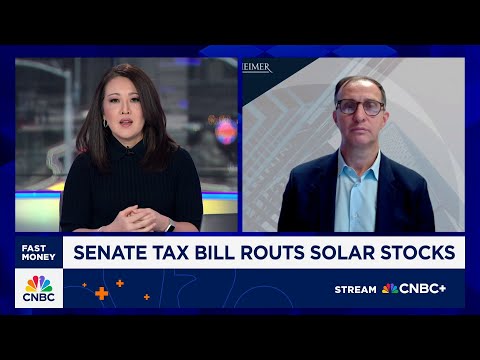
Electricity prices will continue to climb as Senate tax bill routs solar stocks: Oppenheimer's Rusch
CNBC Television· 2025-06-17 22:17
fix continues to be naive. Melissa. >> All right.Thank you, Pippa Stevens. Let's get more with Oppenheimer senior Research analyst Colin Rusch. Colin, great to have you with us.I first want to focus on the residential solar sector, which had already been under pressure because of consumer confidence, because of financing costs, so many other reasons. And now this. And I'm just wondering what what happens in this sector.It's been rerated obviously. Is it enough what happens to these stocks. >> Honestly this ...
瑞银:再探 100% 清洁能源人工智能数据中心
瑞银· 2025-06-16 03:16
Investment Rating - The report assigns a "Buy" rating to First Solar Inc (FSLR) with a target price of US$160.16 as of June 9, 2025 [112]. Core Insights - AI data centers are a significant driver of electricity demand growth in the U.S., with six major technology companies (Amazon, Microsoft, Google, Meta, Oracle, and Apple) accounting for nearly 20% of the growth in U.S. electricity demand, which grew by 3.2% year-over-year [2][3]. - The report anticipates that the potential loss of U.S. renewable tax credits will not materially impact the demand for renewables from large tech companies, as electricity costs average around 1.3% of their revenue [3][7]. - There is a shift towards hourly matching of renewable energy consumption by corporations, with some companies aiming for 24/7 carbon-free energy by 2030, which will increase the demand for diverse energy generation sources [4][90]. Summary by Sections Electricity Demand Growth - U.S. electricity generation increased by 3.2% year-over-year, equating to an additional 144 TWh [2]. - The six technology companies mentioned are growing their electricity consumption at approximately 30% per annum [2]. Tax Credits and Cost Impact - The estimated loss of U.S. renewable tax credits would have less than a 25 basis points impact on operating margins across the technology sector [3][11]. - Electricity costs are projected to average around 1.3% of revenue for the companies analyzed, indicating minimal impact from potential tax credit losses [3][7]. Corporate Renewable Targets - Corporations primarily meet renewable targets through Power Purchase Agreements (C-PPAs), which allow them to match their total annual non-renewable electricity consumption with renewable energy [4][89]. - Companies are increasingly focusing on achieving hourly matching of renewable energy consumption, which will require a more diverse energy generation mix [4][90]. Technology Company Insights - Amazon's electricity consumption was reported at 30.9 TWh in 2021, with a commitment to match 100% of its electricity with renewable sources by 2023 [25][26]. - Microsoft reported a 180% increase in electricity consumption since 2020, with electricity costs making up only 1.8% of its revenue in 2024 [40]. - Google's electricity consumption grew by 17% year-over-year in 2023, with a goal of operating on 24/7 carbon-free energy by 2030 [46]. - Meta has maintained net zero emissions since 2020 by matching 100% of its electricity use with renewable energy [53]. - Oracle's electricity consumption increased by 55% year-over-year in 2023, with electricity costs representing a small fraction of its revenue [56]. - Apple's electricity usage is significantly lower than its peers, accounting for only an estimated 0.14% of its revenue in 2023, but it is pushing for renewable energy in its supply chain [57]. Market Dynamics - The report highlights that if the growth rates of the six technology companies continue at approximately 25% per annum, their annual incremental electricity demand will exceed the entire U.S. utility-scale solar industry's generation growth by early 2028 [64][68]. - The corporate renewable demand is dominated by solar energy, which comprised 87% of the C-PPA market in 2025 [62].
Has CSLM Acquisition Corp. (SPWR) Outpaced Other Oils-Energy Stocks This Year?
ZACKS· 2025-06-12 14:46
Group 1: Company Performance - CSLM Acquisition Corp. (SPWR) has shown a year-to-date return of 3.9%, outperforming the average gain of 1.1% in the Oils-Energy group [4] - Over the past 90 days, the Zacks Consensus Estimate for SPWR's full-year earnings has increased by 129.6%, indicating improved analyst sentiment and a stronger earnings outlook [4] - In the Solar industry, which includes 16 companies, CSLM Acquisition Corp. ranks 179 in the Zacks Industry Rank and has outperformed the industry average gain of 2.5% this year [6] Group 2: Sector and Industry Context - The Oils-Energy group, which includes CSLM Acquisition Corp., is currently ranked 16 within the Zacks Sector Rank, which evaluates 16 different groups based on the average Zacks Rank of individual stocks [2] - Tigo Energy, Inc. (TYGO), another stock in the Oils-Energy sector, has achieved a year-to-date return of 26.9% and has a Zacks Rank of 2 (Buy) [5] - The Zacks Rank system focuses on earnings estimates and revisions to identify stocks with improving earnings outlooks, with a historical record of success in predicting market performance [3]



Will First Solar Weather the Tariff Headwinds and Shine Again?
ZACKS· 2025-06-11 15:21
Core Viewpoint - First Solar Inc. has lowered its full-year 2025 earnings guidance due to challenges from recent U.S. import tariffs, now expecting earnings between $12.50 and $17.50 per share, down from $17.00 to $20.00 [1][9] Financial Projections - Revenues are now projected to be between $4.50 billion and $5.50 billion, a decrease from the previous range of $5.30 billion to $5.80 billion [2] - Expected module shipments have been lowered to 15.5-19.3 gigawatts (GW) [2] Tariff Impact - The implementation of double-digit reciprocal tariffs on India, Malaysia, and Vietnam is a significant economic headwind for First Solar, potentially reducing U.S.-bound demand and leading to production slowdowns [3] - Sustained pressure from tariffs could result in partial shutdowns, affecting the company's near-term operational performance [3] Long-term Outlook - Despite short-term challenges, First Solar's long-term growth prospects remain strong due to its vertically integrated U.S. manufacturing, established footprint in the U.S. solar market, and a robust domestic supply chain [4] - The Zacks Consensus Estimate for First Solar's long-term earnings growth rate is 34.5%, above the industry's average of 23.1% [5] Industry Context - Other solar stocks, such as Canadian Solar Inc. and JinkoSolar, are also facing pressure from increased tariffs on solar equipment imports from China and Southeast Asia, leading to reduced demand and sales [6][7] Stock Performance and Valuation - First Solar shares have declined by 43.9% over the past year, compared to a 45% decline in the industry [8] - The company's shares are trading at a forward Price/Earnings ratio of 9.26X, significantly lower than the industry's average of 15.66X [10] - The Zacks Consensus Estimate for First Solar's near-term earnings has decreased over the past 60 days [11]

JinkoSolar Earns RETC's "Overall Highest Achiever" Award for the Sixth Consecutive Year
Prnewswire· 2025-06-11 13:00
Core Insights - JinkoSolar has been recognized as the Overall Highest Achiever in the Renewable Energy Testing Center's 2025 PV Module Index Report, marking the sixth consecutive year of this distinction, reinforcing its leadership in the solar industry [1][4]. Company Performance - The RETC's PVMI evaluates solar modules over a 12-month period using advanced testing protocols, ensuring that only the most reliable and high-performing modules receive recognition [2]. - The Overall Highest Achiever award acknowledges excellence in reliability, performance, and quality, providing assurance to project developers and stakeholders regarding the consistent performance of JinkoSolar's modules [3][4]. Industry Recognition - JinkoSolar ranks 1 among 40 manufacturers in the Wood Mackenzie Global Solar Module Manufacturers list and has received AAA ratings in PV Tech's ModuleTech Bankability Report, highlighting its strong performance in key bankability indices [4]. - The company is the only manufacturer rated bankable by 100% of survey participants in the BNEF PV Module Bankability Survey, underscoring its commitment to quality and reliability [4]. Global Presence - JinkoSolar operates over 10 production facilities globally and has more than 20 overseas subsidiaries in various countries, including Japan, South Korea, and Germany, showcasing its extensive international footprint [6]. - The company has a global sales network with teams in multiple countries, including the United States, Canada, and Brazil, indicating a diversified customer base [6].


CEO T.J. Rodgers on Solar ITC Loss
Globenewswire· 2025-06-09 12:18
Core Viewpoint - The solar industry, particularly SunPower, is poised for significant change as the federal government considers eliminating the 30% solar Investment Tax Credit (ITC), which could lead to both challenges and opportunities for the company and the sector as a whole [1][5][18]. Company Overview - SunPower, founded in 1985, has navigated various economic downturns and crises, including a Chapter 11 bankruptcy in 2024, attributed to management failures and reliance on government subsidies [7][9]. - The company has recently restructured under new ownership, Complete Solar, which acquired key assets and aims to operate more efficiently and profitably [10][12]. Financial Performance - SunPower reported a revenue of $1.4 billion and an operating income of $168 million in 2008, but faced significant losses leading to bankruptcy in 2024 [8][9]. - The new SunPower has achieved a revenue of $320 million with a target of $80 million per quarter, and is on track for its second profitable quarter [10][17]. - Current financial models predict a breakeven revenue of approximately $72 million, which could decrease to $65 million with ongoing cost reductions [19][26]. Market Analysis - The solar market has seen significant growth, with shipments increasing from 2,176 MW to 6,953 MW between 2015 and 2024, while prices remained relatively stable [22]. - A potential price increase from $3.30 to $3.88 per watt (17.6%) could result in a volume loss of 134 MW, impacting SunPower's revenue by approximately 7.2% [25]. - The company’s revenue is projected to drop from $80 million to $74.2 million per quarter if market conditions worsen due to the ITC phase-out [25][27]. Strategic Direction - The company advocates for a free market approach, suggesting that the removal of the ITC could ultimately benefit the solar industry by reducing reliance on government subsidies [2][5]. - SunPower's strategy involves leveraging its existing assets and workforce to create a leaner, more profitable organization, moving away from the inefficiencies associated with previous government support [14][17]. Valuation Concerns - SunPower's stock price remains low, with a price-to-sales ratio of about 0.5x, despite recent operational improvements and profitability [33][34]. - The company aims to eliminate the "going concern" rating by year-end to improve investor confidence and stock valuation [34].