有机农业

Search documents
土壤配备“医生” 污水变成“财富”
Ke Ji Ri Bao· 2025-05-23 01:06
Core Viewpoint - The establishment of the "Organic Agricultural Technology Institute" in Lingqiu County, Shanxi Province, is significantly enhancing agricultural productivity and farmer income through the use of agricultural enzymes and innovative farming techniques [1][2][3]. Group 1: Agricultural Innovation - The "Organic Agricultural Technology Institute" focuses on a "low-cost, high-quality county-level organic agriculture engineering technology system" that integrates scientific research with practical farming [1]. - The enzyme planting demonstration area utilizes a "plant-animal-microbe" organic planting system developed by China Agricultural University, which transforms kitchen waste and agricultural by-products into beneficial microbial strains for high-efficiency fertilizers [2]. - The use of enzymes has led to a 3%-4% increase in protein content in millet and a 55.7%-137.5% increase in lycopene content in tomatoes, showcasing the effectiveness of this approach [2]. Group 2: Economic Impact - The cost of fertilizers for millet cultivation has decreased from 300 yuan to 110 yuan per mu, while the selling price of millet has risen from 2 yuan to 3.5 yuan per jin, resulting in a profit increase of 768 yuan per mu compared to traditional methods [2]. - The implementation of the "toilet revolution + organic dry farming" project has transformed waste management in rural areas, producing 1714 tons of organic fertilizer annually and saving significant amounts of irrigation water [4]. - The operational cost of the waste treatment facility is only 53,900 yuan per year, generating direct economic benefits of 165,000 yuan and boosting related industries by over 5 million yuan [4]. Group 3: Sustainable Development - The agricultural enzymes not only serve as fertilizers but also act as "soil doctors," enhancing soil health and promoting sustainable farming practices [3]. - The technology has been successfully promoted to neighboring counties, with nearly 400 demonstration households and over 2000 mu of land benefiting from the enzyme planting method [3]. - The team aims to further develop pathways for organic agriculture, focusing on waste classification and the application of agricultural enzymes to create replicable and scalable solutions for nationwide organic farming [6].
研判2025!中国有机农业行业政策汇总、产业链、发展现状、竞争格局及发展趋势分析:传统农业问题凸显,有机农业引领可持续发展潮流[图]
Chan Ye Xin Xi Wang· 2025-04-27 01:25
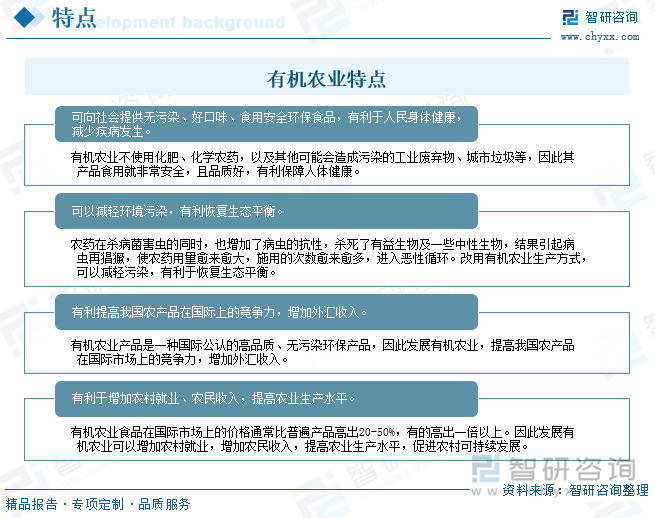
Core Viewpoint - The organic agriculture sector is emerging as a sustainable development engine in response to the challenges posed by traditional agriculture, which relies heavily on chemical inputs, leading to environmental degradation and food safety concerns [1][14]. Industry Overview - Organic agriculture refers to farming practices that avoid synthetic fertilizers, pesticides, and other artificial additives, relying instead on organic fertilizers and sustainable agricultural techniques [3]. - The development of organic agriculture addresses issues such as soil erosion, pollution from chemical use, and loss of biodiversity, while also enhancing farmers' income and rural economic development [3]. Market Size and Growth - The market size of China's organic agriculture industry has been growing steadily, reaching 104.6 billion yuan in 2023, a year-on-year increase of 1.55%, with projections for 2024 to reach approximately 106.2 billion yuan [1][14]. - The organic fertilizer market is also expanding rapidly, with a market size of 141.39 billion yuan in 2023, expected to grow to around 150 billion yuan by 2025 [10]. Government Support and Policies - The Chinese government has been actively promoting organic agriculture through various supportive policies, including the establishment of organic product standards and the encouragement of modern agricultural practices [6][7]. - Recent policies aim to enhance the development of organic agriculture, including the promotion of smart management technologies and the establishment of organic product identification systems [6][7]. Competitive Landscape - The organic agriculture market in China is characterized by a fragmented structure, with many small and specialized companies rather than large integrated enterprises [16]. - Key players in the industry include companies like Guangdong Jinhui An Ecological Agriculture Development Co., Ltd., Mingkanghui Ecological Agriculture Group Co., Ltd., and Heilongjiang Beidahuang Agricultural Co., Ltd., which are focusing on various aspects of organic agriculture [17][19]. Trends in Organic Agriculture - There is a growing demand for organic agriculture driven by increasing consumer awareness of food safety and health [21]. - Sales channels for organic products are diversifying, with e-commerce and community group buying becoming significant avenues for distribution [22]. - Brand building is becoming increasingly important as companies focus on quality and marketing to enhance their market presence and consumer trust [23][24].