
Satellite Communications

Search documents
Gilat Reports Fourth Quarter and Full Year 2025 Results
Globenewswire· 2026-02-10 12:10
Core Insights - Gilat Satellite Networks Ltd. reported strong financial results for Q4 and full year 2025, with significant revenue growth and improved profitability metrics [1][5][6]. Q4 Financial Highlights - Q4 2025 revenue reached $137.0 million, a 75% increase from $78.1 million in Q4 2024 [6]. - GAAP operating income for Q4 was $13.0 million, slightly up from $12.8 million in Q4 2024 [6]. - Adjusted EBITDA for Q4 was $18.2 million, reflecting a 50% increase compared to $12.1 million in Q4 2024 [6]. Full Year Financial Highlights - Total revenue for 2025 was $451.7 million, up 48% from $305.4 million in 2024 [6]. - GAAP operating income for the full year was $23.4 million, down from $27.7 million in 2024 [6]. - Adjusted EBITDA for 2025 reached a record $53.2 million, a 26% increase from $42.2 million in 2024 [6]. Forward-Looking Expectations - Management expects 2026 revenue to be between $500 million and $520 million, indicating a growth rate of approximately 13% at the midpoint [4]. - Adjusted EBITDA for 2026 is projected to be between $61 million and $66 million, representing a growth rate of approximately 19% at the midpoint [4]. Management Commentary - CEO Adi Sfadia highlighted strong execution across the company, driven by growth in Defense, In-Flight Connectivity (IFC), and advanced multi-orbit solutions [5][7]. - The company achieved notable milestones in the Defense Division, including the introduction of an Earth Observation solution [5][7]. Recent Announcements - Gilat secured several significant orders, including over $10 million for LEO constellation support and approximately $11 million for its SkyEdge platform [10]. - The company announced an oversubscribed private placement of $100 million to institutional and accredited investors [10].



Overlooked Stock: VSAT's Bullish Upgrade
Youtube· 2026-02-09 21:30
Core Viewpoint - Deutsche Bank upgraded shares of Viasat (VSAT) to "buy," highlighting the company's participation in low orbit satellite communications and its dual business model that includes defense and aviation technology [2][4]. Company Overview - Viasat has seen its stock price increase over 300% in the past year, driven by demand for Wi-Fi communications and in-flight connectivity, as well as its role in complementing 5G communications [2][4]. - The company is undergoing a spin-off to create two separate divisions: one focused on traditional satellite communications and the other on defense and aviation [3][4]. Market Trends - The shift towards low orbit satellite communications is seen as a response to the need for uninterrupted connectivity, particularly in the context of autonomous driving and connected vehicles [7][9]. - The connected car market is expected to benefit from advancements in satellite communications, which may eventually replace traditional broadband services [8][9]. Analyst Insights - Analysts have mixed views on Viasat, with most leaning towards a "buy" rating, and price targets ranging from $20 to $52, indicating potential upside [11][12]. - Current trading is between the mid and high price targets, with earnings estimates for 2026 at $1.29, but a decrease to $0.64 expected for the next year, suggesting a need for contract renewals to maintain growth [13][14]. Future Outlook - The company's earnings growth will depend on guidance revisions and contract renewals, which will influence stock price movements [15].


Why March 26th Is Quietly Gaining Attention in a New Starlink Video Presentation
Globenewswire· 2026-02-07 14:04
Core Insights - The presentation by technology analyst James Altucher focuses on the emerging shifts in satellite-based internet and global connectivity, particularly highlighting Starlink's progress and potential milestones [1][5]. Group 1: Starlink's Evolution - Starlink has transitioned from an early-stage concept to an operational global system, currently deploying over 6,700 satellites to provide connectivity in underserved regions [3]. - The system's direct data transmission from space minimizes reliance on traditional ground-based infrastructure, effectively serving remote communities and areas where conventional networks are inadequate [4]. Group 2: Importance of March 26, 2026 - March 26, 2026, is emphasized as a significant date due to its alignment with key industry activities and internal benchmarks that indicate Starlink's progress towards achieving consistency and scale [5][6]. Group 3: Historical Context - Altucher compares Starlink's expansion to previous technological shifts, such as the transition to broadband and mobile internet, suggesting that satellite systems may represent the next significant advancement in connectivity [9][10]. - The gradual maturation of infrastructure often precedes broader societal changes, which may be overlooked in their early stages [10]. Group 4: Educational Aspects of the Presentation - The video presentation includes visual aids, timelines, and context to help viewers understand Starlink's role in the evolving internet landscape and the implications of current developments [11].
Viasat Q3 Earnings Surpass Estimates, Revenues Increase Y/Y
ZACKS· 2026-02-06 18:30
Core Insights - Viasat, Inc. (VSAT) reported mixed results for the third quarter of fiscal 2026, with net income exceeding estimates but revenue falling short of expectations [1][10] Financial Performance - The company achieved a net income of $25 million, or 18 cents per share, a significant recovery from a net loss of $158.4 million, or a loss of $1.23 per share, in the same quarter last year [2] - Excluding non-recurring items, Viasat's non-GAAP net income was $110.7 million, or 79 cents per share, compared to $14.7 million, or 11 cents per share, in the prior-year period, beating the Zacks Consensus Estimate by 74 cents [3] Revenue Breakdown - Total revenues increased to $1.15 billion from $1.12 billion year over year, although this figure missed the consensus estimate by $10 million [4] - Product revenues rose to $334.2 million from $314.3 million in the previous year, while net sales from services increased to $822.8 million from $809.4 million [4] - The Communication Services segment generated revenues of $825 million, up from $820 million, driven by growth in government satcom and aviation services, despite declines in maritime and U.S. fixed broadband [5] - The Defense and Advanced Technologies (DAT) segment reported revenues of $332 million, reflecting a 9% year-over-year increase, primarily due to growth in information security and cyber defense [6] Operational Metrics - Viasat's operating income for the quarter was $26.3 million, compared to $21.2 million in the prior-year quarter, while adjusted EBITDA was $387 million, down from $393 million [7] - The company generated an operating cash flow of $307 million, up from $219 million in the prior-year period, indicating improved operational performance [8] Future Outlook - For fiscal 2026, Viasat anticipates low single-digit revenue growth and flat adjusted EBITDA year over year, with the Communication Services segment expected to perform flat due to low double-digit growth in aviation services [11] - The DAT segment is projected to grow in the mid-teens, driven by strong growth in information security and cyber defense [11] - Capital expenditures are forecasted to be between $1 billion and $1.1 billion, including approximately $400 million for Inmarsat-related capital expenditures [11]

Spotlight on EchoStar: Analyzing the Surge in Options Activity - EchoStar (NASDAQ:SATS)
Benzinga· 2026-02-06 16:00
Group 1: Options Trading Activity - Over 9 options trades for EchoStar (NASDAQ:SATS) detected, totaling $795,230, with an additional 5 trades amounting to $227,600 [1] - Big players are targeting a price window for EchoStar between $25.0 and $190.0 over the past quarter [2] - Volume and open interest metrics indicate liquidity and investor interest in EchoStar's options, with fluctuations observed in the last 30 days [3] Group 2: Company Performance and Analyst Insights - Current trading volume for EchoStar stands at 1,446,953, with the stock price up by 3.1% at $110.33 [5] - An average price target of $121.0 has been set by analysts, with Citigroup maintaining a Neutral rating on the stock [4] - The stock's RSI indicators suggest a neutral position between overbought and oversold [5]


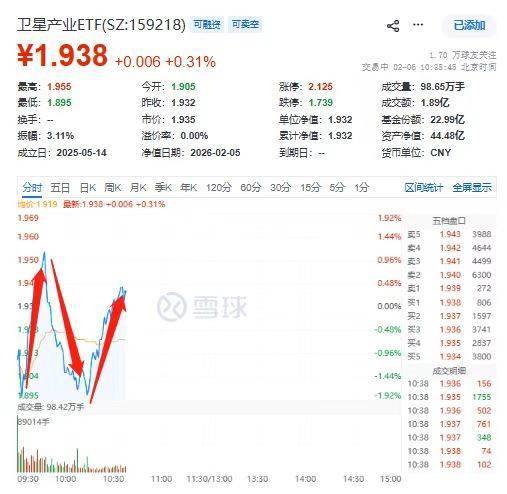
N型反转!卫星产业ETF(159218)盘中多空极限拉扯,SpaceX再放大招!
Sou Hu Cai Jing· 2026-02-06 03:08
Core Insights - The satellite industry ETF (159218) showed resilience with a 0.3% increase, driven by significant developments in the sector, particularly SpaceX's plans to launch "Starlink Phone" and direct internet connection devices, marking a shift in global satellite internet competition [1][2][3] Market Dynamics - The introduction of "Starlink Phone" aims to connect consumer devices like smartphones directly to satellite networks, potentially increasing the user base from millions to billions, thus breaking previous market ceiling perceptions and opening vast growth opportunities for the entire industry [3] - The focus on high-tech requirements for terminal antennas, RF chips, and baseband chips indicates a shift in value distribution within the industry, with investors concentrating on segments with the highest technological barriers that are likely to benefit from this ecological transformation [3] Investment Implications - Continuous global strategic investments are expected to generate stable demand and orders across the satellite manufacturing, rocket launching, and ground operation sectors, suggesting that the investment logic transcends short-term market fluctuations [4] - The satellite industry ETF (159218) is positioned to benefit from external stimuli that lead to the revaluation of domestic industry value [4]


Compared to Estimates, ViaSat (VSAT) Q3 Earnings: A Look at Key Metrics
ZACKS· 2026-02-06 01:00
Core Insights - ViaSat reported $1.16 billion in revenue for the quarter ended December 2025, marking a year-over-year increase of 3% and an EPS of $0.79 compared to -$1.23 a year ago, indicating a significant turnaround in profitability [1] - The revenue fell slightly short of the Zacks Consensus Estimate of $1.17 billion, resulting in a surprise of -0.85%, while the EPS exceeded expectations with a surprise of +1404.76% against a consensus estimate of $0.05 [1] Revenue Breakdown - Product revenues were reported at $334.23 million, which is lower than the estimated $345.69 million, reflecting a year-over-year increase of +6.3% [4] - Service revenues reached $822.82 million, slightly above the estimated $820.9 million, with a year-over-year increase of +1.7% [4] - Communication Services revenue totaled $825.34 million, slightly below the estimated $827.72 million, with a year-over-year increase of +0.6% [4] - Defense and Advanced Technologies revenue was reported at $331.7 million, below the average estimate of $350.36 million, but showing a year-over-year increase of +9.3% [4] Stock Performance - ViaSat shares have returned +5.2% over the past month, outperforming the Zacks S&P 500 composite, which saw a +0.5% change [3] - The stock currently holds a Zacks Rank 3 (Hold), suggesting it may perform in line with the broader market in the near term [3]

ViaSat(VSAT) - 2026 Q3 - Earnings Call Transcript
2026-02-05 23:32
Financial Data and Key Metrics Changes - Revenue for Q3 FY 2026 was $1.2 billion, up approximately 3% year-over-year, driven by growth in DAT and communication services [21][22] - Adjusted EBITDA was $387 million, down 2%, primarily due to increased R&D investments and the impact of the government shutdown [23] - Net income improved to $25 million, an increase of $183 million, mainly due to higher interest income from Ligado's quarterly fees [22] - Free cash flow was $444 million, or $24 million excluding the lump sum payment from Ligado [23][24] - The net debt to trailing 12-month Adjusted EBITDA ratio improved to 3.25 times, down from approximately 3.7 times a year ago [24] Business Line Data and Key Metrics Changes - Communication services awards were $671 million, down 11%, reflecting lower aviation awards and the effects of the government shutdown [24] - Maritime awards grew 25%, while revenue was $825 million, up 1%, with solid growth in aviation and government SATCOM [25] - Aviation revenue increased by 15%, driven by a 9% rise in commercial aircraft in service [25] - Government SATCOM revenue grew 4%, indicating strong growth with U.S. and international governments [26] - Fixed services revenue declined by 20% due to a decrease in U.S. fixed broadband subscribers [28] Market Data and Key Metrics Changes - Backlog reached approximately $4 billion, a record high, up about 12% or $430 million, driven by strong awards in government SATCOM and DAT [22] - The global space economy is projected to grow from $626 billion in 2025 to $1 trillion by 2034, indicating significant market opportunities [16] Company Strategy and Development Direction - The company focuses on three key areas for revenue growth: ViaSat-3, multi-orbit networks, and new defense technology [6][10] - Ongoing capital allocation and strategic initiatives aim to unlock shareholder value while enhancing competitive positioning in fast-growing markets [11][15] - The company is evaluating strategic options, including the potential separation of government and commercial businesses to enhance shareholder value [15] Management's Comments on Operating Environment and Future Outlook - Management expressed confidence in the strategic direction and operational targets, particularly regarding the deployment of ViaSat-3 satellites [20][32] - The company anticipates that the entry into service of ViaSat-3 Flights 2 and 3 will catalyze future growth in both government and commercial franchises [31][32] - Management acknowledged the impact of the government shutdown on operations and expects similar effects in the fourth quarter [31] Other Important Information - The company is committed to reducing capital intensity while enhancing innovation and customer value [12] - A divestiture of the minority interest in Navarino is expected to close in March, subject to regulatory approval [24] - The company plans to invest in next-generation mobile user terminals and additional sources of LEO bandwidth for government and aero customers [9] Q&A Session Summary Question: Update on Flight 2 and Flight 3 launches - Management confirmed that Flight 3 will have a shorter orbit raise period of about two months compared to Flight 2's 100 days [43] Question: Strategic review process and timing - Management indicated that the successful deployment of Flights 2 and 3, along with macro market conditions, will influence the timing of strategic decisions [46] Question: Thoughts on data centers in space and AI - Management noted that the feasibility of data centers in space hinges on power generation efficiency and expressed no plans to enter the data center business [50][51] Question: Addressable markets for competitive advantages - Management identified broadband and L-band markets as key growth areas, emphasizing government applications and sovereign ownership trends [56][57] Question: Evaluation of government assets and potential separation - Management acknowledged the complexity of managing key dependencies and emphasized a thorough evaluation process for maximizing shareholder value [88]
ViaSat(VSAT) - 2026 Q3 - Earnings Call Transcript
2026-02-05 23:32
Financial Data and Key Metrics Changes - Revenue for Q3 FY 2026 was $1.2 billion, up approximately 3% year-over-year, reflecting growth in both DAT and communication services [21][22] - Adjusted EBITDA was $387 million, down 2%, primarily due to $10 million of incremental R&D investments related to growth initiatives [23] - Net income improved to $25 million, an increase of $183 million, mainly due to higher interest income recognized during the quarter [22] - Cash flow from operations was $727 million, or $307 million excluding the lump sum payment from Legato, resulting in free cash flow of $444 million [21][23] - The net debt to trailing twelve-month adjusted EBITDA ratio improved to 3.25 times, down from approximately 3.7 times a year ago [24] Business Line Data and Key Metrics Changes - Communication services awards were $671 million, down 11%, reflecting lower aviation awards and the effects of the government shutdown [24] - Maritime awards grew 25%, while revenue was $825 million, up 1%, with solid growth in aviation and government SATCOM [25] - Aviation revenue grew 15%, driven by a 9% increase in commercial aircraft in service [25] - Government SATCOM revenue increased by 4%, indicating strong growth with U.S. and international governments [26] - Fixed services and other revenue declined by 20%, with U.S. fixed broadband subscribers continuing to decrease [28] Market Data and Key Metrics Changes - Backlog reached approximately $4 billion, a record for the company, up about 12% or $430 million, largely due to strong awards in the second quarter [22] - The global space economy is projected to grow from $626 billion in 2025 to $1 trillion by 2034, indicating significant market opportunities [16] Company Strategy and Development Direction - The company focuses on three key areas for revenue growth: ViaSat-3, multi-orbit systems, and new frontier defense technology [6] - Ongoing capital allocation and strategic initiatives aim to unlock shareholder value while positioning the company to deliver differentiated value in fast-growing space and defense markets [11] - The company is evaluating strategic options, including the potential separation of government and commercial businesses to enhance shareholder value [15] Management's Comments on Operating Environment and Future Outlook - Management expressed confidence in the strategic direction and operational targets, emphasizing the importance of bringing ViaSat-3 flights 2 and 3 into service [20][32] - The company anticipates that the capabilities of the new satellites will catalyze future growth in both government and commercial franchises [31] - Management acknowledged the impact of the government shutdown on operations and expects similar effects in the fourth quarter [31] Other Important Information - The company is committed to reducing capital intensity while enhancing its reputation for reliable innovation and customer value [12] - The Equatys Mobile Satellite Services partnership is expected to leverage technical innovation and reduce capital costs for targeted business segments [13] Q&A Session Summary Question: Update on Flight 2 and Flight 3 launches - Management confirmed that Flight 3 will likely have a shorter orbit raise period of about 2 months compared to Flight 2's 100 days [43] Question: Strategic review process and timing - Management indicated that the successful deployment of Flights 2 and 3, along with macro market conditions, will influence the timing of strategic decisions [45][46] Question: Thoughts on data centers in space and AI - Management noted that the feasibility of data centers in space hinges on power generation efficiency and expressed no plans to enter the data center business [51][52] Question: Addressable markets for competitive advantages - Management identified broadband and L-band markets as key areas for growth, particularly in mobile platforms and government applications [56][57] Question: Evaluation of government assets and potential separation - Management stated that a thorough evaluation is ongoing regarding the management of key dependencies if a separation occurs [85][86]
ViaSat(VSAT) - 2026 Q3 - Earnings Call Transcript
2026-02-05 23:30
Financial Data and Key Metrics Changes - Revenue for Q3 FY 2026 was $1.2 billion, an increase of approximately 3% year-over-year, driven by growth in DAT and communication services [18][20] - Adjusted EBITDA was $387 million, down 2%, primarily due to increased R&D investments and the impact of the government shutdown [21][26] - Net income improved to $25 million, a significant increase of $183 million compared to the previous year, mainly due to higher interest income [20] - Free cash flow was $444 million, or $24 million excluding a lump sum payment from Legato, with trailing twelve-month free cash flow exceeding $200 million [21][22] Business Line Data and Key Metrics Changes - Communication services awards were $671 million, down 11%, affected by lower aviation awards and the government shutdown [22] - Maritime revenue grew 25%, while overall maritime revenue declined 3% due to a decrease in vessels in service [24][25] - Defense and Advanced Technologies (DAT) revenue was $332 million, up 9%, driven by strong growth in InfoSec and cyber defense [26][29] Market Data and Key Metrics Changes - Backlog reached approximately $4 billion, a record high, up about 12% or $430 million, largely due to strong awards in government SATCOM and DAT [19] - The global space economy is projected to grow from $626 billion in 2025 to $1 trillion by 2034, indicating significant market opportunities [13][14] Company Strategy and Development Direction - The company is focused on three key areas for revenue growth: ViaSat-3, multi-orbit networks, and new defense technology [5][6] - Ongoing capital allocation and strategic initiatives aim to unlock shareholder value while positioning the company to deliver differentiated value in fast-growing space and defense markets [9][12] - The company is evaluating strategic options, including the potential separation of government and commercial businesses to enhance competitive positioning [12][14] Management's Comments on Operating Environment and Future Outlook - Management expressed confidence in the strategic direction and operational targets, emphasizing the importance of the upcoming launches of ViaSat-3 Flight 2 and Flight 3 [17][30] - The company anticipates that the capabilities of the new satellites will catalyze future growth in both government and commercial franchises [29][30] - Management acknowledged the impact of the government shutdown on operations and expects similar effects in the fourth quarter [29] Other Important Information - The company is committed to reducing capital intensity while enhancing innovation and customer value [10][33] - A strategic partnership with Space42 aims to develop a shared space infrastructure to reduce capital costs and improve service delivery [11][34] Q&A Session Summary Question: Update on Flight 2 and Flight 3 launches - Management confirmed that Flight 3 will have a shorter orbit raise period of about two months compared to Flight 2's 100 days [42] Question: Strategic review process and timing - Management indicated that the successful deployment of Flight 2 and Flight 3, along with macro market conditions, will influence the timing of strategic decisions [44][45] Question: Thoughts on data centers in space and AI - Management stated that the feasibility of data centers in space hinges on power generation efficiency and expressed interest in partnerships for communication capabilities [49][51] Question: Competitive landscape for D2D players - Management highlighted the importance of spectrum allocation and national security considerations in the competitive landscape for mobile satellite services [66][68] Question: Evaluation of government assets and potential separation - Management acknowledged the complexity of managing key dependencies and emphasized a thorough evaluation process to enhance shareholder value [84][85] Question: Position in information security and competitive threats - Management expressed optimism about growth in the information security sector, citing increased urgency and market size as favorable factors [86]