
Cybersecurity

Search documents
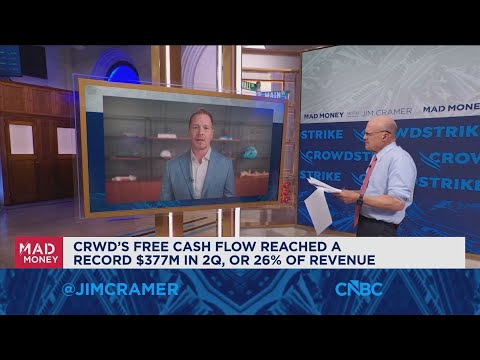
CrowdStrike CEO George Kurtz goes one-on-one with Jim Cramer
CNBC Television· 2026-08-27 23:28
Financial Performance - CrowdStrike reported the best quarter in company history, driving the stock up more than 20%[2] - Full-year forecast for Net New Annual Recurring Revenue (ARR) growth was raised from 27.7% to 34.34%[2] - Annual Recurring Revenue reached almost 1.5 billion dollars, with Net New ARR at 333 million dollars, up 51% year-over-year[5] - Operating income reached 372 million dollars, representing a 46% increase year-over-year[5] - Record free cash flow reached 377 million dollars, accounting for 26% of revenue[5] - Innovative licensing model (Flex numbers) reached nearly 2.3 billion dollars[14] Market Trends & Industry Dynamics - The rise of artificial intelligence has made cybersecurity and CrowdStrike more essential as attackers leverage AI technology[3] - CrowdStrike developed the Falcon platform from the ground up to provide defensive AI against offensive AI and address the agentic era[7][8] - CrowdStrike successfully consolidates two to three, four, five, and six point products to reduce customer complexity and overall costs[14] - CrowdStrike acquired a next-generation identity company called Signal to build a control plane for human and non-human identities and manage AI agents[20][21] - Software agents running in 176 countries provide crowdsourced visibility to continuously improve algorithms[24]


X @BSCN
BSCN· 2026-08-27 19:50
InterLink ID verifies humans without storing the face it scansInterLink ID starts with a face scan, and @inter_link runs an AI deepfake and liveness check before anything is stored.The face becomes a feature vector, a string of numbers describing facial geometry rather than an image. Those numbers are scrambled and hashed so the original face cannot be rebuilt.What gets stored is a cryptographic commitment to that hash, a sealed record that can be checked against but not read, held across a decentralized no ...
X @TechCrunch
TechCrunch· 2026-08-27 17:45
Industry Dynamics - Global technology companies and artificial intelligence startups unite to address current cybersecurity challenges [1] Market Trends - Technology and artificial intelligence sectors launch new solutions to defend against next-generation cyber threats [1]
Nvidia Ignites AI Rally Ahead of Jackson Hole | Open Interest 8/27/2026
Bloomberg Television· 2026-08-27 17:32
Financial Performance - NVIDIA reported a quarterly revenue more than doubling to 96 billion dollars, topping Wall Street estimates[2] - NVIDIA targets 70% sales growth for the next fiscal year 2028, potentially reaching a 1 trillion dollar annualized revenue run rate[2][31] - Salesforce reported strong results with a guidance update and expanded partnership, showing a 17% increase in shares[64][78] Market Dynamics & Industry Trends - Artificial intelligence demand remains robust with memory chip availability acting as a bottleneck and demand running at 100% against a 70% achievable shipping rate[4][5] - Cybersecurity demand continues to grow as AI-powered threats drive strong forecasts for companies like CrowdStrike and Okta[26][84][134] - Retail sector shows divergence as Dollar General raises sales guidance while Dollar Tree disappoints and Best Buy sees slower demand following a strong second quarter[14][17][133] Regulatory & Macroeconomic Environment - Federal Reserve officials like Kansas City Fed President Jeff Schmid discuss monetary policy stances and potential rate adjustments ahead of the Jackson Hole symposium[22][168] - U.S. trade relations face tensions as trade representatives consider potential bans on Canadian goods and sweeping tariffs on semiconductors[118][122] - Regulatory scrutiny increases over private firms and asset managers utilizing insurance company balance sheets and collateral loan structures[159][160]



X @Forbes
Forbes· 2026-08-27 13:55
Market Performance - CrowdStrike shares surged by 13% following the earnings announcement [1] Industry Dynamics - The Chief Executive Officer highlighted the period as the company's best-ever quarter [1] - Anthropic was credited as a key factor driving the strong quarterly results [1]