
Ports

Search documents
UTF: The 6.9% Yielding Monthly Payout Infrastructure Fund You Can't Ignore
Seeking Alpha· 2025-08-27 17:00
Group 1 - The Cohen & Steers Infrastructure Fund (NYSE: UTF) is a diversified closed-end fund focused on infrastructure companies across various sectors including utilities, pipelines, toll roads, airports, railroads, ports, and telecommunications [1] - The fund aims to provide high-yield investment opportunities by investing in a broad range of infrastructure assets [1] Group 2 - The company invests significant resources, including thousands of hours and over $100,000 annually, into researching profitable investment opportunities [2] - The investment approach has garnered over 180 five-star reviews from members, indicating a strong satisfaction rate and perceived benefits [2]


X @Bloomberg
Bloomberg· 2025-08-14 12:50
Deal Status - CK Hutchison ruled out completing the global ports sale to a BlackRock-backed consortium in 2025 [1] - CK Hutchison remains optimistic about the deal's prospects after inviting a Chinese investor [1]
中国工业-跟踪美国对中国关税变化中的贸易流动-China Industrials _Tracking trade flows amid changing..._
2025-08-14 02:44
Summary of Key Points from the Conference Call Industry Overview - The report focuses on the **China Industrials** sector, particularly the impact of changing US tariffs on trade flows with China, covering shipping, shipbuilding, ports, international freight flights, and land transportation [2][40]. Core Insights and Arguments 1. **Port Volume Decline**: Container throughput at key ports in China fell by **9% week-over-week (WoW)** and **7% year-over-year (YoY)**, marking the first decline since March. However, combined throughput for weeks 30 and 31 showed a **2% YoY increase** [3][6]. 2. **US Port Import Volumes**: The Port of Los Angeles reported a **5% WoW** and **2% YoY** increase in import volumes for week 33, following a **6% YoY** increase in week 32 [3][9]. 3. **Shipping Rates**: The Shanghai Containerized Freight Index (SCFI) decreased by **3% WoW**. Specifically, freight rates between China and the US dropped by **2%** and **7%** for the West Coast and East Coast, respectively, due to overcapacity pressures [4][12]. 4. **European Port Congestion**: Ongoing congestion at European ports, particularly in Antwerp and Hamburg, has led to longer waiting times for container pickup and delivery, with average waiting times for container ships over **8,000 TEU** increasing by **9% WoW** [5][26]. 5. **International Freight Flights**: The number of international freight flights increased by **9% YoY**, although it was down **2% WoW** last week [3][33]. Additional Important Insights 1. **Intra-Asia Supply Improvement**: There was a slight improvement in the Asia feeder ship availability index, which rebounded by **26% WoW** [4][14]. 2. **China Expressway Truck Traffic**: Truck traffic on expressways in China increased by **3% YoY** last week, indicating a potential uptick in domestic logistics activity [27]. 3. **Vietnam's Export Growth**: Vietnam's exports rose by **17% YoY** in the first half of July, showcasing strong trade performance amidst global uncertainties [18][20]. 4. **Direct Shipping Volumes**: Direct shipping volumes from China to ASEAN and the US showed a **22% increase** WoW, but a **15% decrease** YoY in week 31 [21][23]. Risks and Considerations - The macroeconomic environment poses risks to China's industrial sector, with potential demand shrinkage for industrial goods and import/export volumes if the economy remains weak. Additionally, the cancellation of preferential policies for high-tech companies could adversely affect earnings [40]. This summary encapsulates the critical data and insights from the conference call, providing a comprehensive overview of the current state of the China Industrials sector and its implications for trade and shipping dynamics.
X @Bloomberg
Bloomberg· 2025-08-14 02:28
CK Hutchison investors may get a chance to hear an update on its politically sensitive global port asset sale on Thursday https://t.co/HHETGCJspl ...
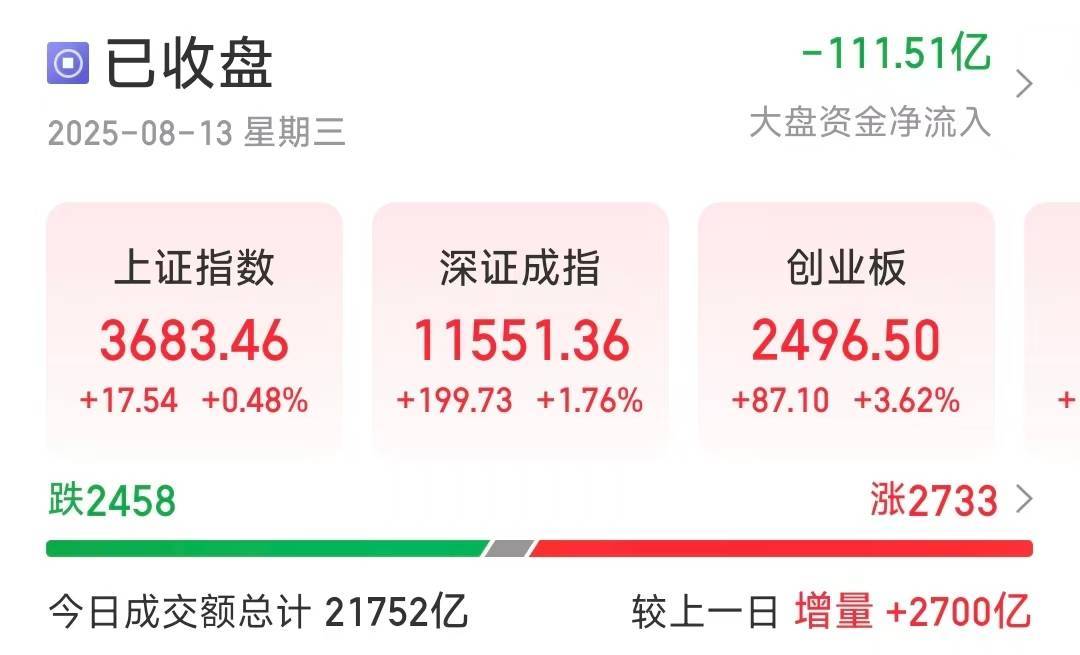
重回2万亿!沪指创近4年新高,创业板大涨3.62%
Sou Hu Cai Jing· 2025-08-13 07:29
Core Insights - The A-share market has shown strong performance, with the Shanghai Composite Index rising by 0.48% to 3683.46 points, marking a nearly four-year high [1] - The Shenzhen Component Index increased by 1.76%, and the ChiNext Index surged by 3.62%, both reaching new highs for the year [1] - The total market turnover reached 2.18 trillion yuan, an increase of 270 billion yuan compared to the previous trading day, surpassing 2 trillion yuan for the first time in 114 trading days [1] Sector Performance - Leading sectors included optical modules (CPO), copper industry, optical chips, and industrial gases, which saw significant gains [1] - AI hardware stocks continued to perform well, with companies like Industrial Fulian reaching historical highs [1] - Brokerage stocks experienced a brief surge, with Guosheng Financial Holdings achieving two consecutive trading limit ups [1] - Conversely, sectors such as coal, banking, ports, and logistics faced declines [1] - Over 2700 stocks in the market recorded gains [1]

X @Bloomberg
Bloomberg· 2025-08-12 20:16
Business Expansion - The Panama Canal plans to enter the ports business through a tender for two terminals [1] Geopolitical Context - This move follows a high-profile clash between the US and China over the waterway [1]
AS Tallinna Sadam financial results for 2025 Q2 and 6 months
Globenewswire· 2025-08-11 05:00
Core Insights - Tallinna Sadam reported a sales revenue of approximately 30 million euros and a profit exceeding 3 million euros in Q2 2025, with total revenue for the first half of the year at 58 million euros and profit over 10 million euros [1][10] - The company experienced a decline in sales revenue by 7% and profit by 15% in Q2, while adjusted EBITDA increased by 7% year-on-year [2][9] - The number of passengers grew by 3.8%, cargo volumes increased by 8%, and vessel calls rose by 2.1% in Q2 2025, indicating stable growth in operational volumes [3][4] Financial Performance - Q2 2025 revenue was 29.5 million euros, down from 31.7 million euros in Q2 2024, representing a decrease of 6.8%. For the first half of 2025, revenue decreased by 2.9% to 57.9 million euros [6][8] - Adjusted EBITDA for Q2 2025 was 15.9 million euros, up from 14.9 million euros in Q2 2024, marking a 6.7% increase. The adjusted EBITDA margin improved to 53.8% from 47.0% [6][9] - Net profit for Q2 2025 was 3.5 million euros, a decrease of 15.2% compared to 4.1 million euros in Q2 2024. However, net profit for the first half of 2025 increased by 10.7% year-on-year to 10.3 million euros [10][14] Investment Activities - The company invested a total of 12 million euros in the first half of 2025, which is 13 million euros less than the previous year. In Q2 2025, investments amounted to 8.4 million euros [11][12] - Investments were primarily focused on the construction of an offshore wind quay, dry-docking of a ferry, and improvements in cargo harbours [11] Operational Highlights - The ferry segment showed stable growth, with a 2.4% increase in passenger numbers despite a 1.5% decrease in the number of trips [3][4] - The chartering of the icebreaker Botnica saw a significant decrease in utility rate, chartered only 22% of the time, which is 63% less than the previous year [3][4][10] - The company noted an increase in cruise vessel calls, positively impacting overall results despite the decline in sales revenue [4][10] Key Events - A subsidiary, OÜ TS Laevad, agreed to an additional 485 trips with the ferry Regula during the summer period [7] - A resolution from the Circuit Court was made regarding a criminal case involving former management board members of AS Tallinna Sadam [7]
X @Bloomberg
Bloomberg· 2025-08-06 13:18
Business Strategy - Turkish billionaire Robert Yuksel Yildirim is expanding his ports business [1] Market Trend - The ports business expansion is a bet on shorter voyages by merchant shippers [1] - Shorter voyages are anticipated due to trade tensions between the US and China [1]
Invitation to Tallinna Sadam Investor Conference Webinar for the unaudited results of Q2 2025
Globenewswire· 2025-08-04 13:30
Core Viewpoint - Tallinna Sadam is hosting an investor conference webinar to present its unaudited Q2 2025 results, scheduled for 11 August 2025 [1] Group 1: Webinar Details - The webinar will be conducted in two languages: Estonian at 10:00 (EET) and English at 11:00 (EET) [1] - The management board chairman Valdo Kalm and CFO Andrus Ait will present the results and address questions from participants [1] - Participants are encouraged to submit questions in advance due to time constraints [1] Group 2: Company Overview - Tallinna Sadam is one of the largest cargo and passenger port complexes in the Baltic Sea region [3] - The company operates ferry services between the Estonian mainland and its largest islands through its subsidiary OÜ TS Laevad [3] - OÜ TS Shipping, another subsidiary, charters the multifunctional vessel Botnica for icebreaking and offshore services [3] - Tallinna Sadam is also a shareholder in AS Green Marine, which provides waste management services [3]
X @Bloomberg
Bloomberg· 2025-07-29 15:35
Shipping giant CMA is angling to be part of a mega-deal that would see the sale of dozens of ports owned by billionaire Li Ka-shing’s CK Hutchison https://t.co/8THFo0tvrb ...