
互动媒体与服务

Search documents
A股1月展望:跨年行情还能持续吗?
Sou Hu Cai Jing· 2025-12-30 11:27
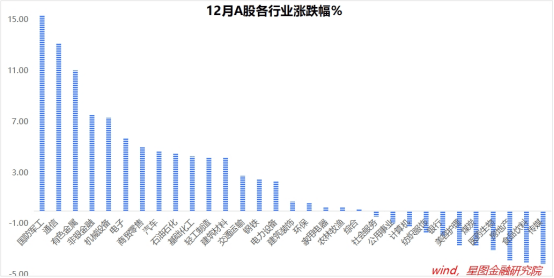
Market Overview - The A-share market in December 2025 ended with a structural differentiation, characterized by a growth style leading the market, with the Wind All A Index rising by 3.34% [1] - The ChiNext Index surged by 5.57%, indicating a strong preference for small and medium-sized growth stocks, while the Shanghai Composite Index only saw a modest increase of 1.97% [1] - The cyclical style index rose by 5.21%, and the growth style index increased by 4.97%, significantly outperforming the consumer style index, which fell by 1.44% [1] Sector Performance - The commercial aerospace sector was notably strong, driven by intensive industrial policies, with the aerospace and defense sector rising by 15.87% and the communication equipment sector increasing by 16.51% [2] - The insurance sector also performed well, rising by 16.98% due to year-end institutional allocation demand and expectations of long-term investment policies [2] - Conversely, sectors such as interactive media and services, as well as the media sector, experienced declines due to previous overheating or lack of catalysts [2] Driving Factors - The primary driver of the market's performance was the influx of incremental capital, with net subscriptions to broad-based ETFs exceeding 110 billion yuan, particularly in the A500 ETF [4] - Strong domestic industrial policies, such as the National Space Administration's action plan for commercial aerospace, played a crucial role in stimulating related sectors [4] - Global liquidity expectations shifted with the Federal Reserve's interest rate cut in December, alongside the appreciation of the yuan, creating a favorable external environment [4] Market Expectations - Looking ahead to January 2026, the cross-year market trend is expected to continue, but with a focus on structure and rhythm [6] - Major broad-based indices may experience a "volatile consolidation and structural differentiation" pattern, with support from institutional fund layouts for the spring rally [6] - Opportunities in sectors are anticipated to revolve around dual drivers of policy and industry, with ongoing stories in the non-ferrous metals sector and a focus on commercial aerospace themes due to policy developments [6] Investment Strategy - A flexible and structured approach is recommended for upcoming market conditions, with a "core + satellite" investment strategy suggested [7] - Core positions should focus on high-growth sectors with clear industry trends, such as energy storage and precious metals, while flexible positions can target policy-sensitive themes like commercial aerospace [7] - Overall positions should be controlled to avoid chasing high prices, especially in light of potential market volatility from upcoming economic data releases and policy announcements [7]

美银:标普500高估值具有合理性 三大板块最具投资价值
Zhi Tong Cai Jing· 2025-06-16 03:50
Group 1 - The S&P 500 index is considered overvalued based on all valuation metrics tracked by Bank of America, but this is seen as a characteristic of the high-quality, tech-driven index rather than a flaw [1] - The expected price-to-earnings ratio of the S&P 500 is 21 times, approximately 35% higher than its historical average, with all 20 valuation metrics monitored by Bank of America indicating overvaluation [1] - The composition of the S&P 500 has evolved significantly, with nearly 70% of its constituents being capital-intensive manufacturing stocks in 1980, now reduced to less than 20% [1] Group 2 - The valuation premium of about 40% for the U.S. compared to Europe and Asia is justified due to superior balance sheets, higher corporate transparency, and stronger long-term growth potential [2] - U.S. leverage is only half that of other global regions, with lower earnings volatility compared to Europe and higher free cash flow per share than Asia and Europe [2] - Structural advantages such as the dollar's status as a reserve currency, energy independence, and dominance in technology suggest that the valuation gap is unlikely to narrow [2] Group 3 - Bank of America's tactical model suggests investors focus on U.S. sectors such as communication services, utilities, and technology, identifying interactive media and services, metals and mining, and independent power and renewable energy as the most "investable" industries [3] - Outside the U.S., it is recommended to prioritize U.S. utility companies over Asian counterparts, choose Asian communication service companies over European ones, and consider European non-essential consumer goods companies over U.S. companies [3]