会计师行业

Search documents
注册会计师法拟修正:加大审计造假责任追究力度
2 1 Shi Ji Jing Ji Bao Dao· 2026-02-26 01:48
Core Viewpoint - The draft amendment to the Certified Public Accountant (CPA) Law aims to enhance regulatory measures, strengthen accountability, and address issues such as audit fraud within the CPA industry in China [2][3]. Group 1: Regulatory Changes - The amendment includes 22 articles that focus on further regulating CPA practices, including prohibiting the issuance of false reports and ensuring proper audit procedures are followed [2]. - It specifies that CPAs must not engage in unethical practices such as fraud, bribery, or unfair competition to solicit business [2]. - The amendment also clarifies the business scope that limited liability CPA firms are prohibited from engaging in [2]. Group 2: Industry Context - As of the end of 2024, there are approximately 11,000 CPA firms and around 100,000 registered CPAs in China, highlighting the industry's significant role in the modern service sector [3]. - The role of CPAs is evolving from merely ensuring the accuracy of historical financial data to becoming proactive in identifying future risks and core values during critical business phases such as IPOs and mergers [3]. - Regulatory scrutiny has intensified, with reports indicating that several CPA firms faced business suspensions ranging from 3 to 12 months in 2024 due to audit fraud and negligence [3].


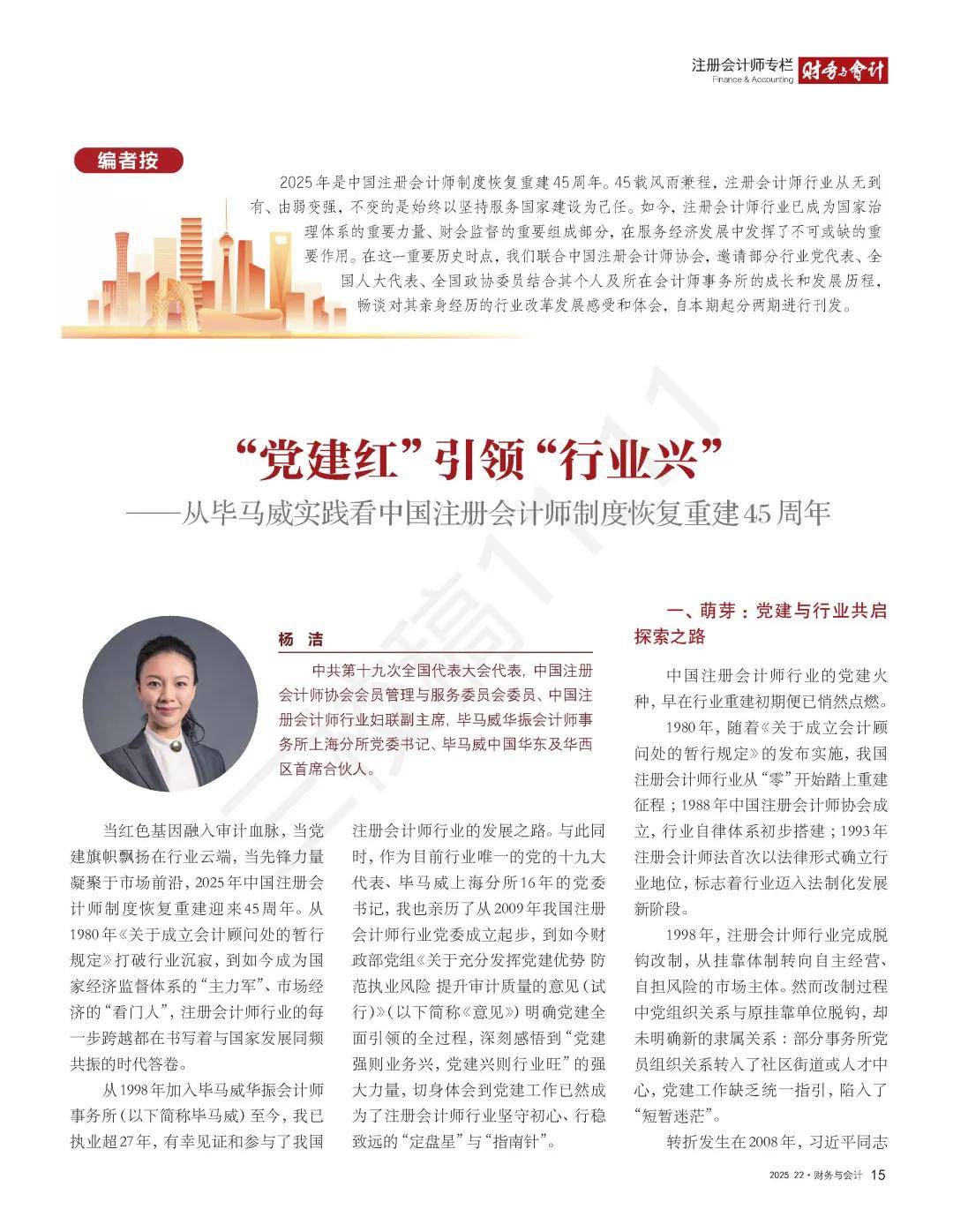
“党建红”引领“行业兴”——从毕马威实践看中国注册会计师制度恢复重建45周年
Sou Hu Cai Jing· 2025-12-24 06:35
Core Viewpoint - The article emphasizes the significant evolution of the Chinese Certified Public Accountant (CPA) industry over 45 years, highlighting its role as a crucial component of the national governance system and economic development, while also focusing on the integration of party-building work within the industry [1][2][3]. Group 1: Historical Development - The CPA industry in China began its reconstruction in 1980 with the issuance of the "Interim Regulations on the Establishment of Accounting Advisory Offices," marking the start of its journey from non-existence to a vital part of the national economic supervision system [4][12]. - The establishment of the Chinese Institute of Certified Public Accountants in 1988 laid the groundwork for the industry's self-regulatory framework, and the enactment of the CPA Law in 1993 marked a new phase of legal development [4][13]. - The industry underwent a significant transformation in 1998, shifting from a reliance on government affiliations to a self-managed market entity, although this led to challenges in party organization affiliations [4][14]. Group 2: Party-Building Initiatives - In 2009, a pivotal year for party-building in the CPA industry, the Ministry of Organization and the Ministry of Finance jointly issued a notice to strengthen party-building efforts, establishing a national-level party committee for the CPA industry [6][14]. - The establishment of the party committee at KPMG Shanghai in 2009 marked a proactive step in addressing issues of party member organization and enhancing participation in organizational life [6][15]. - By 2010, the CPA industry achieved full coverage of party organizations, creating a structured management system that served as a model for social organization party-building [6][15]. Group 3: Integration with Business - The integration of party-building with business operations has become a core focus for the industry, with recent government documents emphasizing the role of party-building in financial supervision [9][17]. - KPMG has taken steps to embed party-building requirements into its operational framework, ensuring that party leadership is reflected in strategic decision-making and quality control processes [9][17]. - The firm has categorized its party-building activities into four types: learning and exploration, collaborative construction, social contribution, and exemplary demonstration, reinforcing the relationship between party-building and business success [10][18]. Group 4: Social Responsibility and Community Engagement - KPMG has engaged in various social responsibility initiatives, including building schools in underprivileged areas and supporting educational programs for marginalized groups, demonstrating the integration of party-building with social responsibility [20][21]. - The firm has collaborated with local organizations to provide community support, such as offering free services to elderly residents and conducting educational activities for children with autism [20][21]. - These initiatives reflect the commitment to using party-building as a guiding principle for enhancing community welfare and professional engagement [20][21]. Group 5: Future Directions - The article concludes with a call for the CPA industry to continue leveraging party-building as a foundational element for future development, aligning with national modernization efforts [21][25]. - Emphasis is placed on the need for ongoing innovation in party-building practices to enhance the industry's integrity and professional standards [21][25]. - The future vision includes a commitment to maintaining high-quality audit practices and a strong sense of responsibility, ensuring that the CPA industry remains a key player in national economic governance [21][25].