
城市综合服务

Search documents
国际城市观察|从上海在五大城市评估榜单表现看未来战略方向
Xin Lang Cai Jing· 2025-12-29 05:51
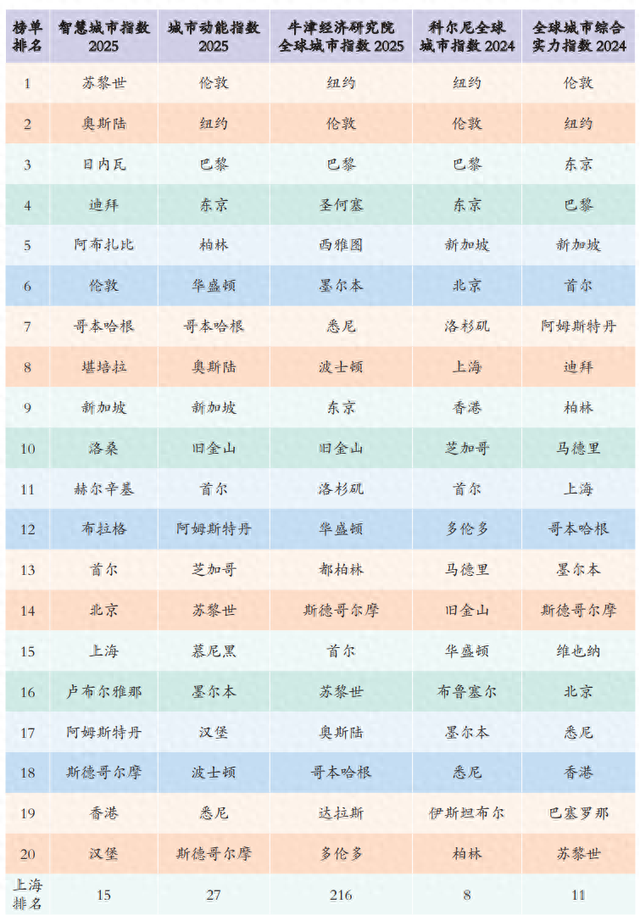
Core Insights - The article discusses the competitive landscape of global cities and evaluates Shanghai's performance in five authoritative city rankings for 2024-2025, highlighting its strengths and weaknesses while providing strategic recommendations for future development [1][14]. Group 1: Rankings Overview - Shanghai ranks 15th in the Smart City Index (SCI), 27th in the City Momentum Index (CIMI), 216th in the Oxford Economics Global City Index (OEGCI), 8th in the Kearney Global City Index (GCI), and 11th in the Global City Comprehensive Strength Index (GPCI) [2][5]. - Shanghai's rankings have improved significantly across various indices, with the most notable increase of 62 places in the OEGCI from 2024 to 2025 [5][11]. Group 2: Strengths - Shanghai excels in economic foundation, human capital, transportation hub capabilities, and digital infrastructure, showcasing its robust economic structure and global connectivity [1][15]. - The city has made significant advancements in digitalization, ranking 2nd globally in internet speed and 8th in data center quantity, indicating a strong digital infrastructure [10][16]. - Shanghai's transportation system is highly developed, ranking 2nd in the CIMI for transportation, reflecting its efficient public transit and multi-modal transport integration [8][15]. Group 3: Weaknesses - Despite its strengths, Shanghai faces challenges in livability, environmental sustainability, social inclusiveness, and governance effectiveness, indicating areas for improvement [1][6]. - The city ranks poorly in environmental metrics, with a position of 806th in the OEGCI for environmental quality, highlighting significant ecological pressures [11][17]. - Governance and institutional efficiency are also areas of concern, with rankings of 640th in the OEGCI and 151st in the CIMI for governance, suggesting a need for enhanced public engagement and policy responsiveness [11][17]. Group 4: Strategic Recommendations - To enhance livability and inclusiveness, Shanghai should focus on optimizing housing supply, improving green infrastructure, and developing social service mechanisms [19][20]. - Strengthening governance resilience and institutional supply is crucial, with recommendations for collaborative governance mechanisms and data-driven decision-making processes [20][21]. - Leveraging technology to drive future industrial restructuring is essential, with a focus on fostering innovation in key sectors such as artificial intelligence and quantum technology [21][22].

株洲市城市建设发展集团有限公司2021年度第二期中期票据获“AA+”评级
Sou Hu Cai Jing· 2025-07-28 04:31
Core Viewpoint - Zhuzhou Urban Construction Development Group Co., Ltd. received an "AA+" rating from United Ratings for its 2021 second phase medium-term notes, indicating strong creditworthiness and operational stability [1]. Company Overview - The company is a key urban comprehensive service operator in Zhuzhou, primarily engaged in urban infrastructure construction such as roads, bridges, and pipelines, as well as land development [2]. - It maintains a regional monopoly in public utility operations, including water and gas services [2]. Economic Environment - Zhuzhou is a core city in the Chang-Zhu-Tan metropolitan area, characterized by distinct industrial advantages. The city's GDP and general public budget revenue are expected to grow year-on-year in 2024, providing a favorable external development environment for the company [2]. Business Performance - The company experienced a year-on-year increase in main business revenue and a slight improvement in gross profit margin in 2024, with diversified income sources [2]. - Ongoing infrastructure projects require significant investment, and revenue realization is influenced by construction progress, operational conditions, and government funding arrangements [2]. - The land consolidation service business is highly dependent on government planning and market demand, leading to revenue realization uncertainties [2]. - Real estate sales revenue and gross profit margin have shown a year-on-year recovery, although future sales depend on market conditions and regional regulatory factors [2]. - The commodity sales business is steadily developing, and the company has a substantial amount of contracts for ongoing and planned construction projects, indicating strong business continuity [2]. Financial Analysis - The company has a high proportion of receivables and inventory, which significantly occupies funds and poses liquidity risks [2]. - The structure of owners' equity is relatively stable, but total debt has increased compared to the previous year, leading to a heavier overall debt burden [2]. - A high proportion of bond financing and concentrated short-term debt repayment pressures are present [2]. - Government subsidies and investment income significantly contribute to the company's total profit, with overall profitability indicators appearing strong [2]. - Debt repayment indicators are weaker, but the risk of liabilities is considered controllable, with smooth indirect financing channels [2].